

Inherited a Picasso Ceramic? What to Do Before Selling
First steps for heirs and executors with a Picasso ceramic: protect it, keep the papers, identify it, understand which value you need, then decide.
Prepared by Artemis Collection. Market figures are drawn from public auction records as described in the methodology note; they are not appraisals. This article is general information, not tax, legal or estate advice.
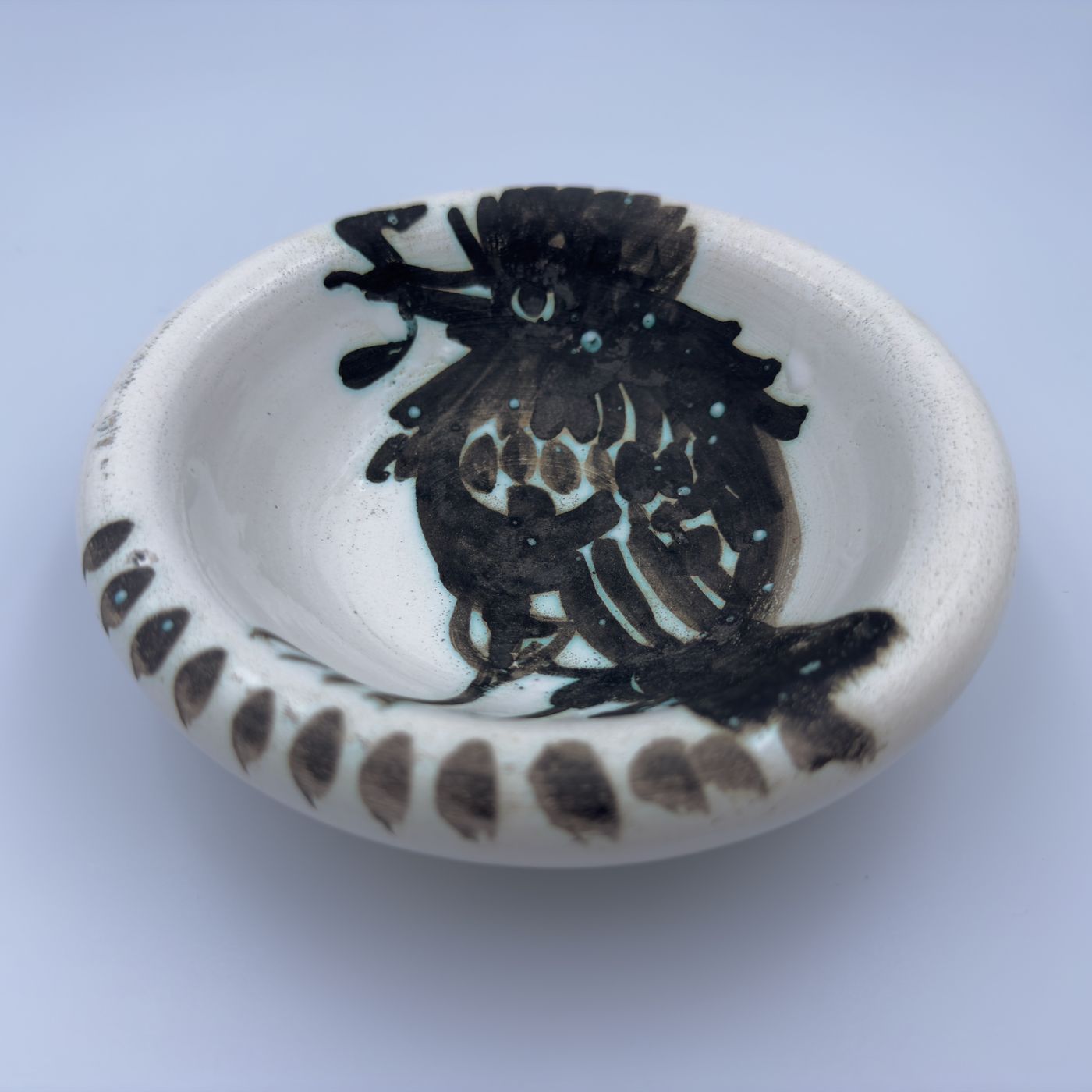
If you have inherited what may be a Picasso ceramic, there is rarely a reason to hurry over the object itself, and several reasons not to. Before anything else: do not clean, repair or post it for sale; photograph it; keep every paper that came with it or mentions it; and find out what it is. Then work out which kind of value you actually need, because a figure for an estate return, an insurance schedule and a sale are different things, and only some of them are a dealer's business. Take tax and legal questions to a qualified adviser in your jurisdiction.
This article sets out those steps in order. It is general information, not advice on any particular estate.
First, do no harm
Most of the ceramics Picasso designed for the Madoura pottery in Vallauris are earthenware. Our transcription of Alain Ramié's catalogue raisonné, which records the technique of each of the 633 designs, describes all but six as white or red earthenware, and many of them as only partly glazed or decorated with engobes (coloured slips), oxides or a patina rather than a full glaze. Earthenware is porous, and unglazed areas, chips and cracks can take up water, dirt and cleaning products; museum guidance on the care of ceramics warns against dishwashers and strong cleaning agents and recommends expert advice before cleaning anything damaged.
- Do not wash or clean it. Not in a dishwasher, not in a sink, not with household cleaners. Dust can wait.
- Do not repair it. Even a small chip is better left as it is and described honestly. An amateur repair can be harder to undo than the damage it covers, and any repair will need to be disclosed when you sell.
- Do not remove labels, stickers, wire hangers or old inventory numbers from the back. They can be part of the record.
- Store it safely. On a stable shelf away from the edge, out of direct sun, not stacked, and away from places where it could be knocked during the business of clearing a house.
- Check insurance. When a home is emptied or a property changes hands, existing household cover may no longer apply. Ask the insurer or the estate's adviser.
Keep the paper trail together
Documents can matter as much as the object. Gather, and keep together, anything that relates to the piece:
- purchase receipts or invoices, from a gallery, dealer, auction house or the pottery;
- auction catalogues, auction invoices or gallery labels;
- letters, certificates or earlier valuations that mention it;
- wills, household inventories and insurance schedules that list it;
- family photographs in which it appears, which can help show how long it has been in the family.
Do not send originals to anyone at this stage; copies are enough. Our article on Picasso ceramic provenance explains how these documents are weighed, and what they can and cannot establish.
Photograph it and find out what it is
Photograph the front, the back or underside with every stamp readable, the profile, and any damage, with a ruler in one shot. Our photography checklist gives the full list.
Then identify it. Picasso's edition ceramics are catalogued by Alain Ramié, and each design has an A.R. number. The stamps on the back (such as Madoura Plein Feu, Edition Picasso or Empreinte originale de Picasso) and any edition number help narrow it down, but no single mark proves that a piece is genuine; copies and later imitations exist. Our guide to identifying a Picasso Madoura ceramic walks through the process.
Identification matters more than it might seem, because "a Picasso ceramic" covers a very wide range. Two designs illustrate it. Bearded man's wife (A.R. 193) and Fish subject (A.R. 139) are both turned pitchers, and Ramié records both as editions of 500. In public auction results their median hammer prices are about $34,000 (71 sales) and $6,000 (103 sales). The same form and the same edition size, more than five times apart. And of the 633 designs in the catalogue, 49 have no public auction result in our records at all.
Which value do you need?
An heir may hear several different numbers for the same object. They answer different questions.
| Figure | What it is | Who produces it |
|---|---|---|
| Value for estate or probate purposes | The value the tax authority asks for, under the rules of your jurisdiction, usually as at the date of death | A qualified appraiser or valuer engaged for that purpose, with your adviser |
| Insurance value | Often the cost of replacing the piece, which can be higher than what it would fetch | An appraiser or valuer engaged for insurance |
| Auction estimate | A range the auction house sets to attract bidding; not a valuation | The auction house |
| Hammer price | The winning bid at auction | The sale |
| Price realised | The hammer price plus the buyer's premium; the figure most houses publish | The sale |
| Net proceeds | What the seller receives after commission and other charges | The seller's settlement statement |
Two points from public auction records show why the distinctions matter.
Published prices include the buyer's premium. Across 8,928 sold Madoura lots for which we have the price as published, the median published price was $9,231 and the median hammer price about $7,300. The seller is paid from the hammer, less commission and costs, so a published price overstates what the seller of that lot received. Our article on the cost of selling at auction sets out the deductions.
Estimates are set differently by different houses. At Christie's, 66% of the Madoura lots we have with estimates sold above the high estimate, and the median lot at about 1.4 times the middle of its estimate. At Doyle and at Phillips about a third sold above the high estimate, and the median lot at about 1.05 times the middle. An estimate tells you how a particular house has chosen to present a piece, not what it is worth. Our guide to reading an auction listing explains how to interpret one.
Tax authorities define the value they require. In the United States, for example, the IRS explains that assets in an estate are valued at fair market value at the date of death, and it gives an example in which an insured replacement value is not the same thing as fair market value; in the United Kingdom, GOV.UK sets out how an estate's possessions are valued for Inheritance Tax. These are the starting points for a conversation with your adviser, not a substitute for one.
None of these figures is a valuation of your piece. Artemis Collection is a dealer, not an appraiser; if the estate needs a formal valuation for tax, probate or division among heirs, it should come from a qualified appraiser or valuer appointed for that purpose, and your adviser can tell you what standard of value applies.
Questions for your advisers
Inherited works can raise questions that depend on where you live, where the deceased lived and where the object is. Before you sell, it is worth asking a tax adviser, estate lawyer or the executor:
- Who has the authority to sell, and is any consent needed from other heirs or from a court?
- Does the estate need a formal valuation, and as at what date?
- How would a sale be treated for tax purposes, and does it matter whether the sale happens before or after the estate is distributed?
- If the piece is to be divided among heirs, or given to a museum or charity, what rules apply?
- If the piece needs to cross a border, are export or import permissions needed?
We do not answer these questions. Our part comes after them.
When you are ready to consider selling
With the piece protected, photographed, identified and the advice in hand, the choices are broadly a sale at auction, a private sale, or a sale to a dealer. Each has different costs, timescales and degrees of certainty; our articles on how to sell a Picasso Madoura ceramic, auction versus private sale and how long a sale takes cover them. If the piece has damage or old repairs, read how condition affects value before deciding anything about restoration.
Artemis Collection buys and consigns works, gives informal opinions of value (not formal appraisals), and welcomes confidential inquiries from owners, executors and families considering a sale or consignment. We will review photographs and documentation. You do not need to know what the piece is before you write.
How these figures were calculated
- Dataset. Public auction results for Picasso ceramics identified by Ramié A.R. number, compiled by Artemis Collection from auction houses' published results and from results aggregators; sold lots only; 9,377 lots of 584 catalogued designs, May 1986 to October 2026. Duplicate records of the same lot, lots described as "style of" or as replicas, lots under $300 hammer and multi-object lots were removed. Lots identified as sold by Artemis Collection itself are excluded. (The cleaned pool holds about 9,200–9,900 sold lots, depending on the data snapshot and how strictly multi-object lots are filtered; this article uses the run described here.)
- Hammer and published price. Most houses publish a price including the buyer's premium; hammer was derived by removing a standard buyer's-premium rate for each house (26.5% for Christie's and Sotheby's; actual rates were lower in earlier decades, so older derived hammers are somewhat understated). Rago and LiveAuctioneers report hammer directly. The published-price median excludes LiveAuctioneers records, which are hammer only; published-price and hammer medians are for the same 8,928 lots. US dollars at the time of sale, not adjusted for inflation.
- Design examples. All sales of A.R. 193 and A.R. 139 in the dataset, 1986–2026. Ramié's catalogue records both as turned pitchers in editions of 500.
- Estimates. Lots with a published low and high estimate in the sale currency, compared with the lot's hammer price in the same currency: Christie's 4,378 lots (1995–2026); Doyle 506 (2001–2026); Phillips 284 (2015–2026). Unsold lots are not included.
- Materials. Counted from the technique descriptions in our transcription of Ramié's catalogue: 627 of 633 entries describe white or red earthenware.
Sources
- Ramié, Alain. Picasso: Catalogue of the Edited Ceramic Works, 1947–1971. Madoura, 1988.. Catalogue raisonné; source of the material and glaze descriptions summarised in this article.
- Museum of Royal Worcester: Care of ceramics. Cleaning guidance: no dishwashers or strong cleaning agents; consult an expert before cleaning damaged pieces. Accessed 6 November 2026.
- Internal Revenue Service: Frequently asked questions on estate taxes. United States: estate assets are valued at fair market value at the date of death. Accessed 6 November 2026.
- Internal Revenue Service: Publication 561, Determining the Value of Donated Property (December 2025). Illustrates that an insured (replacement) value is not fair market value. Accessed 6 November 2026.
- GOV.UK: Valuing the estate of someone who's died. United Kingdom: how an estate's money, property and possessions are valued for Inheritance Tax. Accessed 6 November 2026.
Is there a best month to sell a Picasso ceramic? We tested 6,100 public auction results. No seasonal pattern held up; which sale you join matters more.
From consignment to payment: how long selling a Picasso ceramic at auction takes, what the houses publish about settlement, and what causes delay.
What 461 public Madoura results that hammered below the low estimate have in common, and what the records can and cannot explain.