

How to Sell a Picasso Madoura Ceramic
The routes for selling a Picasso Madoura ceramic, where the public market trades, what to prepare, and how prices are arrived at under each route.
Prepared by Artemis Collection. Market figures are drawn from public auction records as described in the methodology note; they are not appraisals.
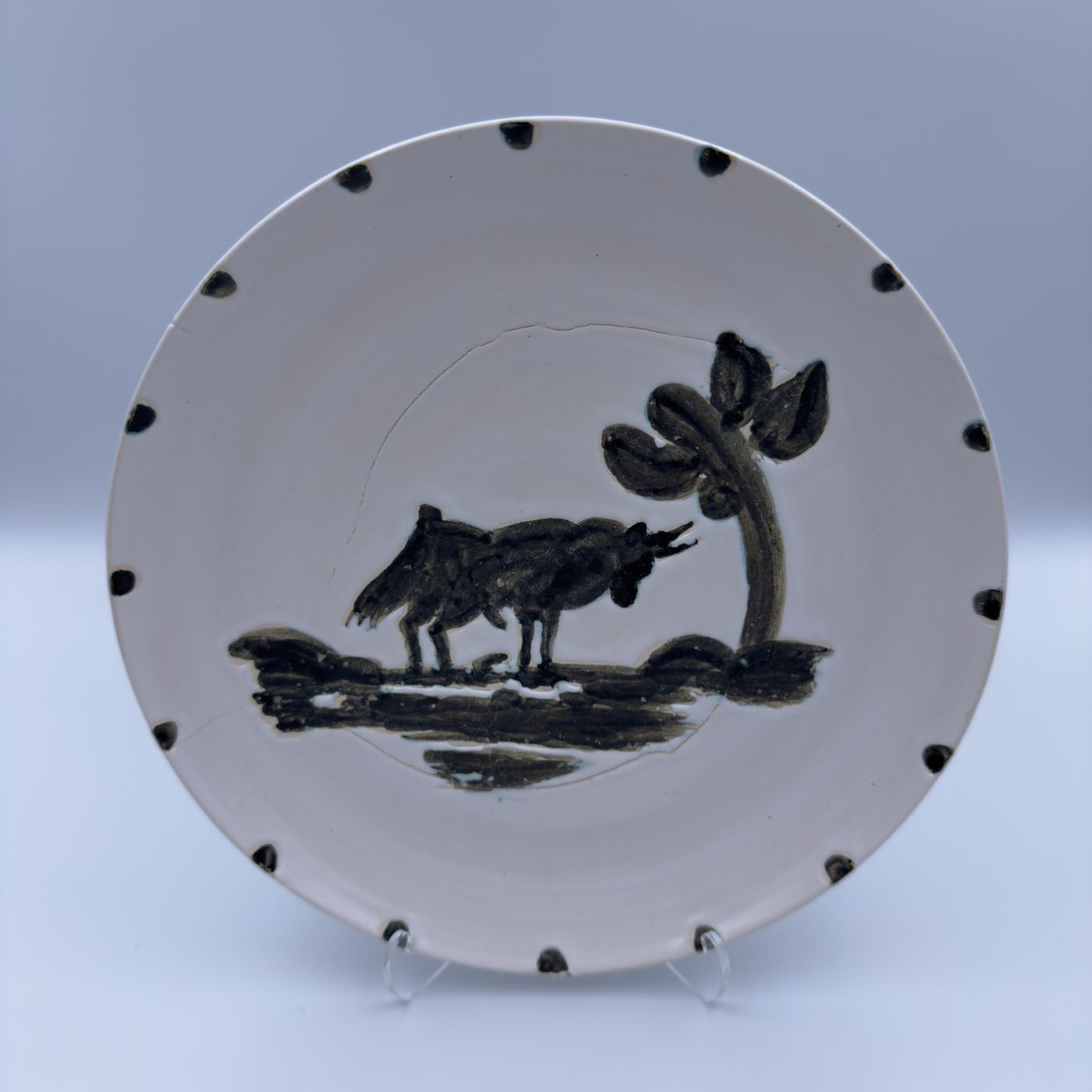
There are three practical ways to sell a Picasso Madoura ceramic:
- Consign it to an auction house, which sells it to the highest bidder for a commission.
- Sell it outright to a dealer, who pays you and takes on the risk of reselling.
- Sell it privately to a collector, directly or through an intermediary.
Online marketplaces are a fourth route. They are crowded with misattributed and imitation pieces, which makes buyers cautious and depresses prices for genuine ones.
Whichever route you choose, the work at the start is the same. Identify the design and its catalogue number, photograph the piece and its marks, record the condition honestly, and gather any papers. With those in hand, you can compare routes on net proceeds rather than on headline prices.
Before anything else: know what you have
Nearly every buyer and every house will ask the same questions first, so answer them before you approach anyone:
- Which design is it? Each Madoura edition has a number in Alain Ramié's 1988 catalogue raisonné, the "A.R. number". Auction houses describe pieces by that number, and price is driven mainly by the design. Our guide to identifying your Madoura ceramic explains how to find it.
- What do the marks on the reverse say? "Madoura Plein Feu", "Edition Picasso", "Empreinte originale de Picasso", any painted number such as 34/200. Photograph them clearly; our photography and documentation checklist lists the views a specialist needs. The marks should agree with the catalogue entry.
- What size is it? Measure in centimetres. Ramié records the dimensions of each design.
- What condition is it in? Note chips, hairline cracks, glaze wear, and any old repair or overpaint. Do not clean, polish or repair the piece first; our guide to damage, restoration and condition explains why.
- What do you know about its history? Receipts, gallery labels, letters, earlier auction records, or simply when and where it was bought. Keep the originals; send copies.
Well-documented pieces move faster through every route. Specialists ask for exactly these items before proposing an estimate or an offer, and a house can decline a piece when identification or condition is in doubt.
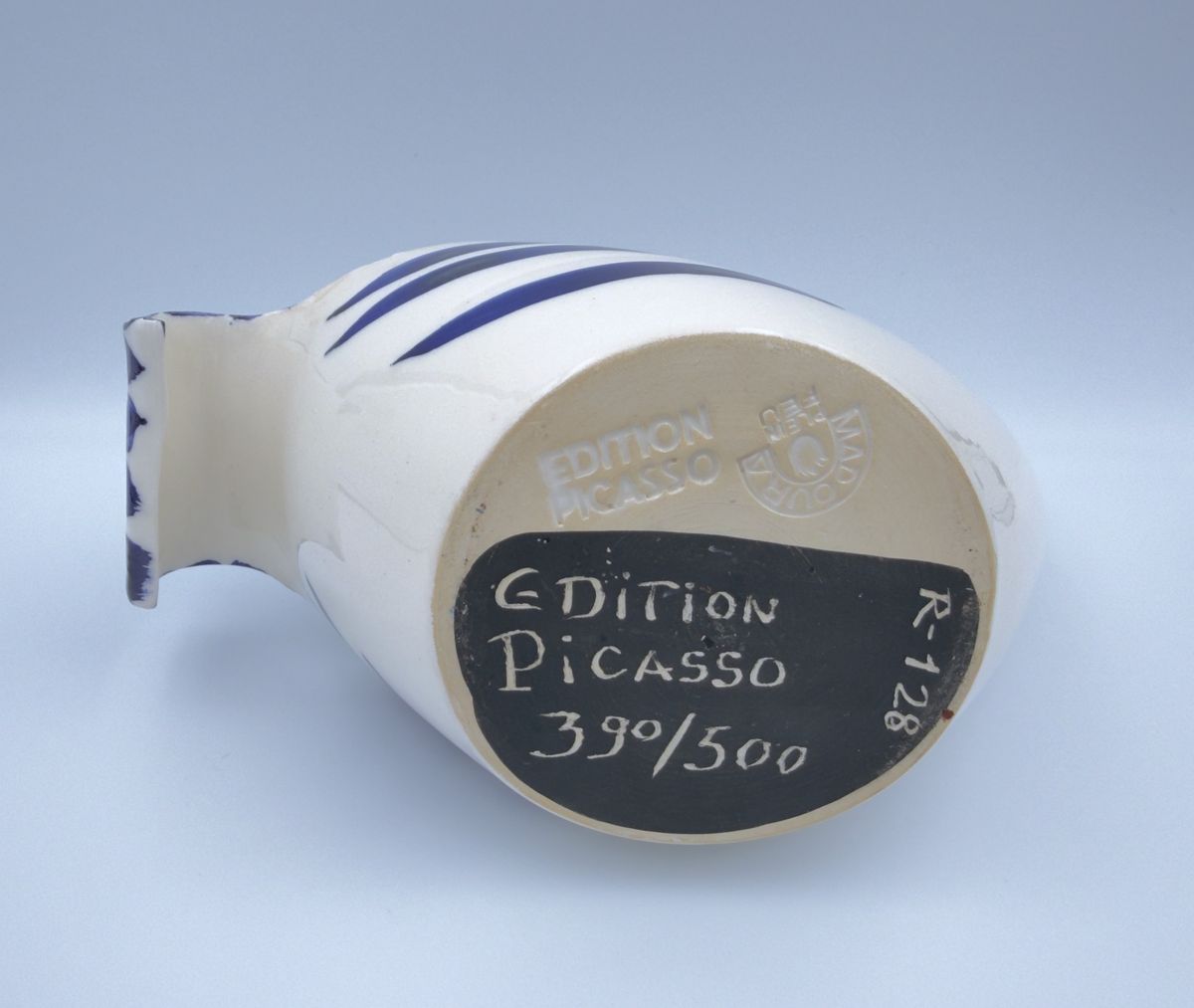
Where Madoura ceramics actually sell
The public auction market for Madoura editions is large, regular and concentrated. In the public results we have compiled, between about 540 and 730 Madoura lots have sold at auction in each full year since 2015. From 2023 to October 2026, those sales were distributed as follows:
| House | Share of public Madoura sales, 2023–Oct 2026 |
|---|---|
| Christie's (all salerooms and online) | 37% |
| Sotheby's | 16% |
| Doyle | 8% |
| Phillips | 6% |
| Piasa | 6% |
| Rago | 6% |
| Artcurial | 5% |
| Freeman's, Heritage, Bonhams, Palm Beach Modern | 2% each |
| Others, about 88 houses | the remaining ~8% |
About two-thirds of these lots were sold in sales devoted to Picasso or to ceramics, rather than in general sales. Christie's has held online Picasso ceramics sales each May and November in recent years, Sotheby's holds dedicated Picasso ceramics sales from time to time, and several other houses run curated Picasso or ceramics sales.
Two things follow:
- The calendar matters. A piece consigned just after a dedicated sale may wait months for the next one.
- Houses are not interchangeable. For the same design, median hammer prices have been higher at Christie's than at most other houses. Estimates are also set differently: since 2020, most Madoura lots at Christie's have sold above the high estimate, while at Doyle, Phillips and Piasa the typical lot has sold near the middle of it. Our article on what a Picasso ceramic is worth sets out the figures and their limits. The comparison of auction houses goes further, with sell-through where it can be measured.
Route 1: consigning to auction
How it works.
- Send photographs and details to the house's specialist department.
- If the house wants the piece, it proposes an estimate, a reserve and a sale date, and sets out its terms in a consignment agreement.
- You ship the piece to the house. It is photographed, catalogued and offered.
- If it sells, the house collects from the buyer and pays you the hammer price less the commission and agreed charges.
How the price is set. By bidding, against a reserve that you agree with the house. At Christie's, the reserve sits at or below the low estimate. The buyer pays a premium on top of the hammer, 28–30% at the major houses, and that premium is included in the "price realised" that appears online.
Worth checking.
- Read the catalogue description before the sale. Edition descriptions are a common source of error. A painted letter or service mark can be mistaken for a copy number, even on a design that Ramié lists as unnumbered. Errors like that can mislead bidders either way.
- Know the full cost. See the real cost of selling at auction for the line items and an illustrative calculation.
- Expect to wait. Placement in the next suitable sale can take months, and payment typically follows the sale by several weeks. See how long it takes to sell a Picasso ceramic.
Route 2: selling to a dealer
How it works. You send photographs and details. The dealer identifies the piece, asks about condition and history, and makes an offer. Typically it is subject to seeing the object. Once you agree and the piece is received and checked, the dealer pays.
How the price is set. A dealer's offer reflects the auction or retail result the dealer expects, less the dealer's own costs of selling, the time the money will be tied up, and the risk of a weaker result. It will be below the best plausible auction outcome. It may be close to, or above, what you would actually net from auction after costs and with the risk of a buy-in. Compare it on that basis. Our comparison of auction and private sale works through an example.
Worth checking. Is the offer firm, or conditional on inspection? Who pays for and arranges shipping and insurance? When and how will payment be made?
Route 3: selling privately to a collector
A direct sale to a collector can achieve a good price with no commission. But you must find the buyer, agree a price without a public reference point, and handle payment and shipping safely. Many private sales happen through intermediaries, such as dealers or an auction house's private-sales department, who charge a commission and handle the logistics.
Online marketplaces
General marketplaces carry a large number of Madoura-style pieces. Some are genuine, many are not, and many are simply misdescribed. Serious buyers know this and bid accordingly. A genuine piece offered alongside imitations, with a seller's photographs and no specialist description, tends to fetch less than it would through a specialist channel. The fees and the risks of shipping and returns fall on the seller.
Common mistakes
- Pricing from a published auction result without allowing for the buyer's premium and the seller's costs. The figure online is not the seller's net.
- Pricing from the wrong design. Many designs share a title: Ramié lists 20 different designs called "Face". The A.R. number, not the title, identifies the comparable.
- Cleaning or restoring before asking. An amateur repair can cost more than the damage it hides.
- Relying on a single stamp. Marks support an attribution; they do not prove it. Buyers and houses look at the whole object.
- Shipping unprepared. Ceramics break in transit. Use professional packing and insure the shipment.
- Accepting the first estimate or offer without understanding how it was reached. Ask what comparable sales it rests on.
A simple sequence
- Identify the design and find its A.R. number.
- Photograph the front, the reverse and the marks, and a side view. Measure the piece.
- Note the condition and gather any papers.
- Look at recent public results for that A.R. number, remembering the difference between published prices and hammer prices.
- Ask one or two specialist houses, and a dealer, what they would propose. Compare the expected net outcomes and the timing.
- Read every agreement before signing. Ship only with professional packing and insurance.
Artemis Collection buys and consigns Madoura ceramics and other selected works, gives informal opinions of value (not formal appraisals), and welcomes confidential inquiries from owners considering a sale or consignment. We will review photographs and documentation and tell you what we can, and cannot, help with.
How these figures were calculated
Dataset. The figures come from our compiled dataset of public auction results for Picasso Madoura ceramics with an A.R. (Ramié) number, sold lots only, 1986–2026. It is cleaned of aggregator duplicates, "style of" and multi-object lots, and results under $300 hammer, and it excludes lots identified as sold by Artemis Collection itself. The cleaned pool holds about 9,200–9,900 sold lots, depending on the data snapshot and how strictly multi-object lots are filtered.
House shares. Sold lots dated 1 January 2023 to 29 October 2026, 2,544 lots in all. Christie's salerooms and online sales are combined. Shares are of lots, not of value.
Dedicated sales. "Devoted to Picasso or ceramics" means the sale title names Picasso or ceramics.
The full dataset description is in What Is My Picasso Ceramic Worth?
Sources
- Ramié, Alain. Picasso: Catalogue of the Edited Ceramic Works 1947–1971. Vallauris: Galerie Madoura, 1988. The catalogue raisonné; source of A.R. numbers, edition sizes and mark classes.
- Christie's, 'Understanding auction fees'. Accessed 7 November 2026.
- Christie's, 'What is a reserve?'. Accessed 7 November 2026.
- Public auction records of Picasso Madoura ceramics, 1986–2026, compiled by Artemis Collection. See 'How these figures were calculated'.
Is there a best month to sell a Picasso ceramic? We tested 6,100 public auction results. No seasonal pattern held up; which sale you join matters more.
From consignment to payment: how long selling a Picasso ceramic at auction takes, what the houses publish about settlement, and what causes delay.
What 461 public Madoura results that hammered below the low estimate have in common, and what the records can and cannot explain.