

How to Identify Your Picasso Madoura Ceramic Before Selling
Identify a Picasso Madoura ceramic before selling: read the marks, find the Ramié number, check size and edition, and why no single stamp is proof.
Prepared by Artemis Collection. Market figures are drawn from public auction records as described in the methodology note; they are not appraisals.
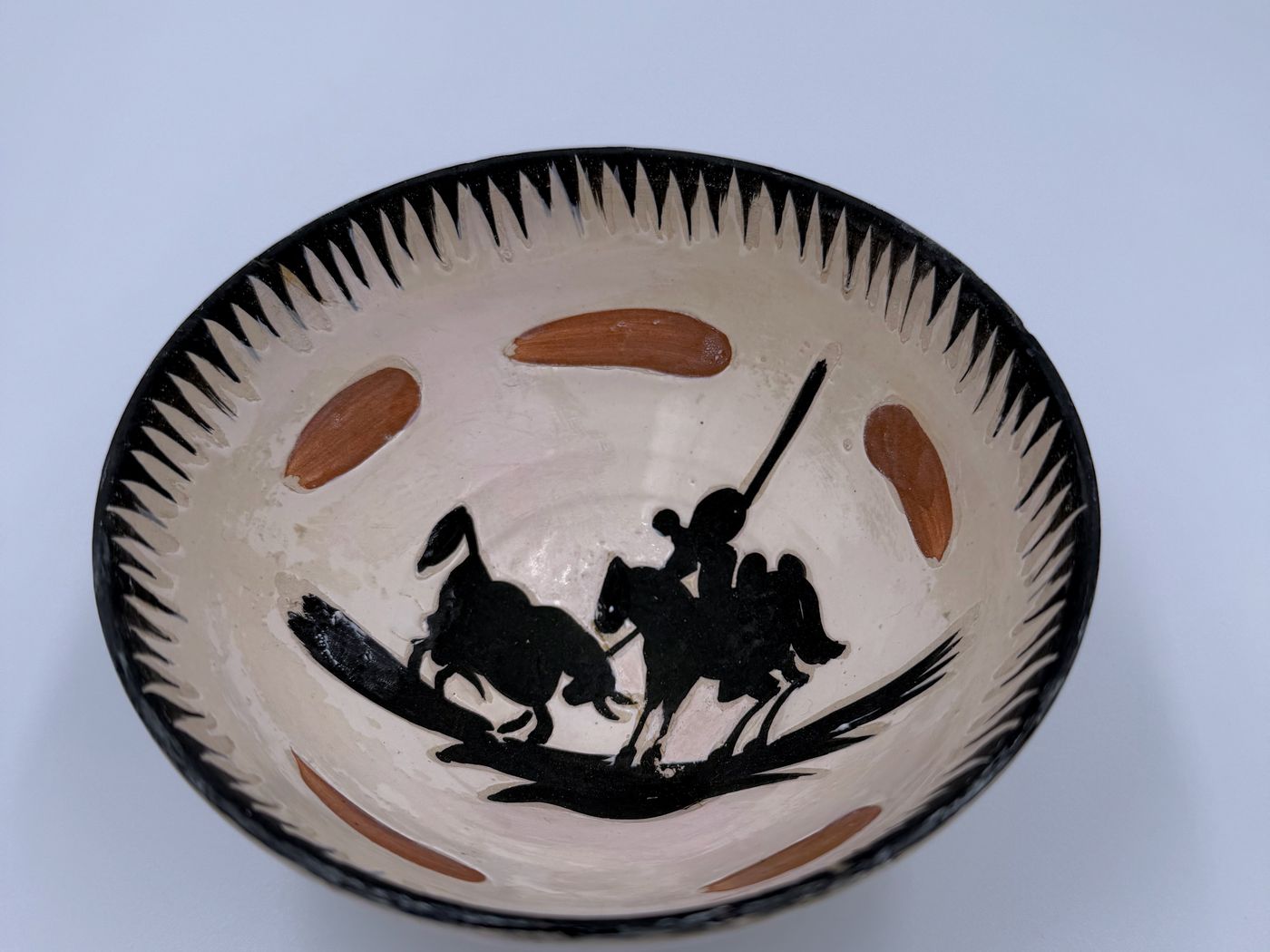
You can usually establish four things yourself: the design, its catalogue number in Alain Ramié's catalogue raisonné (the "A.R. number"), the edition it belongs to, and whether the object's marks, size and colours match what the catalogue records for that design. What you cannot establish from home is authenticity. Marks can be copied, and the same stamp appears on thousands of objects. Treat identification as building a description that a specialist can check quickly, not as a verdict.
The steps below go in a practical order: describe the object, read the reverse, match it to the catalogue, then look for the inconsistencies that call for a closer look.
What a Madoura edition is
According to Ramié's preface, Picasso first visited the annual potters' exhibition in Vallauris on 21 July 1946 (the Musée Magnelli in Vallauris gives 26 July) and was welcomed into the Madoura pottery by Suzanne and Georges Ramié. He began working there the following year.1 Besides unique pieces, he wanted to be able to repeat certain designs. According to Ramié's catalogue, Madoura did this in two main ways:
- Authentic replica (A.R.). The workshop remade an original "by exact repeating of volumes and illuminations": the shape and painted decoration were reproduced by hand, using the materials and methods of the first model.
- Original print (O.P.), marked "Empreinte originale de Picasso". Picasso engraved a subject into a hardened plaster matrix. A fresh sheet of clay was pressed into it, taking a positive impression of the engraved motif.
The catalogue's legend adds a third, much smaller class, the original stamp (O.S.): a linoleum block engraved by Picasso and pressed into soft clay. Ramié calls the products of the two main methods the "ceramic editions of Picasso". His catalogue, published by Galerie Madoura in 1988, lists 633 designs created between 1947 and 1971. It gives each design's date, dimensions, technique, colours and the number of copies produced.
Three terms to keep separate:
- A.R. number: the catalogue entry, for example A.R. 160.
- A.R. class: the authentic-replica technique.
- Edition number: the copy number painted on some pieces, for example 112/500.
People mix these up all the time, in conversation and in sale listings.
Step 1: describe and measure the object
Before turning the piece over, write down:
- Form. Plate, dish, pitcher, vase, plaque, tile, ashtray, cup or medallion. Is it round, square, oval or rectangular? Was it turned on a wheel?
- Size. Measure in centimetres: diameter for round pieces, width and length for rectangular ones, height for vessels. Ramié records the dimensions of each design, so measurement is one of the quickest checks available.
- Subject and colours. A face, a bull and picador, a goat, an owl, fish, a bird. List the colours you can see.
- Surface. Is the decoration painted onto a smooth surface, or is the design raised or recessed, as an impression would be?
Dimensions are a guide, not a test. Ramié notes that size varies between pieces because clays shrink by different amounts in the kiln. A plate that is a few millimetres off is normal. One that is several centimetres off, or a different shape, needs explaining.
Step 2: read the reverse
Most Madoura editions carry a group of marks on the underside, neck or base. Photograph them in raking light before you try to interpret them. The marks you are most likely to see:
| Mark | What Ramié's catalogue says it signifies |
|---|---|
| Madoura, with "Edition Picasso" | Limited authentic replica |
| Madoura, "Edition Picasso" and a copy number | Limited and numbered authentic replica |
| Madoura, "after Picasso" ("d'après Picasso"), with "Edition Picasso" | Limited authentic replica |
| Madoura, "Empreinte originale de Picasso" | Limited original print |
| Madoura, "Empreinte originale de Picasso" and a copy number | Limited and numbered original print |
| Madoura, "Poinçon original de Picasso" and a copy number | Limited and numbered original stamp |
Mark wording as it appears on the pieces; meanings as given in the "Marks" table of Ramié's catalogue (English edition).
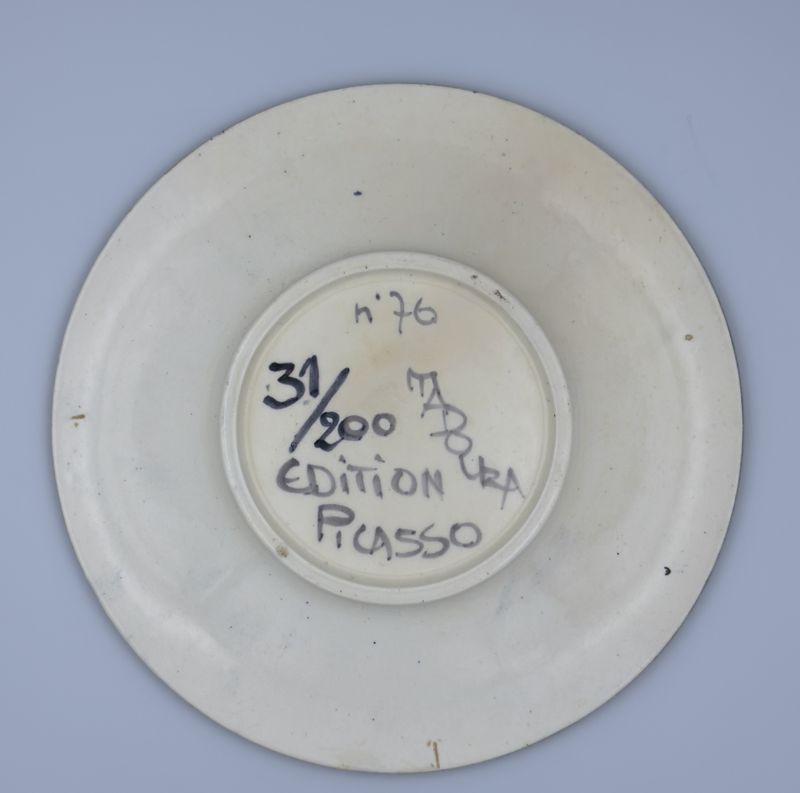
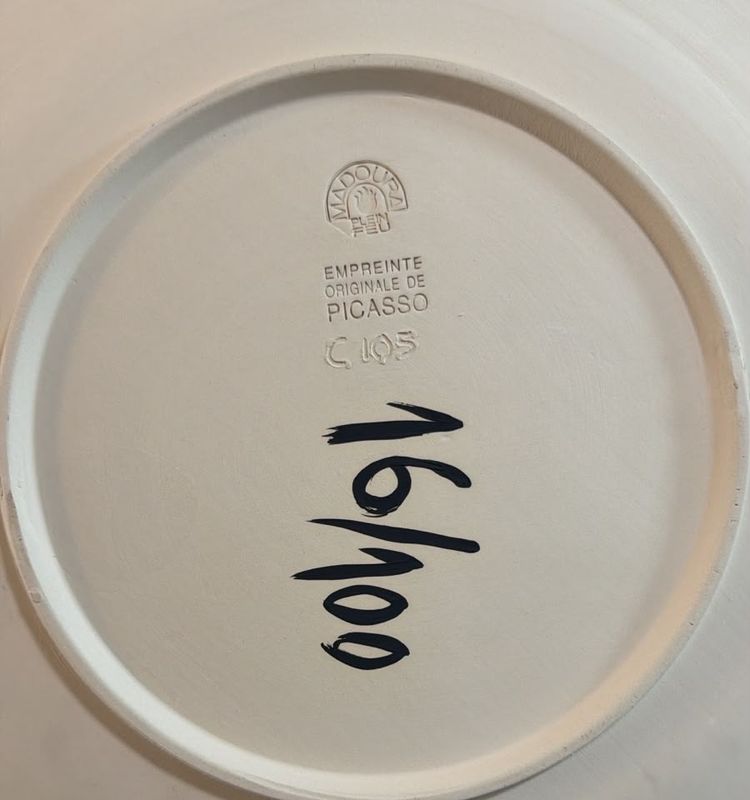
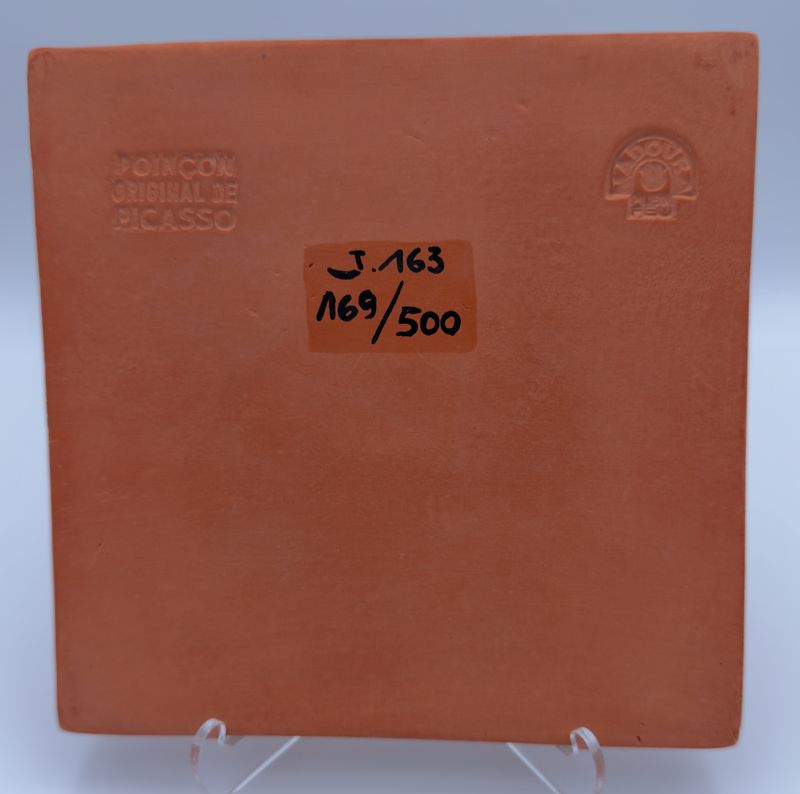
Three points deserve emphasis.
"D'après Picasso" is not a reproduction mark. "After Picasso" sounds like a copy, but on a Madoura piece the catalogue lists it as one of the authorised authentic-replica markings (our guide to originals, editions and reproductions explains the terms). It is uncommon in public auction descriptions: it appears in about 8% of lot descriptions for A.R.-class designs.
The stamp wording follows the technique. We compared the stamp wording that Christie's and Phillips transcribe in their lot descriptions with the class Ramié assigns to each design (2,773 lots, 1995–2026):
- "Edition Picasso" appears in 94% of descriptions of A.R.-class designs and 4% of O.P.-class ones.
- "Empreinte originale" appears in 98% of descriptions of O.P.-class designs and almost never otherwise.
- "Poinçon original" appears in about 85% of the 46 descriptions of O.S.-class designs, and on no other class.
So the stamp should agree with the catalogue entry. A plate whose design Ramié lists as an original print, but which is stamped "Edition Picasso", is a mismatch worth asking about. Our stamps and marks reference covers each mark in detail.
Not every number is an edition number. Ramié records 387 of the 633 designs as "numbered" editions. About 230 more give only an edition size, without numbering, and 13 say "few copies produced". Some pieces also carry painted letters and figures that are not copy numbers. The pieces of the Fish service ("Service poisson"), for example, are lettered within the service, and Ramié lists each as produced in 300 copies, with no mention of numbering. A figure painted beside such a letter should not be read as a copy number. If your piece has a painted fraction such as 34/200, check that the second figure matches the edition size Ramié gives for that design.
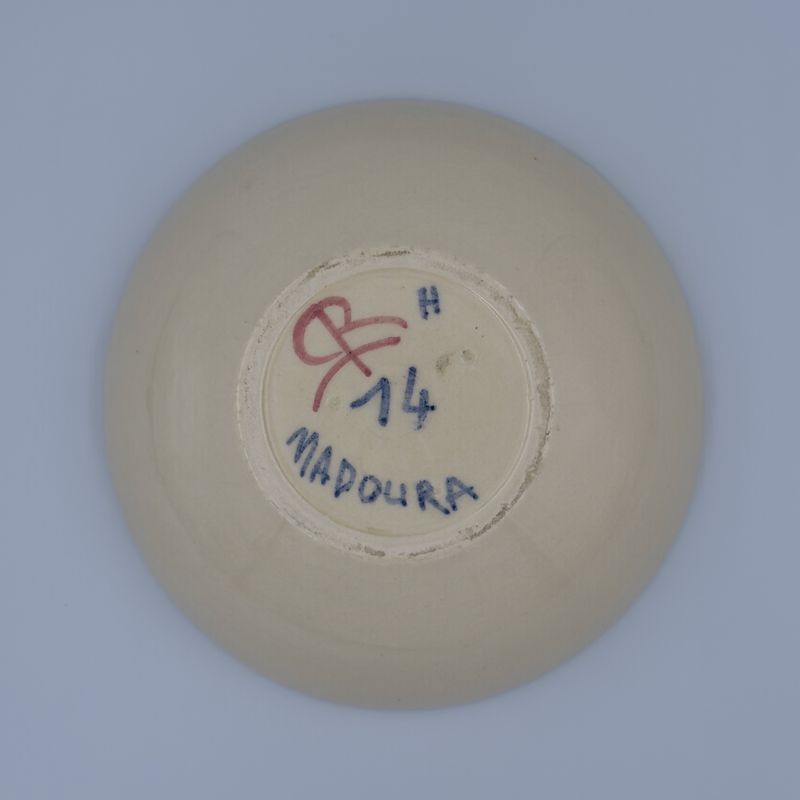
Step 3: match the object to a catalogue entry
With form, size, subject and marks in hand, you can usually narrow the search to a few entries. Ramié's catalogue is the standard reference, and auction houses cite its numbers; our guide to Alain Ramié catalogue numbers explains how to read an entry. The book is out of print and expensive, so most owners start from public auction listings: search by the subject and form, then confirm the A.R. number against the catalogue or a reliable lot description.
Similar titles are the main trap. In Ramié's catalogue, 101 titles are shared by more than one design, and those titles cover 409 of the 633 entries. "Face" alone names 20 different designs. "Goat's head in profile" names 19, and "Picador" 13. The Fish service and the Fruits from Provence service each run to more than 20 entries. "A Picasso picador plate" is therefore not an identification. You need the entry whose form, dimensions, colours and edition size all match.
Look-alikes also sit next to each other in the numbering. A.R. 160 (Picador) and A.R. 161 (Toros) are both small plates of about 19–20 cm, both made in editions of 500, and both among the most frequently sold designs at auction. Each has sold more than a hundred times in the public record we hold, and they are easy to confuse in a quick search.
Edition size helps. Ramié's editions range from 25 copies to 500. A hundred copies is the most common size (256 designs), followed by 500 (75), 200 (74) and 300 (52). If the number on your piece reads 312/500 and the design you have matched was made in an edition of 100, one of the two identifications is wrong.
Step 4: why one mark is never enough
A Madoura stamp tells you which workshop mark was applied. It does not, on its own, tell you who applied it or when. The same marks appear on thousands of genuine pieces. That makes them easy to recognise, and also worth imitating. Picasso-style pottery from other workshops, and objects with copied marks, turn up regularly in online sales. Even an image that matches the catalogue photograph is not proof, because a convincing copy is made to match it.
Attribution rests on agreement across several independent features:
- the design and its catalogue entry;
- the form and dimensions;
- the technique (painted surface or impression), consistent with the catalogue class;
- the mark wording and how it was applied, consistent with that class;
- the edition number, consistent with the edition size;
- the colours and glazes;
- the clay body visible at the foot;
- documentation and ownership history.
Auction houses can and do decline pieces when these features do not line up, even when the stamps look right. A specialist's view, or the house's own vetting, is the step that turns a good identification into a saleable attribution.
Signs that call for a closer look
- The mark wording does not match the catalogue class (see the table above).
- The edition number is larger than the edition size for that design, or the design was not numbered and yours is.
- The size differs from the catalogue by more than a small shrinkage margin, or the form is different.
- The decoration looks printed or transferred rather than painted or impressed.
- The piece is described as "signed by Picasso" when it is a numbered edition. Ask how the signature relates to the catalogue entry.
- Several near-identical pieces, with the same wear, are offered together cheaply.
- There is a repair or overpaint near the marks.
None of these settles the question on its own, but each is worth raising before you set a price or sign a consignment agreement.
What to have ready before you ask anyone
- Clear photographs of the front, the reverse showing all marks, and a side view (our photography checklist lists them all).
- Close-ups of each stamp and any painted number.
- Measurements in centimetres.
- Any receipts, gallery labels, inventory sheets or letters. Keep originals; send copies.
- What you know about how and when the piece entered the family or collection.
With these, a dealer or auction specialist can usually tell you within one exchange whether the identification holds and which catalogue entry applies.
How these figures were calculated
Catalogue figures. These come from our transcription of all 633 entries in Ramié's catalogue: edition size, edition class, form, dimensions and title. Counts of shared titles compare entry titles in the English edition, ignoring case. The meanings of A.R., O.P. and O.S., and the mark table, are taken from the catalogue's front matter.
Mark-wording figures. We took 2,773 Christie's and Phillips lot descriptions of Madoura editions, dated 1995 to 2026, that carry an A.R. number. Each description was searched for the stamp wording ("Edition Picasso", "Empreinte originale", "Poinçon original", "d'après Picasso"), and the result was grouped by the class Ramié assigns to the design. A description records what the cataloguer transcribed. It is not a photograph of the mark.
Sale counts. The counts for individual designs come from our cleaned set of public auction results described in What Is My Picasso Ceramic Worth?.
-
Ramié, Preface, p. 9. Sotheby's (McCully, 2019) gives the same sequence: a first visit in the summer of 1946 and regular work from 1947. ↩
Sources
- Ramié, Alain. Picasso: Catalogue of the Edited Ceramic Works 1947–1971. Vallauris: Galerie Madoura, 1988. Preface (pp. 9–10); 'Marks' table; 'Definitions of the abbreviations and technical terms used' (front matter). The catalogue raisonné for A.R. numbers. Consulted in the original.
- Sotheby's, 'Picasso and the Ramiés in the Valley of Gold' (Dr Marilyn McCully, 29 March 2019). Accessed 7 November 2026. Background on the Madoura pottery and the original-impression technique.
- Musée Magnelli, musée de la céramique (Vallauris), press release and chronology for the Salle Suzanne et Georges Ramié, 2022. Accessed 7 November 2026.
- Public auction records of Picasso Madoura ceramics, 1986–2026, compiled by Artemis Collection. Lot descriptions from Christie's and Phillips; see 'How these figures were calculated'.
A practical checklist for photographing and documenting a Picasso Madoura ceramic: the views, marks, measurements, condition and papers a specialist needs.
Which past auction results predict a Madoura ceramic's price best? We tested nine ways of choosing comparables on 5,000+ public sales.
Size is the strongest catalogue predictor of Madoura prices: what extra centimetres add within each form, and where size stops adding value.