

Picasso Plates, Bowls, Pitchers and Vases: Which Ceramic Forms Command Higher Prices?
Which Madoura forms sell highest, measured across 9,200 auction results: what remains of the vase and pitcher premium once size and edition are equal.
Prepared by Artemis Collection. Market figures are drawn from public auction records as described in the methodology note; they are not appraisals.
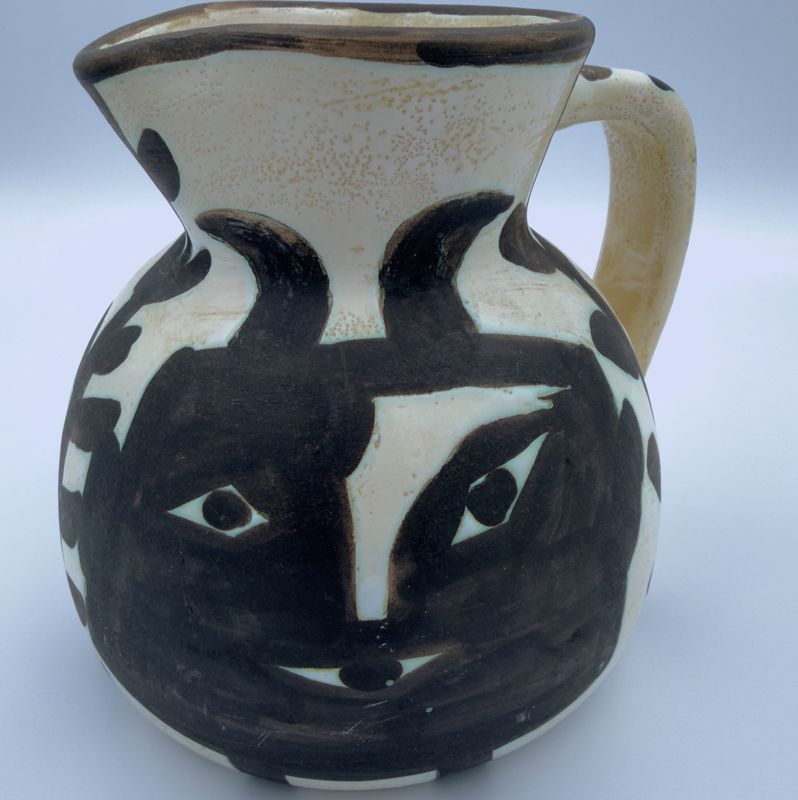
Turned vases and pitchers are the dearest Madoura forms, and they keep a real premium even when compared with flat pieces of the same size, edition and subject: about 2.1 times a comparable plate for vases and 1.65 times for pitchers. Wall plaques also sell above plates of the same size. Large dishes, by contrast, sell for more than plates only because they are larger. Form is a useful first sorting of the market, but it is a weak guide to any single piece: inside every form, the dearer designs sell for several times the cheaper ones, and the ranges overlap heavily.
These conclusions come from 9,231 public auction results for 583 Madoura designs sold between May 2000 and October 2026, compared after allowing for when and where each piece sold. They describe the public record. They do not value any particular piece.
How form is defined here
Alain Ramié's catalogue gives every design a form: "round plate", "turned pitcher", "convex wall plaque", "round cupel" and so on. We grouped those labels into families. A cupel is Ramié's word for a small shallow bowl. "Turned" pieces were thrown on the wheel, then decorated.
| Form family | Designs in catalogue | Typical catalogue size |
|---|---|---|
| Dishes (round, oval, rectangular) | 170 | 42 cm across is the commonest size |
| Plates | 145 | 25 cm |
| Plaques and medallions | 111 | 5–60 cm; most square plaques 17–31 cm |
| Cupels and bowls | 62 | mostly 18 cm across |
| Pitchers | 57 | 12–42.5 cm high |
| Vases | 54 | 16–75.5 cm high |
| Tiles | 19 | 14.7 cm square |
| Ashtrays | 6 | 14.5 cm |
Our guide to how the editions were produced explains the forms and methods in more detail.
What the raw numbers show
The table compares forms at the level of designs, so that a design sold a hundred times does not outweigh one sold five times. For each design we took its median price at the fall of the hammer since 2015. The "index" column then adjusts every design for the year and the house of each sale, and expresses it relative to the median design (1.00, which corresponds to a hammer of roughly $6,800 since 2015).
| Form | Designs | Sales | Median design, hammer since 2015 | Index, median design | Index, dearer and cheaper 10% of designs |
|---|---|---|---|---|---|
| Vases | 48 | 1,062 | $20,700 | 2.81 | 1.58 – 18.1 |
| Pitchers | 57 | 2,010 | $9,800 | 1.40 | 0.70 – 5.11 |
| Dishes | 138 | 2,149 | $9,900 | 1.39 | 0.94 – 2.93 |
| Plates | 113 | 1,948 | $6,000 | 0.83 | 0.58 – 1.42 |
| Plaques and medallions | 73 | 908 | $5,300 | 0.70 | 0.43 – 2.20 |
| Cupels and bowls | 32 | 413 | $4,000 | 0.55 | 0.43 – 1.17 |
| Ashtrays | 6 | 326 | $2,200 | 0.36 | 0.34 – 0.38 |
| Tiles | 16 | 139 | $2,100 | 0.29 | 0.20 – 0.75 |
Designs with at least three sales since 2000. Six turned pieces and clay sculptures are left out of the table because there are too few to summarise.
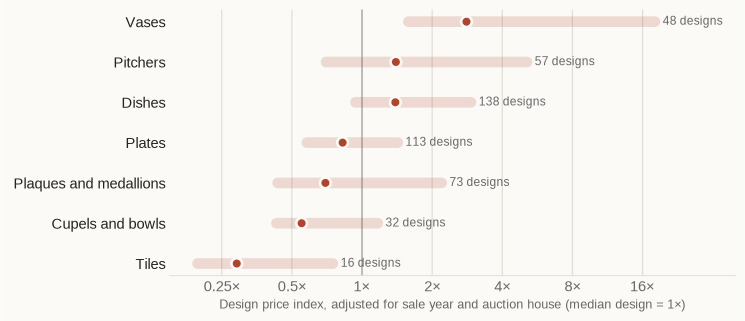
Two things stand out. Vases are in a different bracket from everything else: their median design is worth more than three times the median plate. And the spread inside each form is wide. The cheaper tenth of pitcher designs sells for less than an ordinary plate, and the dearer tenth of plaques sells for more than the median dish.
Most of the raw gap is size and edition
Forms differ in more than shape. Vases and many pitchers are larger objects than plates; ashtrays, cupels and tiles are small. Edition sizes differ too: the median tile was made in 500 copies, the median dish in 100. Subjects and production methods are also unevenly spread. A raw comparison between forms mixes all of this together.
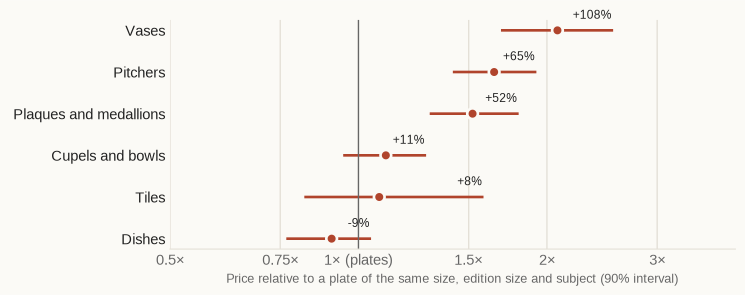
To separate them, we compared each design with others of the same catalogue size, edition size, subject group, production class and period. The chart below shows what is left of each form's premium over plates once those are held equal.
| Form, compared with a plate of the same size, edition and subject | Like-for-like difference | 90% interval |
|---|---|---|
| Vases | +108% | +70% to +154% |
| Pitchers | +65% | +42% to +92% |
| Plaques and medallions | +52% | +31% to +79% |
| Cupels and bowls | +11% | −5% to +28% |
| Ashtrays (6 designs) | +10% | −7% to +34% |
| Tiles | +8% | −18% to +58% |
| Dishes | −9% | −23% to +4% |
Read the dish line carefully. In the raw table, the median dish is worth about 1.7 times the median plate. Once a dish is compared with a plate of the same diameter, that premium disappears. Buyers pay for the larger surface, not for the word "dish". Our article on physical size and value measures how much each extra centimetre is worth.
The vase and pitcher premiums survive the same test. A turned vase sells for roughly twice what a flat piece of the same size, edition and subject makes. We cannot say from auction data why. Plausible reasons include the three-dimensional handling of the decoration, the fact that many vessels were painted by hand rather than pressed, and the demand of collectors who want a sculptural object. Those are interpretations, not findings.
The plaque premium is harder to read. Square plaques are measured by their side, so a 31 cm square has more decorated surface than a 31 cm plate, and our size measure may not capture that fully. Many plaques also belong to the polychrome 1968–69 series. Treat the plaque figure as less settled than the vase and pitcher figures.
These estimates are stable. Re-run on sales since 2015 only, on Christie's sales only, on every other house, and without the three dinner services, the vase premium stays between +73% and +108%, the pitcher premium between +49% and +65%, and the plaque premium between +34% and +56%. The dish figure ranges from −18% to −1%.
The same picture on different objects
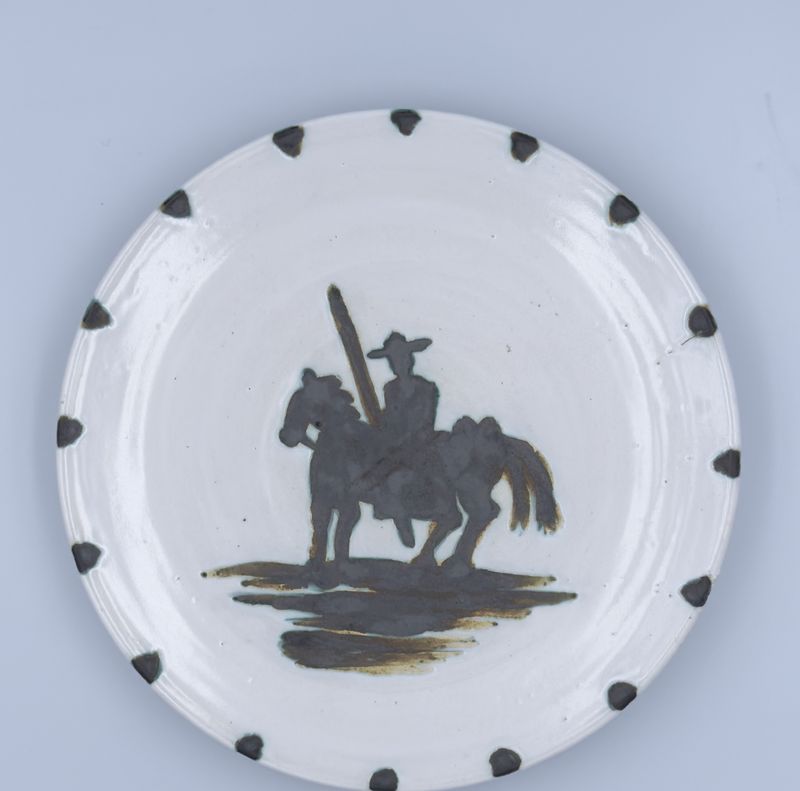
The cleanest evidence comes from images Picasso used on more than one form. The picador, the mounted bullfighter, appears on plates, cupels, pitchers, ashtrays and dishes:
| Design | Form and catalogue size | Edition | Sales since 2015 | Median hammer since 2015 |
|---|---|---|---|---|
| A.R. 176 Picador | Ashtray, 14.5 cm | 500 | 33 | $2,500 |
| A.R. 160 Picador | Plate, 19 cm | 500 | 84 | $2,800 |
| A.R. 289 Picador | Cupel, 12.5 cm | 500 | 31 | $4,200 |
| A.R. 162 Picador | Pitcher, 13.5 cm high | 500 | 70 | $3,800 |
| A.R. 201 Picador | Plate, 22.5 cm | 200 | 15 | $4,200 |
| A.R. 439 Picador and bull | Dish, 42 cm | 100 | 9 | $7,900 |
The small 500-copy pieces sell between about $2,500 and $4,200 whatever their form, with the cupel and the pitcher above the plate and the ashtray. Beyond that, prices rise mainly with size and with smaller editions, and the large dish sits at the top.
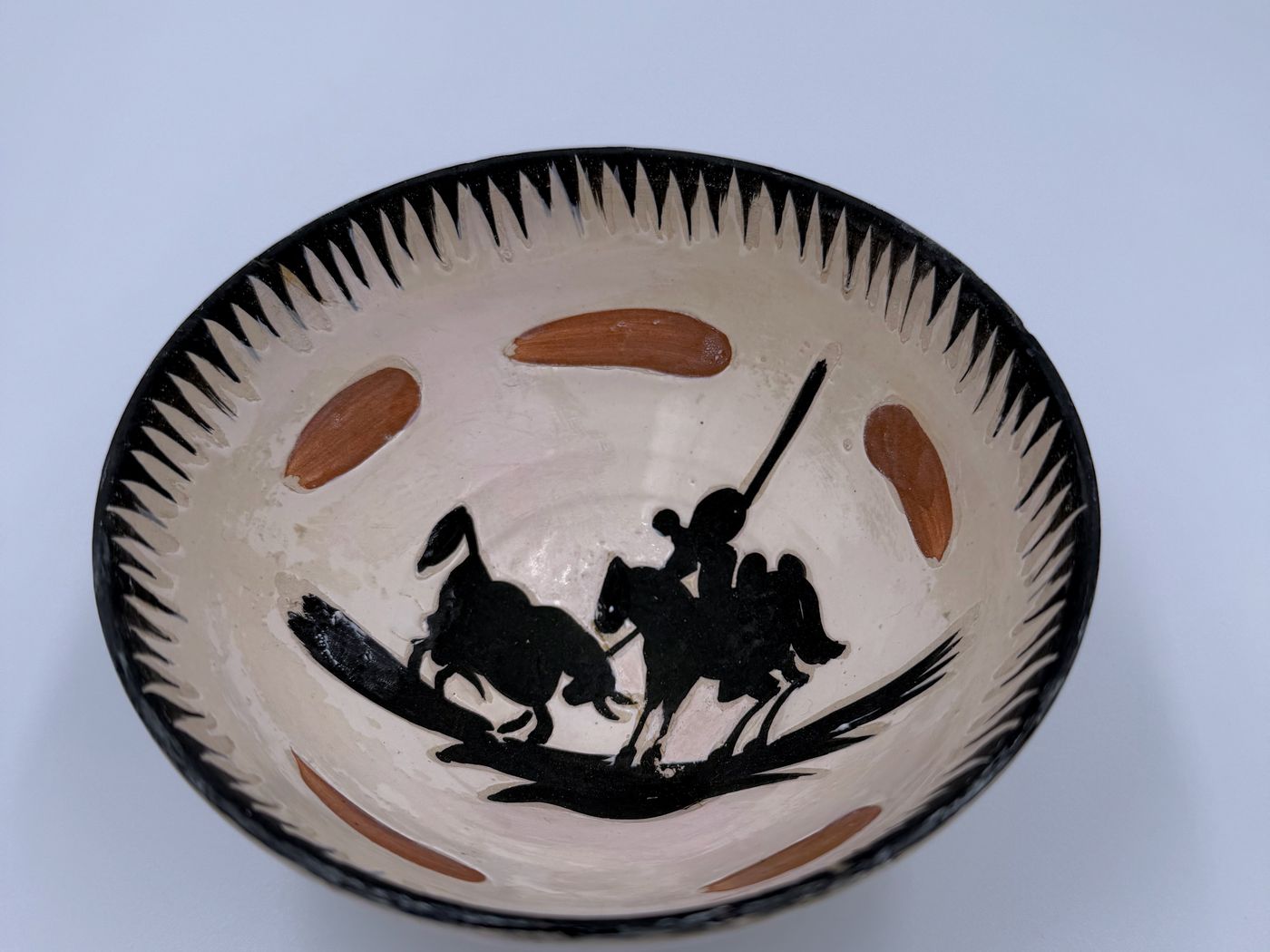
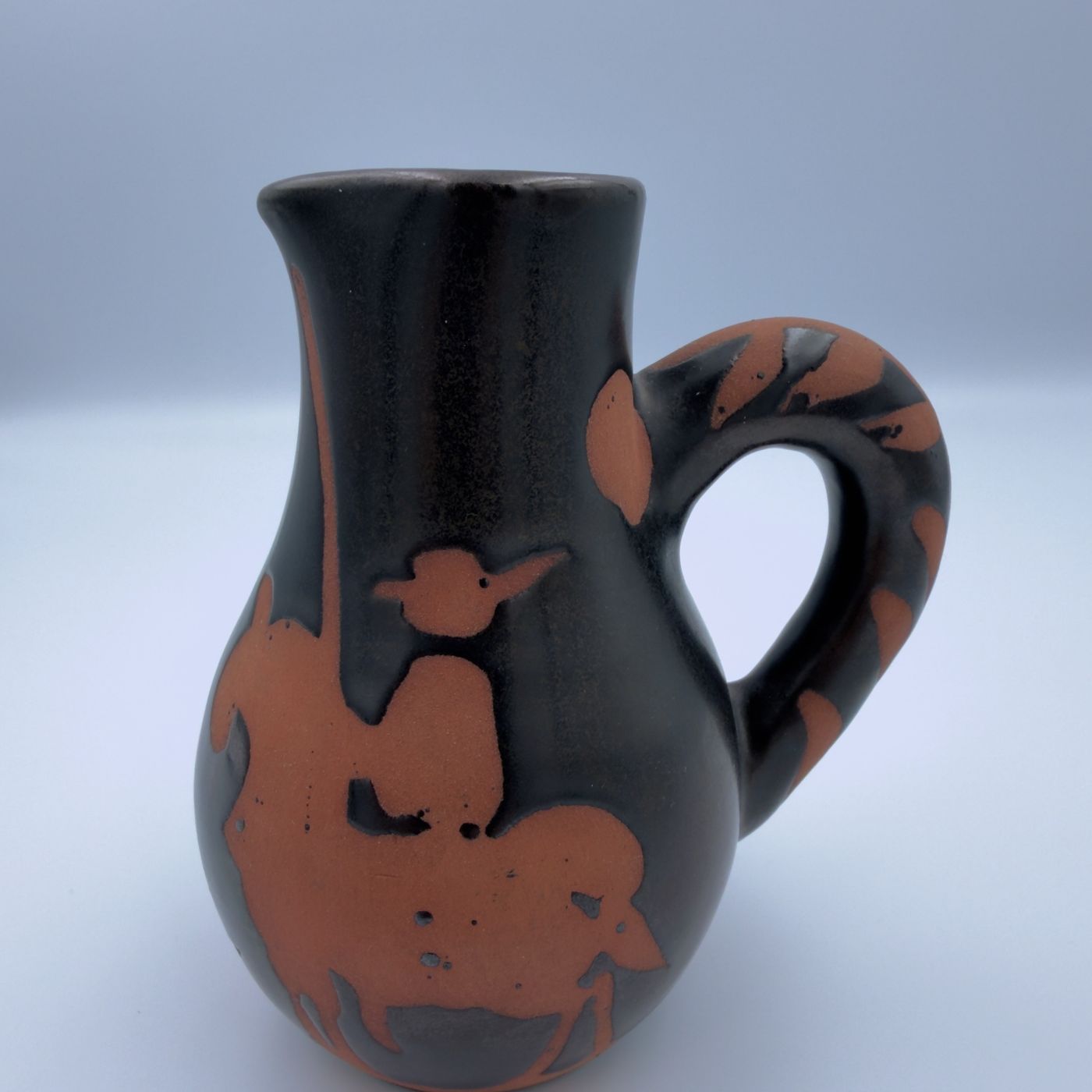
Cavalier and horse goes further, because Ramié records the same subject on a pitcher, a vase and square plaques of the same 21.5 cm height. The pitcher (A.R. 137) and vase (A.R. 138), both in 300 copies, each have a median hammer of about $12,700–12,800 since 2015 (22 and 18 sales). The coloured plaques (A.R. 594 and 595), in editions of only 100, have sold for about $4,400–4,600 (nine sales between them). Same subject, same height, a smaller edition, and the plaques sell for little more than a third of the turned pieces.
Goat's head in profile shows the other side. The 25.5 cm plates (A.R. 105–112) have median hammers of $4,800–7,100 since 2015. Four of the five 41 cm round dishes (A.R. 151 and 153–155) are at $16,300–19,700; the fifth, A.R. 152, has only three sales, at a median of $12,200. That gap is the size effect again, not a separate premium for dishes.
What this means for an owner
- Do not price a piece by its form. "Picasso pitchers sell for $10,000" is true of the median pitcher design and misleading for most others: the cheaper tenth of pitcher designs sells for less than the typical plate. The design, identified by its A.R. number, is still the starting point (see what is my Picasso ceramic worth).
- Turned vessels carry a premium of their own. If two candidates for comparison differ in form, a vase or pitcher is not a fair comparable for a plate, even at the same size.
- A large dish is a large plate. Its premium over a 25 cm plate is about size, so compare it with other pieces of similar diameter.
- Edition and subject were held equal here. How much they matter on their own is the subject of our articles on edition size and subjects.
Knowing the form, size, edition and subject of a design gets you some of the way: together with production class and period, those catalogue facts account for about 72% of the price differences between designs. The rest is the design itself, its condition, and who was bidding on the day.
How these figures were calculated
Dataset. Sold lots of Picasso Madoura ceramics carrying an A.R. (Ramié) number in the Artemis Collection research database. Lots identified as sold by Artemis Collection, and records superseded by a better copy of the same sale, are excluded. Aggregator copies of a house's own result (same design, within four days, price within 2%) are removed, as are lots titled "style of", "after", replica or Italian, lots under $300 hammer, multi-object lots and exact duplicates. The cleaned pool holds about 9,200–9,900 sold lots, depending on the data snapshot and how strictly multi-object lots are filtered. This analysis uses 9,296 of them, of which the 9,231 sold between 9 May 2000 and 29 October 2026 are analysed (583 designs).
Hammer prices. Most houses publish prices that include the buyer's premium. We convert them to hammer using each house's dated premium schedule (for example, Christie's 25% from late 2007, 26% from 2022, 27% from September 2025). Rago and LiveAuctioneers report hammer directly. Figures are nominal US dollars, converted at the time of sale and not adjusted for inflation.
Design index. A regression of log hammer price on the design, the sale year and the auction house (25 house groups) gives each design a price level free of where and when its examples happened to sell. We express it relative to the median design. The model explains 83% of the variation in log prices.
Like-for-like comparison. For the 489 designs with at least three sales, we regressed the design index on form family, log catalogue edition size, log principal catalogue dimension (diameter, length or height), subject group, Ramié production class and design period, weighting designs by their number of sales (capped at 25). Intervals are the 5th and 95th percentiles of 1,000 bootstrap resamples of designs. The model explains 72% of the differences between design indexes. Production class (Ramié's A.R. and O.P. groupings) is a control here, not a finding of this article: in the full model O.P. designs sell about 18% below comparable A.R. designs (90% interval about −28% to −8%), but that gap depends on which other factors are held equal (with form and size alone it is nil), so it should not be read as a simple O.P. discount. Form, edition size, size and so on come from our transcription of Ramié's catalogue. Subject groups are coded from catalogue titles, as described in our subjects article.
Limits. Unsold lots are largely missing from public records, so these figures describe what sold. Christie's accounts for over half the sales. The catalogue dimension is a single figure per design and does not capture surface area or weight. The comparisons show associations in past sales; they do not prove that form causes a price difference.
Sources
- Ramié, Alain. Picasso: Catalogue of the Edited Ceramic Works 1947–1971. Vallauris: Galerie Madoura, 1988 (English edition). Form, dimensions, edition size and production class for each A.R. number, from our transcription of all 633 entries. Cited by catalogue number; not reproduced.
- Public auction records of Picasso Madoura ceramics, May 2000 – October 2026, compiled by Artemis Collection. Results published by the auction houses; see 'How these figures were calculated'.
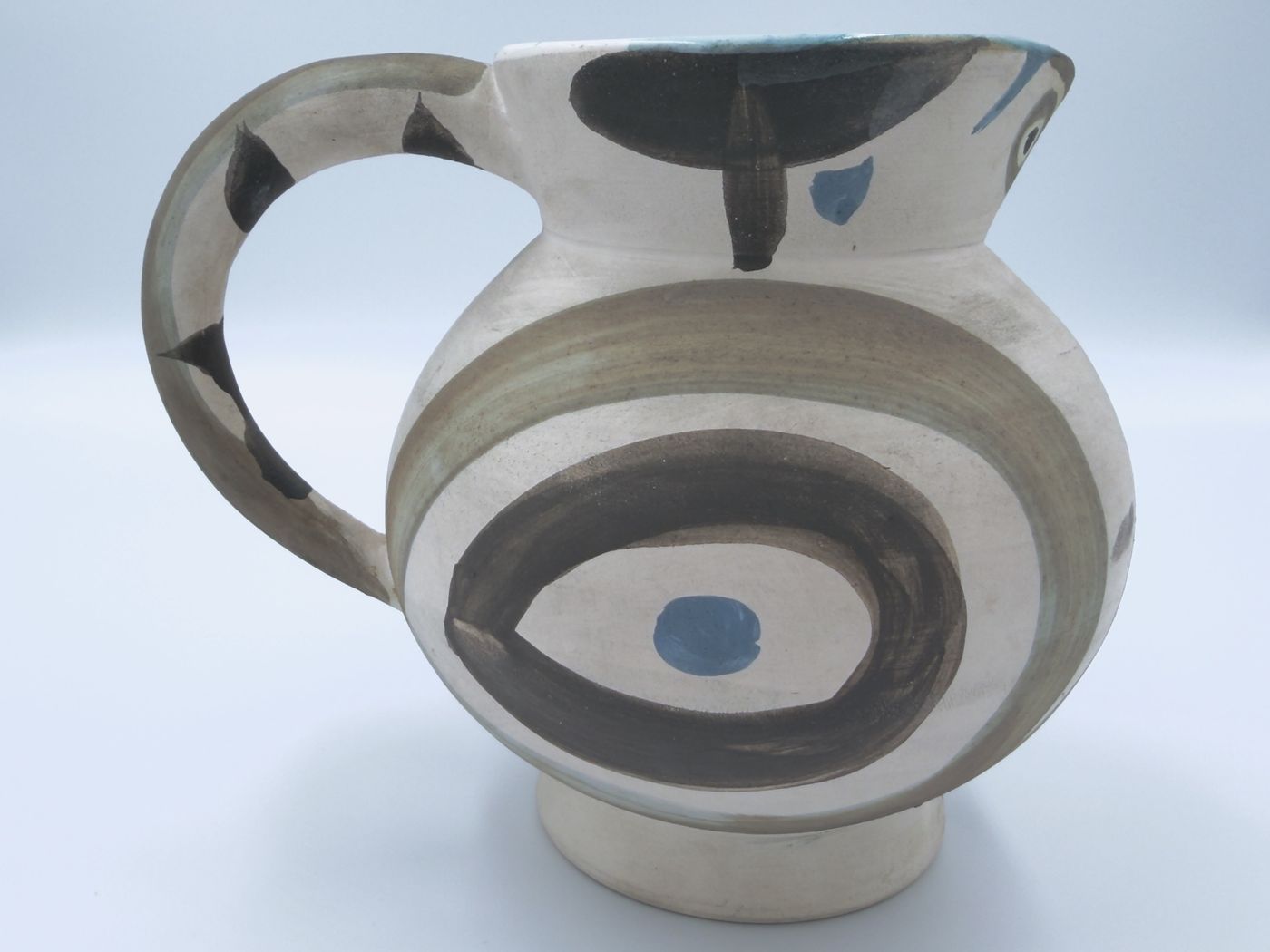
A practical checklist for photographing and documenting a Picasso Madoura ceramic: the views, marks, measurements, condition and papers a specialist needs.
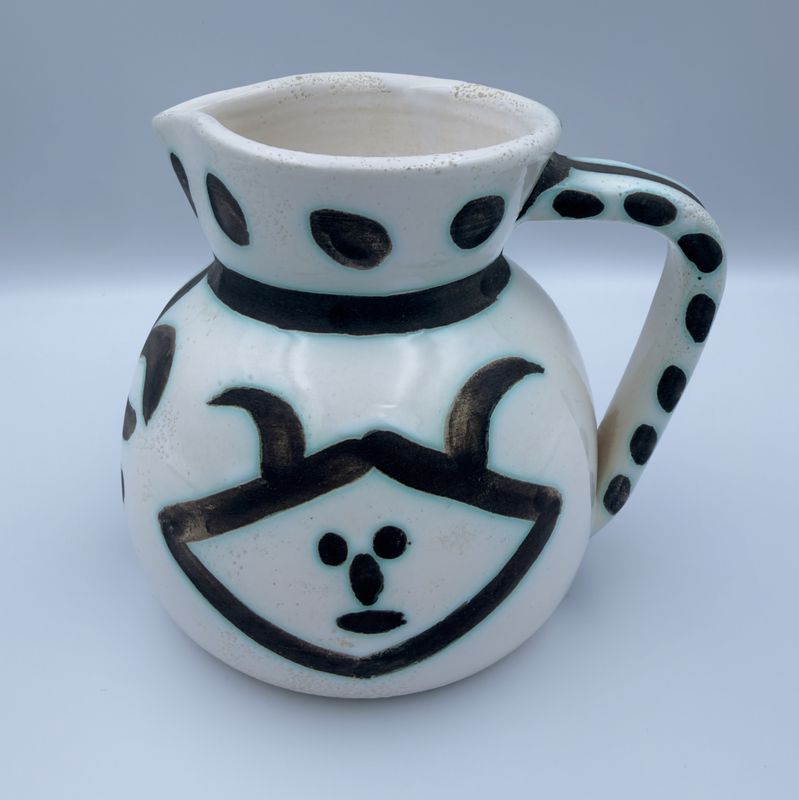
Which past auction results predict a Madoura ceramic's price best? We tested nine ways of choosing comparables on 5,000+ public sales.

Size is the strongest catalogue predictor of Madoura prices: what extra centimetres add within each form, and where size stops adding value.