

Does Edition Size Really Determine the Value of a Picasso Ceramic?
Smaller Madoura editions sell higher on average, yet among comparable designs the smaller edition sold for less almost half the time.
Prepared by Artemis Collection. Market figures are drawn from public auction records as described in the methodology note; they are not appraisals.
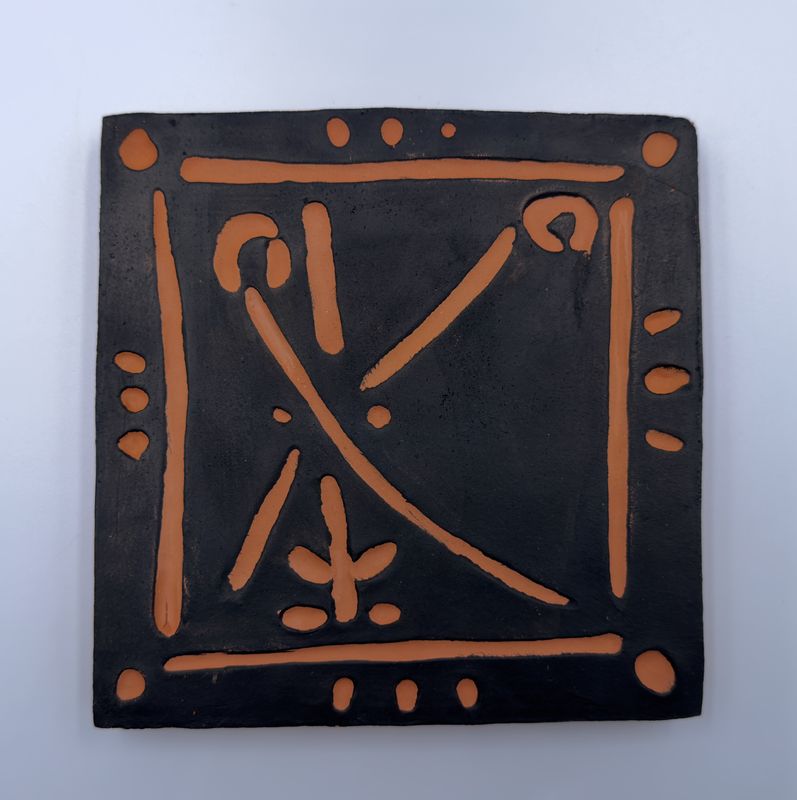
Edition size matters less than most owners expect. Across all Madoura designs, a smaller edition goes with a higher price: compared like for like, doubling the edition size goes with prices about 17% lower. But the relationship is driven by the very smallest editions, and it largely disappears where the comparison is cleanest. Take two designs of the same form and subject group: the one made in fewer copies sold for less 45% of the time. Where the same design was issued in versions of different edition sizes, the edition size made no consistent difference at all. The copy number painted on the base (3/100 versus 97/100) makes none either.
The figures come from 9,231 public auction results for 583 designs sold between May 2000 and October 2026. They describe what has happened at auction and do not value any particular piece.
What "edition size" means for a Madoura piece
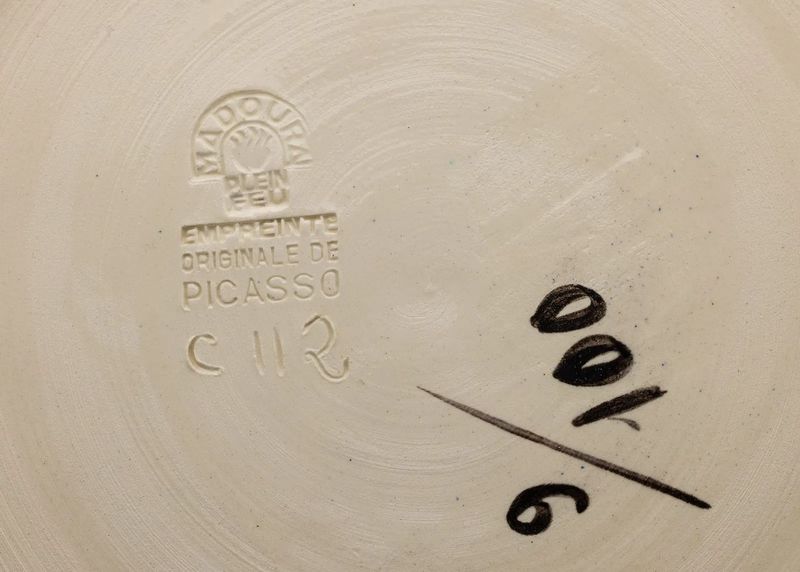
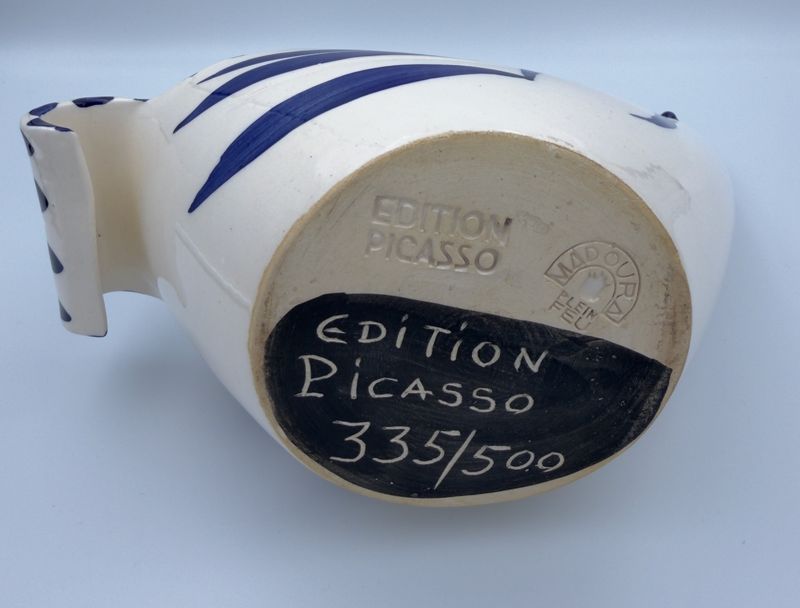
Ramié's catalogue records how many copies of each design were authorised: from 25 to 500 for almost all designs, most often 100. Many editions were numbered, so a piece may carry "45/100" on the base; earlier ones often were not. Our guides to how the editions were produced and to stamps and marks explain the numbering. The number on your piece is its copy number; the figure after the slash is the edition size.
Our valuation guide reported the raw pattern: the smallest editions sell higher, the 500-copy editions lower, and the middle looks flat. This article asks whether that pattern survives once you compare like with like.
The raw pattern hides what kind of object each edition is
Edition sizes were not assigned at random. Madoura's 25- and 50-copy editions include many of the large vases and pitchers. The 500-copy editions include all the ashtrays, most of the tiles and many small plates and cupels, but also some well-known pitchers and vases.
| Edition size | Designs | Sales | Median design, hammer since 2015 | Vases, pitchers and turned pieces | Median catalogue size |
|---|---|---|---|---|---|
| 25–50 | 59 | 535 | $16,300 | 34% | 33.5 cm |
| 51–100 | 188 | 1,981 | $7,400 | 11% | 30 cm |
| 101–200 | 100 | 1,711 | $7,400 | 15% | 25 cm |
| 201–300 | 41 | 1,017 | $8,100 | 59% | 28 cm |
| 301–450 | 29 | 939 | $7,100 | 24% | 30 cm |
| 451–500 | 72 | 2,875 | $4,900 | 33% | 18.5 cm |
Designs with at least three sales since 2000. Vessels sell at a premium of their own (see which forms command higher prices), and larger pieces sell higher (see physical size and value). So the 201–300 band looks at least as strong as the 51–100 band partly because three in five of its designs are vessels, and the 500-copy band looks weak partly because its pieces are small.
We therefore compared each band with designs of the same form, catalogue size, subject group, production class and period:
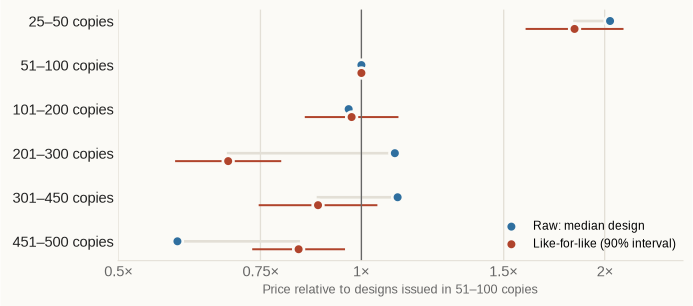
| Edition size, like for like | Compared with 51–100 copies | 90% interval |
|---|---|---|
| 25–50 | +84% | +60% to +110% |
| 101–200 | −3% | −15% to +11% |
| 201–300 | −32% | −41% to −21% |
| 301–450 | −12% | −25% to +4% |
| 451–500 | −16% | −27% to −5% |
Two corrections to the raw picture follow. The premium for the smallest editions is real but smaller than the raw figures suggest: about 1.8 times, not the 2.0 times of the raw comparison. And the "flat middle" was partly an illusion created by the vessels in the 201–300 band: like for like, those editions sell about a third below 100-copy designs. Expressed as a single rate, doubling the edition size goes with prices about 17% lower (90% interval 13% to 20% lower). The raw relationship, before controls, is 22% lower.
Why a smaller edition is a poor predictor of a particular piece
An average effect across 500 designs does not mean that a smaller edition will be dearer in any given comparison. We paired every design with every other design of the same form family and subject group, and looked at the pairs where the edition sizes differed. In 3,485 such pairs, the design with the smaller edition had the lower price index 45% of the time. For an owner comparing two pieces, edition size alone is close to a coin toss.
The cleanest test uses Ramié's own variants: a single design issued in two or more versions of the same form and dimensions, differing in decoration and in edition size. We found 25 such groups (78 designs, 1,207 sales). Within them, doubling the edition made no consistent difference: +1%, with a 90% interval from −9% to +12%. The smaller edition was the dearer in 49 of 76 pairs, but the gaps run both ways and are often large.
| Variants of one design (catalogue) | Edition | Decoration (Ramié) | Sales since 2015 | Median hammer since 2015 |
|---|---|---|---|---|
| Jacqueline at the easel, 42 cm dish, A.R. 333 | 200 | ivory, black, green | 27 | $29,600 |
| Jacqueline at the easel, 42 cm dish, A.R. 334 | 100 | white | 10 | $13,200 |
| Curly-haired face, 31 cm plaque, A.R. 572 | 50 | polychrome | 3 | $16,000 |
| Curly-haired face, 31 cm plaque, A.R. 573 | 100 | white, blue, green | 9 | $10,600 |
| Curly-haired face, 31 cm plaque, A.R. 574 | 200 | black | 4 | $7,200 |
| "Pomona" woman's face, 31 cm plaque, A.R. 590 | 50 | polychrome | 6 | $13,500 |
| "Pomona" woman's face, 31 cm plaque, A.R. 592 | 100 | polychrome, patina | 7 | $10,900 |
| "Pomona" woman's face, 31 cm plaque, A.R. 591 | 200 | black | 3 | $5,600 |
The decorated Jacqueline at the easel, in twice as many copies, sells for more than twice the plain white version. In the 1968–69 square plaques the order runs the other way: the polychrome versions in 50 and 100 copies sell above the black versions in 200. In each case the edition size travels with the decoration, and the decoration appears to be what buyers are paying for. Across the nine plaque groups, doubling the edition went with prices about 17% lower (90% interval −33% to +3%); across the other sixteen groups, about 12% higher (0% to +25%). The two point in opposite directions, and neither is secure enough to serve as a rule.
Low copy numbers do not carry a premium
Owners often ask whether "1/100" or "5/100" is worth more than "87/100". In public results it is not. We read the copy number from 730 lot descriptions of 195 designs, mostly Christie's and Phillips, from 2002 to 2026, and compared each sale with other copies of the same design, allowing for the year of sale and the auction house. Copies numbered 1 to 10 (57 sales) sold at essentially the same level as later copies: −0.6%, with a 90% interval from −11% to +11%. Position in the edition as a whole, first copy against last, made no measurable difference either.
How often each edition reaches auction
Smaller editions are not scarcer at auction in proportion to their size. Since 2000, designs in 25–50 copies have recorded about 20 public sales for every 100 copies authorised, against 7–9 for every other band. Across designs, the price index and the number of public sales per 100 copies move together (rank correlation 0.47). One reading is that demand for a design draws examples out of collections, so the most sought-after small editions come up often. The counts include resales of the same object, and we cannot separate the two, so treat this as a description, not a mechanism.
What this means for an owner
- A small edition helps on average, mainly below 50 copies. Designs in 25–50 copies sell about 1.8 times higher than comparable 100-copy designs.
- It does not settle the value of your piece. Within the same form and subject, the smaller edition was cheaper almost half the time. The design, its decoration and its condition matter more.
- If your design exists in several versions, the decoration counts. Compare your piece with sales of its own A.R. number, not with a "sister" version in a different edition (see Alain Ramié catalogue numbers).
- Your copy number is a matter of record, not of price. Note it accurately; do not expect a low number to add value.
How these figures were calculated
Dataset. Sold lots of Picasso Madoura ceramics with an A.R. number in the Artemis Collection research database, excluding lots identified as sold by Artemis Collection and records superseded by a better copy of the same sale. We removed aggregator copies of house results, "style of", "after", replica and Italian titles, lots under $300 hammer, multi-object lots and exact duplicates. The cleaned pool holds about 9,200–9,900 sold lots, depending on the data snapshot and how strictly multi-object lots are filtered; 9,231 lots of 583 designs, sold from 9 May 2000 to 29 October 2026, are analysed here.
Hammer prices. Converted from premium-inclusive results with each house's dated buyer's-premium schedule; Rago and LiveAuctioneers report hammer directly. Nominal US dollars.
Design index and like-for-like comparisons. A regression of log hammer on design, sale year and auction house gives each design an index free of venue and timing. For the 489 designs with at least three sales, we regressed that index on log edition size (or edition bands), form family, log catalogue dimension, subject group, Ramié production class and design period, weighting designs by sales (capped at 25). Intervals are 90% bootstrap intervals over designs (bands: robust standard errors). The doubling estimate is stable on sales since 2015 only (−16%), on Christie's only (−15%) and excluding Christie's (−16%). Production class (Ramié's A.R. and O.P. groupings) is a control here, not a finding of this article. O.P. designs have smaller editions (median 100 copies, against 200 for A.R. designs) but do not sell higher, so class and edition size are partly entangled: in the full model O.P. designs sell about 18% below comparable A.R. designs (90% interval about −28% to −8%), a gap that is nil when only form and size are held equal.
Pairs. All pairs of designs in the same form family and subject group with different edition sizes (3,485 pairs).
Variants. Designs with the identical catalogue title, form and dimensions, numbered within twelve places of each other in Ramié, with at least two edition sizes: 25 groups. Within-group regression of the design index on log edition size. The entries for A.R. 333–334 and 590–592 were checked against the catalogue (pp. 170–171 and 286).
Copy numbers. A figure "n/N" in the lot title or description was accepted only when N equalled the catalogue edition size. Regression of log hammer on "copy 1–10" (or on position n/N) with design, year and house effects, standard errors clustered by design. 730 lots of 195 designs with at least two numbered sales.
Limits. Unsold lots are largely absent from public records. Edition sizes are as catalogued; the number actually produced may be lower for some editions. Associations in past sales do not show that edition size causes a price difference.
Sources
- Ramié, Alain. Picasso: Catalogue of the Edited Ceramic Works 1947–1971. Vallauris: Galerie Madoura, 1988 (English edition). Edition size, form, dimensions, colours and technique for each A.R. number; variants checked on pp. 170–171 and 286. Cited by catalogue number; not reproduced.
- Public auction records of Picasso Madoura ceramics, May 2000 – October 2026, compiled by Artemis Collection. Results published by the auction houses; see 'How these figures were calculated'.
A practical checklist for photographing and documenting a Picasso Madoura ceramic: the views, marks, measurements, condition and papers a specialist needs.
Which past auction results predict a Madoura ceramic's price best? We tested nine ways of choosing comparables on 5,000+ public sales.

Size is the strongest catalogue predictor of Madoura prices: what extra centimetres add within each form, and where size stops adding value.