
Picasso Madoura Stamps and Marks: An Illustrated Reference Guide
What the stamps on Picasso Madoura ceramics mean: Madoura Plein Feu, Edition Picasso, Empreinte originale, Poinçon original, numbers and codes.
Prepared by Artemis Collection. Market figures are drawn from public auction records as described in the methodology note; they are not appraisals.
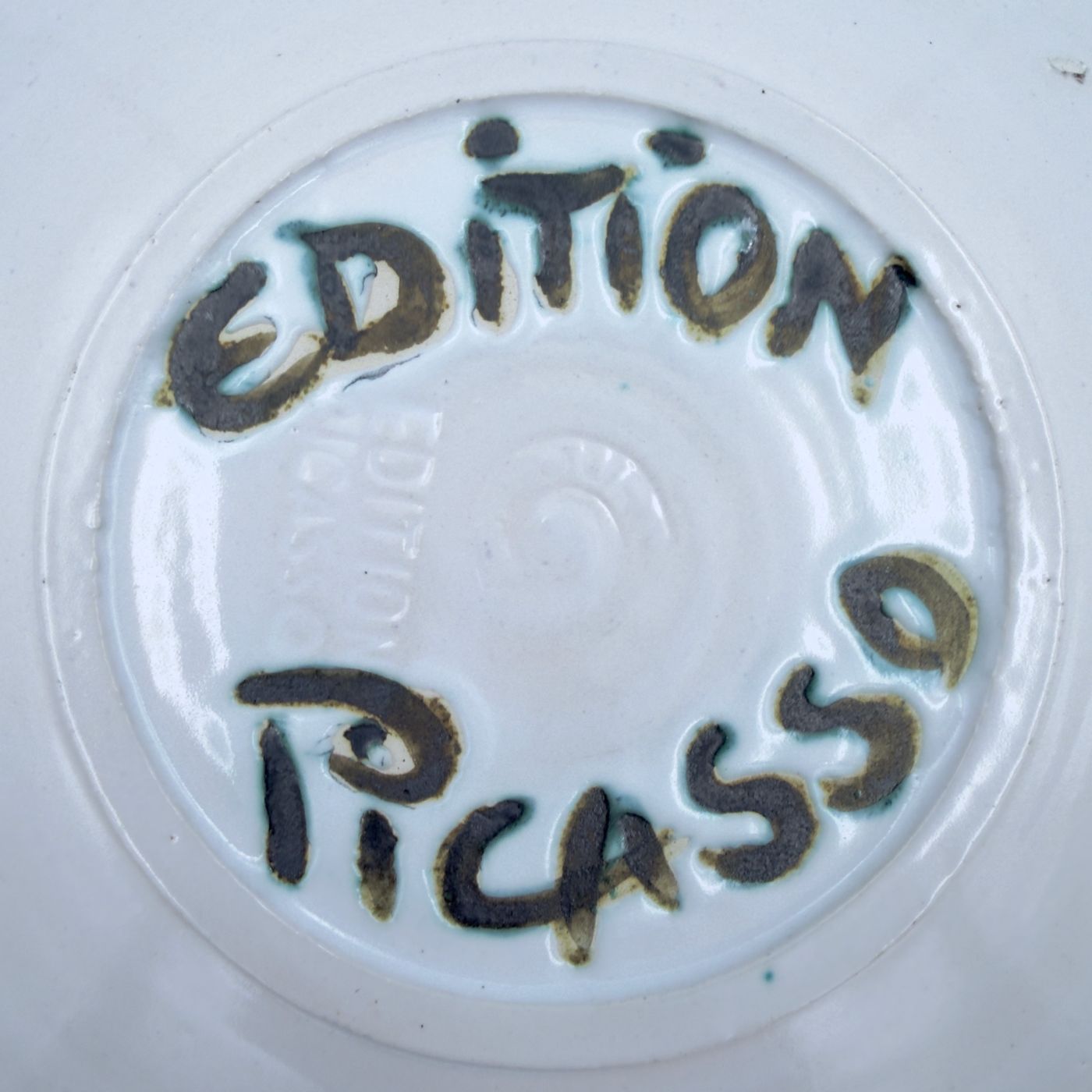
The marks on the underside of a Picasso Madoura ceramic tell you what kind of edition the piece claims to belong to. They do not prove that the piece is genuine. Alain Ramié's catalogue of the editions recognises three kinds of mark, each tied to a production method:
- "Edition Picasso", sometimes with "d'après Picasso", marks an authentic replica. Madoura's craftsmen made these by hand, copying an original that Picasso had made.
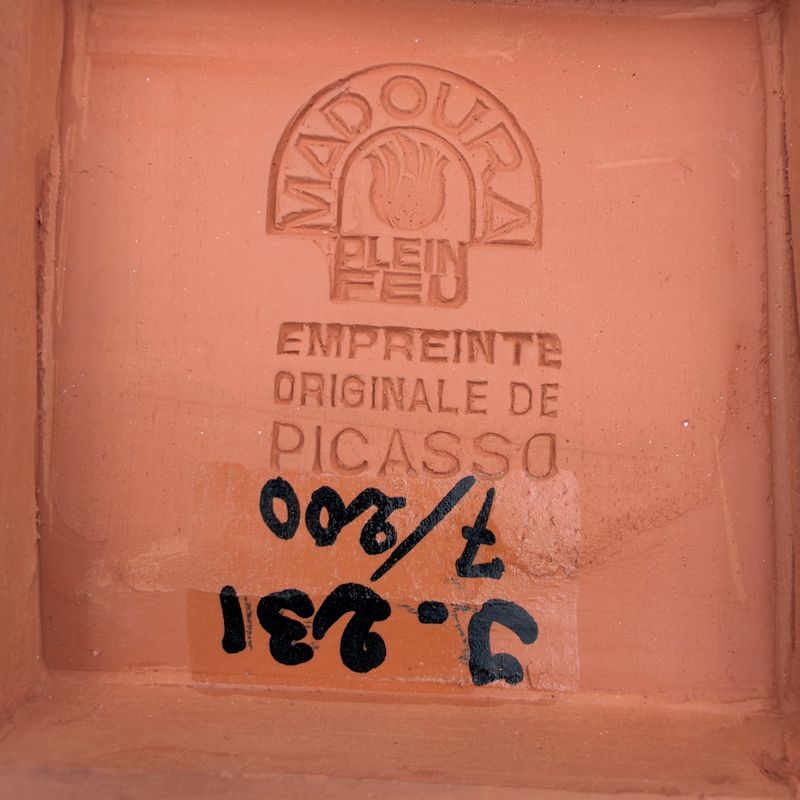
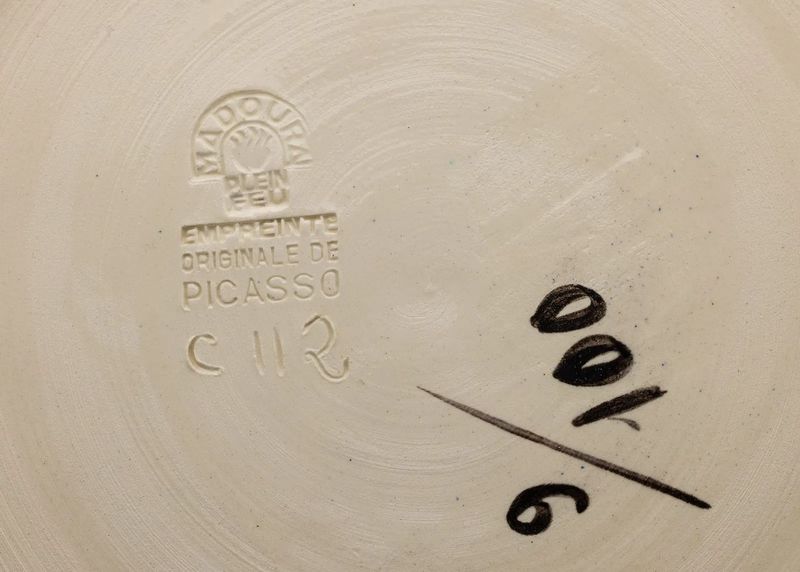
- "Empreinte originale de Picasso" marks an original print. The clay was pressed from a plaster matrix that Picasso had engraved.
- "Poinçon original de Picasso" marks an original stamp. A linoleum block engraved by the artist was pressed into soft clay.
Most pieces also carry the pottery's own "Madoura Plein Feu" stamp. Many carry an edition number, and some carry a handwritten letter-and-number code. This guide covers what each mark means according to the catalogue and how auction houses record it. It also says which questions remain open.
The marks as the catalogue defines them
Ramié's catalogue (the English edition, Madoura, 1988) includes a short table of marks with photographs of examples (pp. 18–19), and a page of abbreviations (p. 23). The English edition translates the French stamp wording. Its "Original print of Picasso" is the stamp that reads Empreinte originale de Picasso on the pieces themselves, and its "Original stamp of Picasso" is Poinçon original de Picasso. We give the French as it appears on the ceramics and the catalogue's English meaning beside it.
| Mark on the piece | Catalogue's meaning | Ramié class | Designs in the catalogue |
|---|---|---|---|
| Madoura with "Edition Picasso", or with "d'après Picasso" and "Edition Picasso" | Limited authentic replica | A.R. | 274 (A.R. class, numbered or not) |
| The same, with an edition number | Limited and numbered authentic replica | A.R. | |
| Madoura with "Empreinte originale de Picasso" | Limited original print | O.P. | 338 (O.P. class, numbered or not) |
| The same, with an edition number | Limited and numbered original print | O.P. | |
| Madoura with "Poinçon original de Picasso" and an edition number | Limited and numbered original stamp | O.S. | 21 |
The design counts come from our transcription of the 633 catalogue entries. Each entry's technique line begins with A.R., O.P. or O.S.
The catalogue defines the three classes as follows (p. 23):
- A.R., authentic replica. A hand-made repetition of an original. It reproduces the original's volumes and decoration, using the materials and methods of the first model.
- O.P., original print. The clay is transferred from an original subject engraved on a hardened plaster matrix. A fresh sheet of clay pressed onto the matrix takes a positive impression of the engraved motif.
- O.S., original stamp. A linoleum block engraved by the artist is applied to malleable clay. All 21 O.S. designs date from March 1971 and are red-earthenware tiles and plaques. The catalogue notes that six of the plaques combine the fifteen single-stamp designs, arranged differently (p. 294).
The catalogue's preface (p. 9) says that both the replicas and the impressions are "certified by an edition monogram or a graphic sign" on the reverse, neck or base, "and for some of them by the piece number within a production series." That is the publisher's statement of what the marks were for. It is not a test that a buyer can apply to an individual object.
Each mark in turn
Madoura Plein Feu
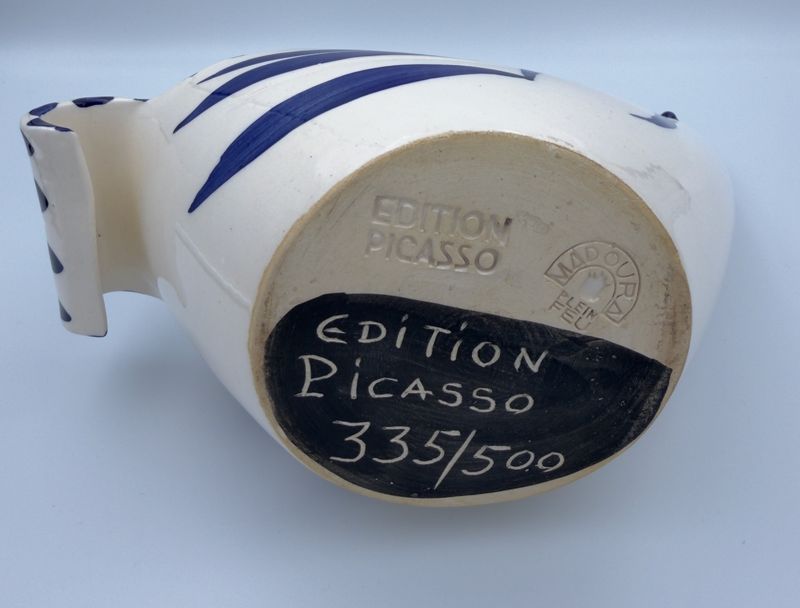
This is the pottery's stamp: the word Madoura arranged around a small emblem, with Plein Feu below. It appears with each class in the catalogue's photographs. It tells you which workshop a piece claims to come from. It does not tell you the edition class. In the auction descriptions we analysed, "Madoura" appears in 98.7% of lots and "Plein Feu" in 80.8%, across all three classes (method below). The catalogue does not define the words plein feu. We have not found an authoritative explanation of them in this context, so we do not offer a technical gloss.
Edition Picasso, and "d'après Picasso"
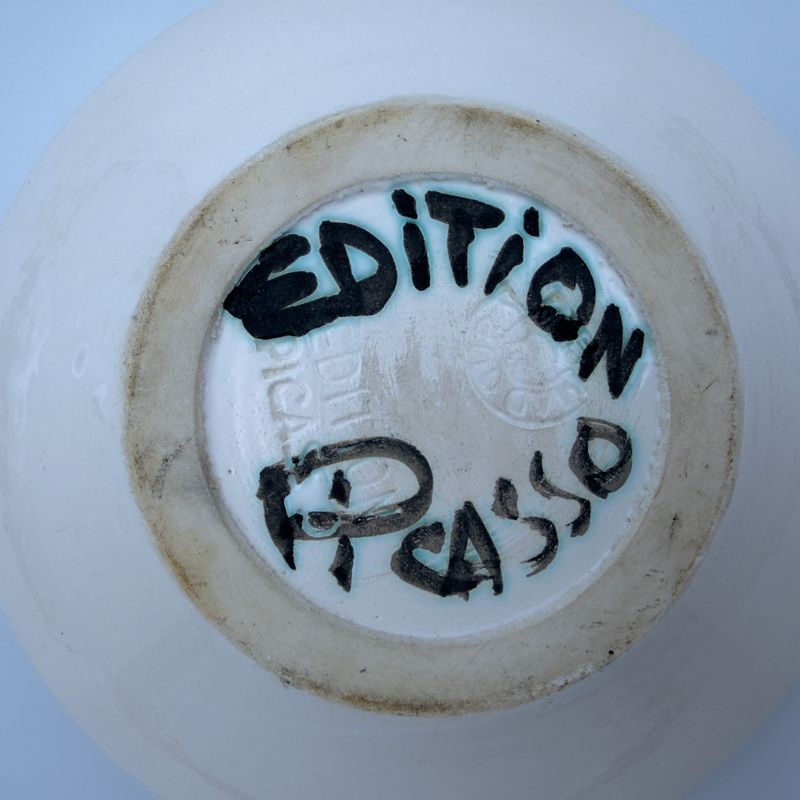
On authentic replicas the words Edition Picasso may be impressed as part of the stamp, painted or written by hand, or both. The catalogue's photographs show all of these. Some replicas also carry d'après Picasso ("after Picasso"). The catalogue's table lists "Madoura / after Picasso / Edition Picasso" as a limited authentic replica (p. 18). So "d'après Picasso" on a Madoura piece is a documented marking of the replica class, not a sign of an unauthorised copy (see originals, editions and reproductions for how the phrase is used off Madoura). In the descriptions we analysed, auction houses recorded "d'après Picasso" on 8.3% of lots of A.R.-class designs, and on almost no lots of the other classes.
Empreinte originale de Picasso
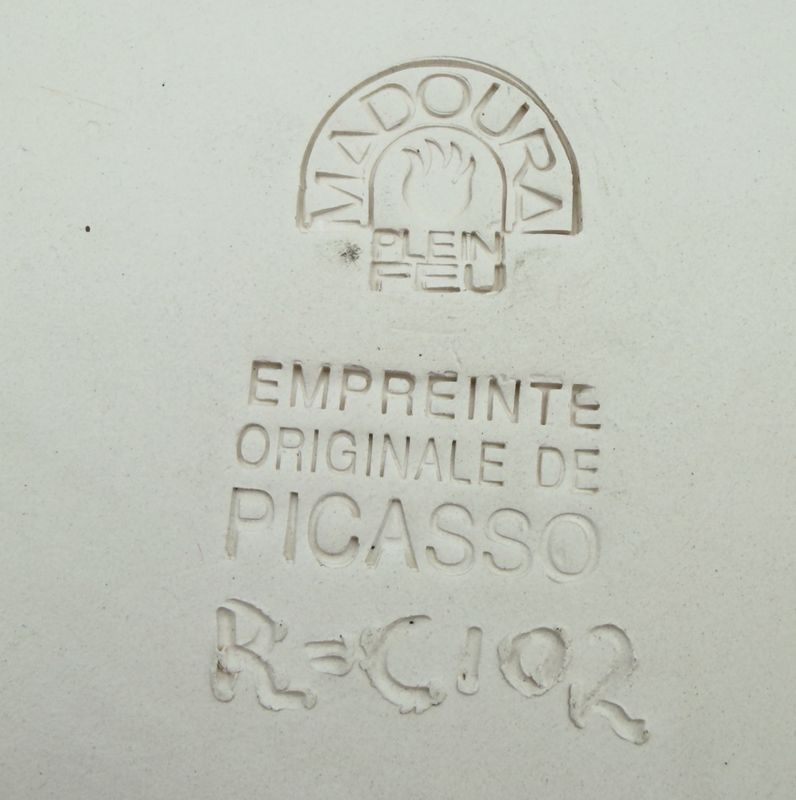
This impressed stamp identifies the original-print class. The catalogue's own photographs show it on its own, with an edition number, and on some pieces together with "Edition Picasso" (p. 19, photographs 10 and 11). The catalogue's photographs of the clay-impression process include a step captioned "impression of the marks" (p. 15). On these pieces the stamp was pressed into the clay while it was being formed.
Poinçon original de Picasso
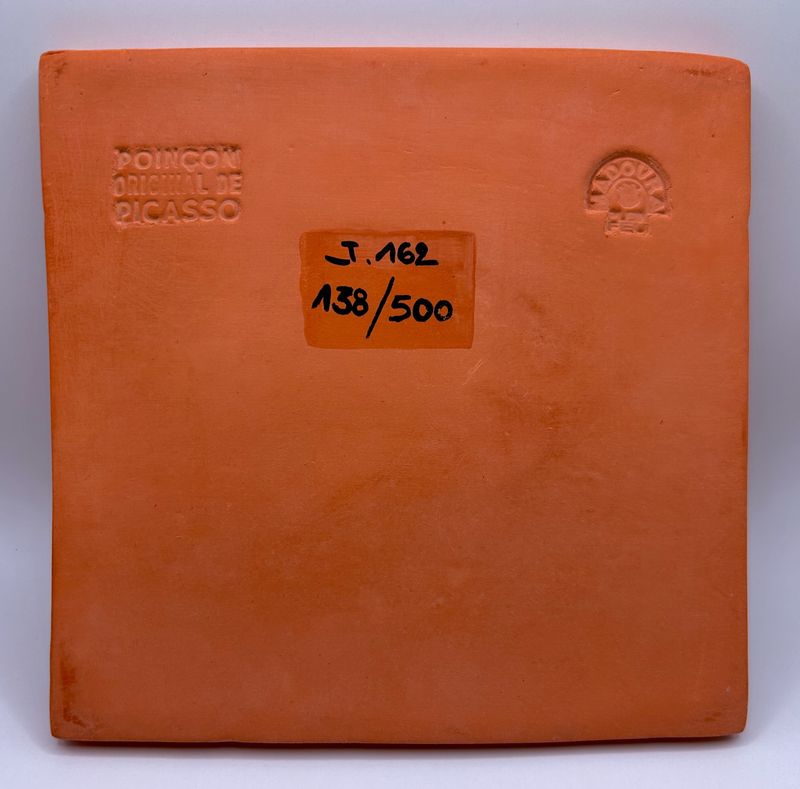
This stamp appears on the 1971 tiles and plaques of the original-stamp class. The catalogue's example shows it with a handwritten code and an edition number (p. 19, photograph 14).
Edition numbers
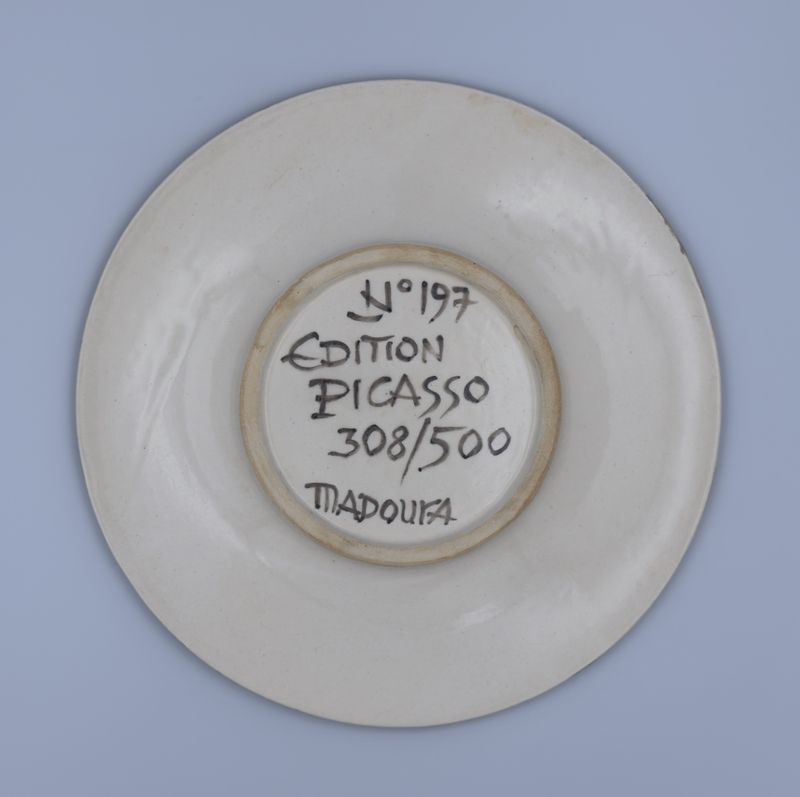
A number such as "35/100" gives the copy and the edition size. It is usually written by hand, not impressed. Not every design was numbered. The catalogue records each edition either as "N numbered copies produced" or as "N copies produced". In our transcription, 387 of the 633 designs are numbered editions, 233 are unnumbered and 13 are described as "few copies produced". The auction record matches this distinction closely:
| Ramié describes the edition as | Lots | Lots whose description records an edition number (x/y) |
|---|---|---|
| Numbered | 1,530 | 94.5% |
| Not numbered | 1,228 | 0.7% |
| "Few copies produced" | 13 | none |
An unnumbered piece from an edition that Ramié lists as unnumbered is therefore normal. It is not a defect. A number on a piece from such an edition, or a missing number on a piece from a numbered edition, is worth a closer look and a question to the seller.
The catalogue also states that "there are three publisher's copies for each piece" (p. 23). It does not say how those copies were marked. Auction descriptions suggest an answer: 44 lots in our dataset transcribe the words "Exemplaire éditeur" (publisher's copy) among the marks, in the examples we checked without an edition fraction. We have not found a statement from Madoura or Ramié confirming this practice.
Handwritten letter-and-number codes
Some pieces carry a handwritten code made of a letter and a number, such as "J. 165", "I. 104", "C 105" or "N 108". These are separate from the edition fraction. The catalogue's own example photographs show such codes (pp. 18–19). As far as we have found, the catalogue does not explain them.
We tested what the codes refer to using auction descriptions that transcribe them. A code appeared inside the quoted marks on lots of 101 different designs. For the 15 designs where we found the code on three or more lots, every lot of the design carried the same code. Different designs almost never shared a code: 3 of 99 codes were each seen on two designs, in each case adjacent catalogue numbers. The pattern suggests the code identifies the design, or a production model, rather than the individual copy. That reading is ours. Neither the catalogue nor any other source we found confirms it, so treat the meaning of the codes as unresolved. The sample is also small, because cataloguers transcribe these codes only occasionally.
Monograms and single letters
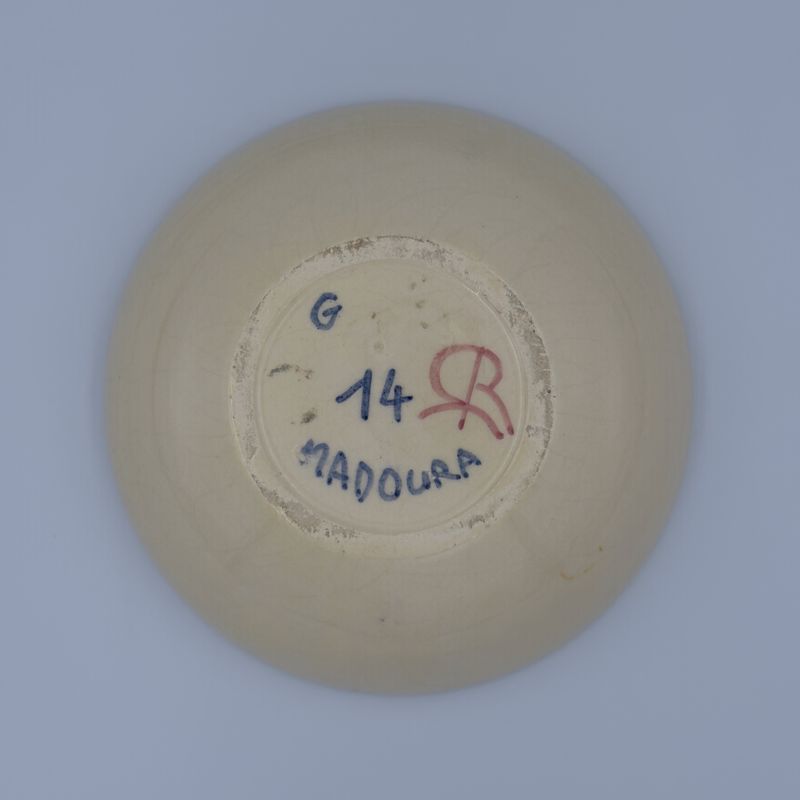
Some auction descriptions note a monogram, which Christie's catalogues identify as Suzanne Ramié's, and sometimes a single letter, particularly on pieces from the 1948 "black face" service. The catalogue's photographs include a monogram beside "Madoura / d'après Picasso" (p. 18, photograph 2) but do not identify it. We record these marks without interpreting them.
How auction houses transcribe the marks
Lot descriptions quote the marks, and the quotations follow the catalogue's classes closely. We joined 2,771 Christie's and Phillips descriptions of sold lots (1995–2026, 514 designs) to the catalogue class of each design.
| Wording in the lot description | A.R. designs (1,780 lots) | O.P. designs (945 lots) | O.S. designs (46 lots) |
|---|---|---|---|
| "Edition Picasso" | 94.4% | 3.7% | 10.9% |
| "Empreinte originale" | 0.2% | 97.5% | 0% |
| "Poinçon original" | 0% | 0% | 84.8% |
| "d'après Picasso" | 8.3% | 0.2% | 0% |
| "Madoura Plein Feu" | 75.7% | 90.4% | 78.3% |
| An edition number (x/y) | 53.4% | 48.8% | 93.5% |
A smaller check on Rago, a different house with its own cataloguing, points the same way: 96.5% of 57 A.R.-class lots and none of 16 O.P.-class lots were described with "Edition Picasso" alone, without the impression stamp.
In practice, then, the stamp wording that a cataloguer transcribes is a dependable guide to the catalogue class of the design. The exceptions are small and mostly explicable. The catalogue's own photographs show some original prints that also carry "Edition Picasso" (p. 19). Of the 1,780 A.R.-class descriptions, 97 name neither stamp, and 71 of those record "d'après Picasso" instead. When the wording and the class disagree, check the catalogue number against the catalogue entry before drawing any conclusion. For how the catalogue numbers work, see our guide to Alain Ramié catalogue numbers.
What a mark cannot establish
A stamp is a claim made by the object. Stamps, painted inscriptions and numbers can all be imitated, and a convincing mark can be applied to an object that does not deserve it. The marks tell you how a piece describes itself. Whether the description is true is a separate question. Answering it takes the whole object: the design, its dimensions against the catalogue entry, the clay, the glaze and decoration, the condition, and the documentary history (which documents matter). Our step-by-step guide to identifying a Madoura ceramic puts these checks in order.
A few practical points follow from the evidence above:
- Check that the class matches the design. An "Empreinte originale" stamp on a design that the catalogue lists as an authentic replica, or the reverse, needs an explanation.
- Check the number against the edition. A fraction whose denominator differs from the catalogue's edition size, or a number on an unnumbered edition, needs an explanation.
- Do not read too much into one detail. The catalogue's photographs show variation in how genuine marks were applied: impressed, painted, handwritten, and in different combinations.
For a formal opinion, the Picasso Administration in Paris describes a dedicated committee, the Comité Picasso, that gives opinions on the authenticity of works submitted to it. Its online request form lists ceramics with the qualification "si œuvre unique" (if a unique work). We have not found a published statement on how it treats edition ceramics, so owners with an authenticity question should ask it directly.
What remains unresolved
- What the handwritten letter-and-number codes stand for (our evidence suggests a design-level reference; unconfirmed).
- What the words "Plein Feu" signify in Madoura's usage.
- Whether "Exemplaire éditeur", which auction houses transcribe on some pieces, was the standard marking for the three publisher's copies of each design.
- Who the monograms and single letters on early service pieces belong to, beyond the attribution given in some auction catalogues.
When we find authoritative answers, we will add them here with sources.
How these figures were calculated
- Dataset. Public auction results for Picasso Madoura ceramics held in the Artemis Collection research database. These are sold lots keyed to a Ramié catalogue number, with duplicate copies from aggregator sites removed (same design, sale within four days, price within 2%). Titles indicating "style of", "after", "replica" or Italian production are excluded, as are lots under $300 hammer, multi-object lots and exact duplicates. The cleaned pool has 9,296 lots of 583 designs sold between May 1986 and October 2026. (Depending on the data snapshot and how strictly multi-object lots are filtered, the pool holds about 9,200–9,900 sold lots; this article uses the run described here.)
- Wording analysis. All Christie's and Phillips lots in that pool with a stored catalogue description: 2,771 lots, sale years 1995–2026. We matched the descriptions, ignoring case and accents, for the phrases shown. Each lot's design was joined to its class (A.R., O.P., O.S.) and edition description in our transcription of the Ramié catalogue. The Rago check uses the 75 Rago lots with a stored marks field (2018–2024).
- Codes. We counted a letter followed by a one- to three-digit number inside a quoted mark that contains "Madoura", excluding edition fractions.
- Limits. Descriptions record what cataloguers chose to transcribe. They are not condition or authenticity reports. Our transcription of the catalogue may contain errors, and we cite catalogue pages so that readers can check them.
If you have a Madoura piece whose marks raise a question, you are welcome to send photographs of the underside and any papers to Artemis Collection.
Sources
- Alain Ramié, Picasso: Catalogue of the Edited Ceramic Works 1947–1971 (English edition, Madoura, © Galerie Madoura 1988). Marks table and photographs, pp. 18–19; definitions of A.R., O.P. and O.S., p. 23; Preface, pp. 9–10. Cited by page; not reproduced.
- Marilyn McCully, 'Picasso and the Ramiés in the Valley of Gold', Sotheby's, 29 March 2019. Accessed 3 November 2026. Replicas and empreintes originales.
- Picasso Administration, home page (authentication section and request form). Accessed 3 November 2026. Describes the Comité Picasso, which gives opinions on authenticity.
- Public auction records (Christie's, Phillips and Rago lot descriptions, 1995–2026). Artemis Collection analysis; method in 'How these figures were calculated'.
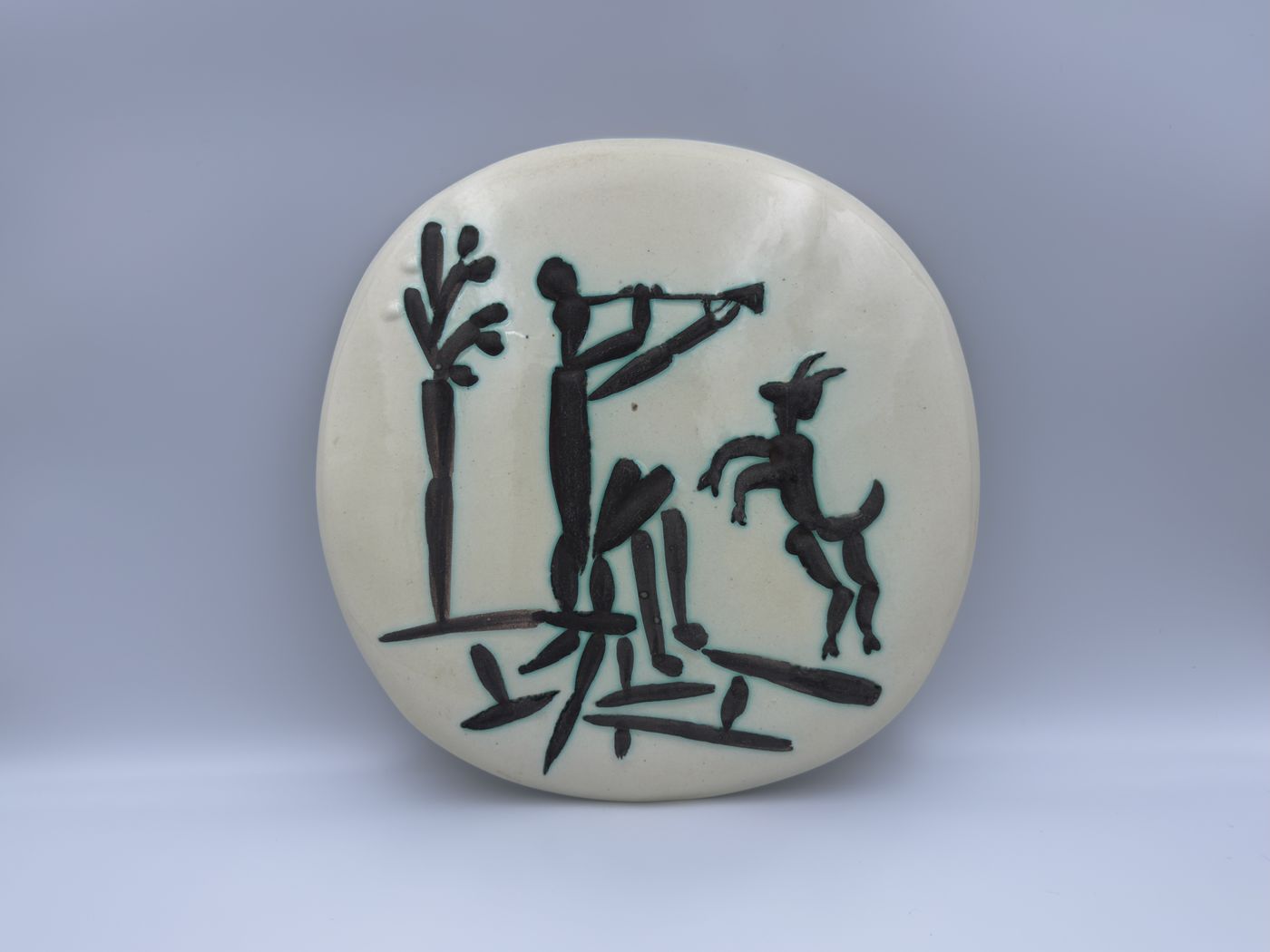
Which documents support a Picasso Madoura ceramic's history, what auction houses actually print as provenance, and what papers cannot prove.
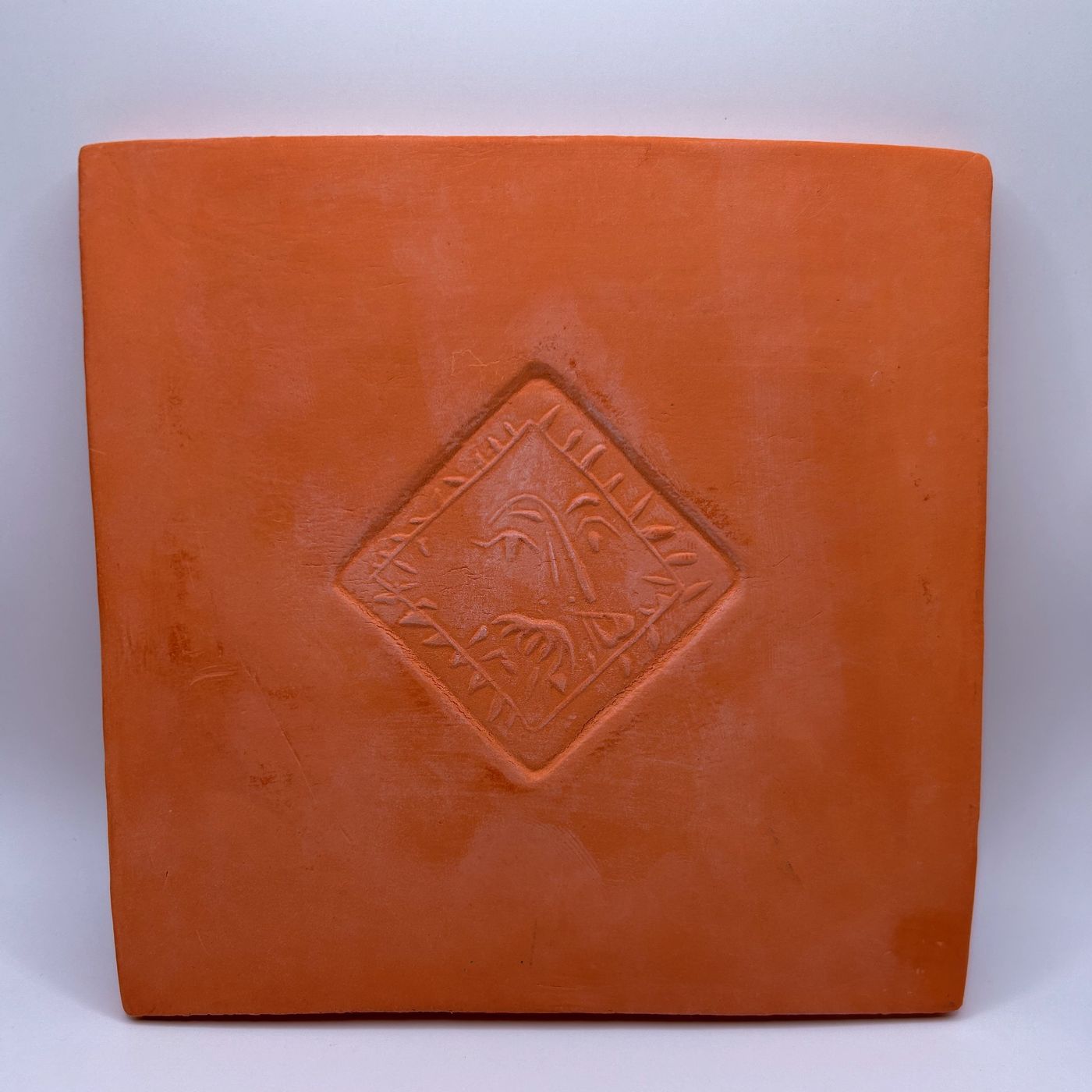
What an A.R. (Alain Ramié) number is, how to read a catalogue entry, and how to use the number to research a Picasso Madoura ceramic.
How the Madoura pottery produced Picasso's ceramic editions: the people, the three methods, materials, forms, edition sizes and numbering, with sources.