

Alain Ramié Catalogue Numbers: How to Identify Picasso Ceramics
What an A.R. (Alain Ramié) number is, how to read a catalogue entry, and how to use the number to research a Picasso Madoura ceramic.
Prepared by Artemis Collection. Market figures are drawn from public auction records as described in the methodology note; they are not appraisals.
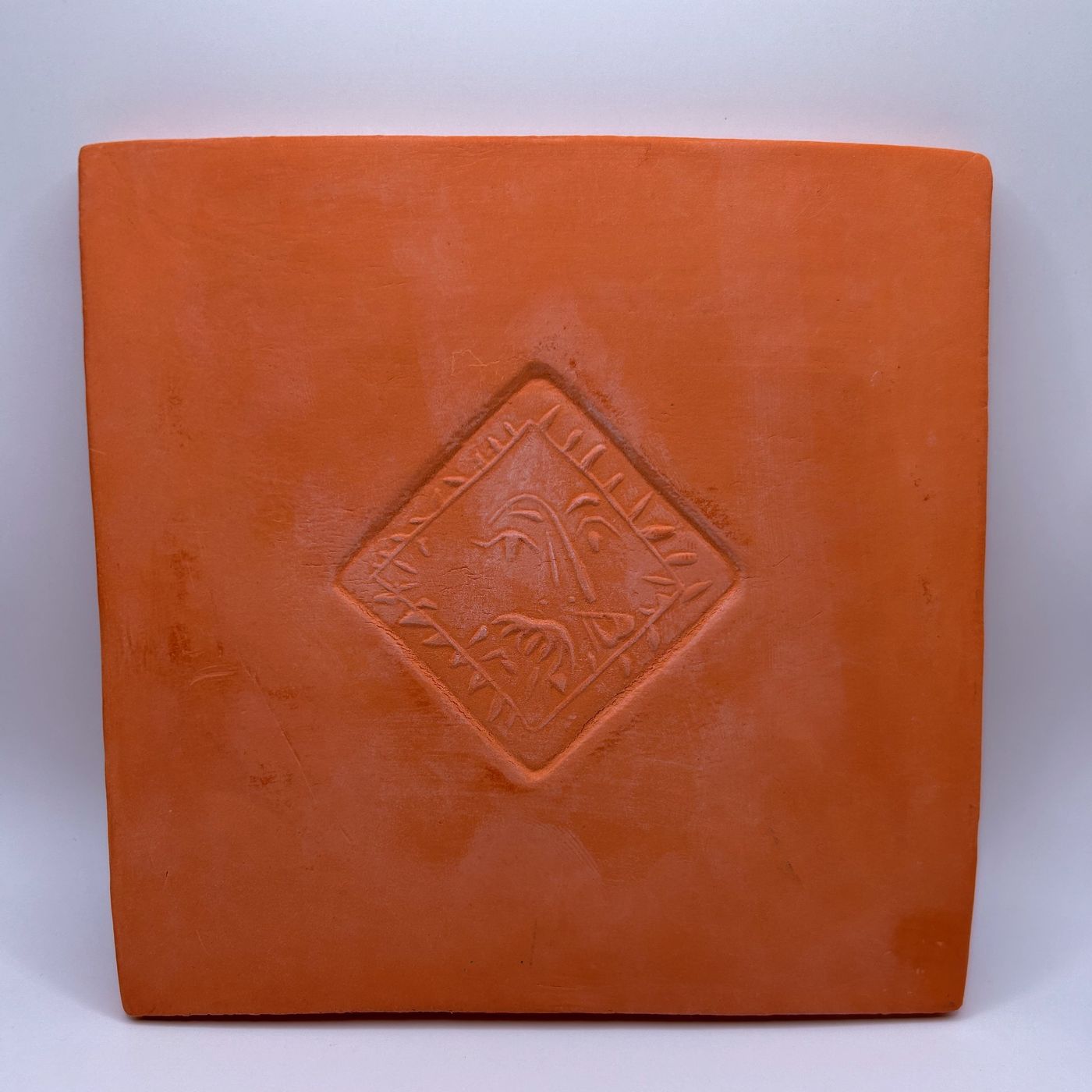
An A.R. number is the entry number of a design in Alain Ramié's catalogue of Picasso's edited ceramics, Picasso: Catalogue of the Edited Ceramic Works 1947–1971. The catalogue was published by Madoura in 1988. Booksellers also list a French edition, which we have not examined. Auction houses and dealers write "A.R. 102", "Ramié 102" or "Alain Ramié 102", and all three mean the same entry.
The number identifies a design, not your individual piece. It tells you which of the 633 edition designs the piece claims to be, and through the catalogue entry it gives you the design's date, form, size, technique, colours and edition. It does not tell you whether a particular object is genuine, or what it is worth.
About the catalogue
Alain Ramié is the son of Suzanne and Georges Ramié, who ran the Madoura pottery in Vallauris where Picasso made his ceramics. He describes the catalogue as showing "the whole of these collections produced throughout the years". For each piece it gives "the date of creation by Picasso, sizes, creative process, the colours and number of copies edited" (Preface, p. 10). The editions were, in his words, "edited and produced with exclusive rights by Madoura Pottery" (p. 9). Our copy is the English edition, © Galerie Madoura, 1988, with the entries starting at page 24.
The catalogue contains 633 numbered entries, A.R. 1 to A.R. 633. This matches the figure Christie's gave when it sold the Madoura Collection in 2012: "633 different plates, bowls, vases and pitchers".
Ramié's catalogue does not list Picasso's unique ceramics. The Musée Magnelli in Vallauris estimates those at between 3,500 and 4,000 pieces. If a ceramic is not in Ramié, that alone tells you neither that it is a unique work nor that it is not by Picasso. It means the catalogue of editions does not cover it. See originals, editions and reproductions.
Reading an entry
An entry gives these fields in this order. We use A.R. 1 as the example (p. 24):
| Field | What it records | Example (A.R. 1) |
|---|---|---|
| Number and title | The design's catalogue number and English title | 1, Diaulos player |
| Date | The date Picasso created the design, sometimes to the day | 1947 |
| Form | The catalogue's name for the shape | Rectangular dish |
| Dimensions | In centimetres (H., W., L., Dia., D.) | W. 32 cm, l. 39 cm |
| Technique | Begins with the class (A.R., O.P., O.S.), then the clay and decoration | A.R., white earthenware clay, engobe decoration, engraved under yellow glaze |
| Colours | The colours used | Yellow, green, white, brown |
| Edition | Number of copies, and whether they were numbered | 200 numbered copies produced |
| Cross-references | "B." (Bloch) and "R." (Georges Ramié) numbers, and "Va." for a variant | R. 669 |
Some fields need explaining.
Date. The date is the design's creation date, not the date a particular copy was made. The Musée Magnelli dates the start of Picasso's ceramic editions to 1949. Copies of a design from 1947 or 1948 could therefore have been made years later. The catalogue does not record when each copy was produced.
Class. The abbreviations are defined on page 23. A.R. means authentic replica: a hand-made repetition of an original. O.P. means original print: clay pressed from a plaster matrix engraved with the original subject, marked "Empreinte originale de Picasso". O.S. means original stamp: a linoleum block engraved by the artist and pressed into soft clay, marked "Poinçon original de Picasso". In our transcription there are 274 A.R. designs, 338 O.P. designs and 21 O.S. designs. The marks that go with each class are covered in our stamps and marks guide.
Edition. The catalogue distinguishes "N numbered copies produced" from "N copies produced". In our transcription, 387 designs are numbered editions, 233 are unnumbered and 13 are recorded only as "few copies produced". One design, A.R. 158, records a single numbered copy. The commonest edition sizes are 100 copies (256 designs), 500 (75), 200 (74), 300 (52), 150 (40) and 50 (40). Page 23 also notes that "there are three publisher's copies for each piece".
Dimensions. The catalogue's own note warns that sizes can vary from piece to piece because clays shrink by different amounts in firing (p. 23). A few millimetres' difference from the entry is expected. A large difference is not.
Cross-references. "B." refers to Georges Bloch's catalogue of the printed ceramics, volume III (Kornfeld and Klipstein, Bern, 1972). "R." refers to Georges Ramié's Ceramics of Picasso (Cercle d'Art, Paris, 1974). In our transcription, 337 entries carry a Bloch number and 326 a Georges Ramié number. In our transcription, Bloch numbers appear only on original-print and original-stamp designs (331 and 6 entries), which fits the subject of Bloch's volume, the printed ceramics. Older literature and some auction catalogues cite these references instead of, or as well as, the A.R. number.
Worked examples
These examples show what the number does and does not settle. The catalogue facts come from the entries cited. The counts are public auction results in our dataset (method below).
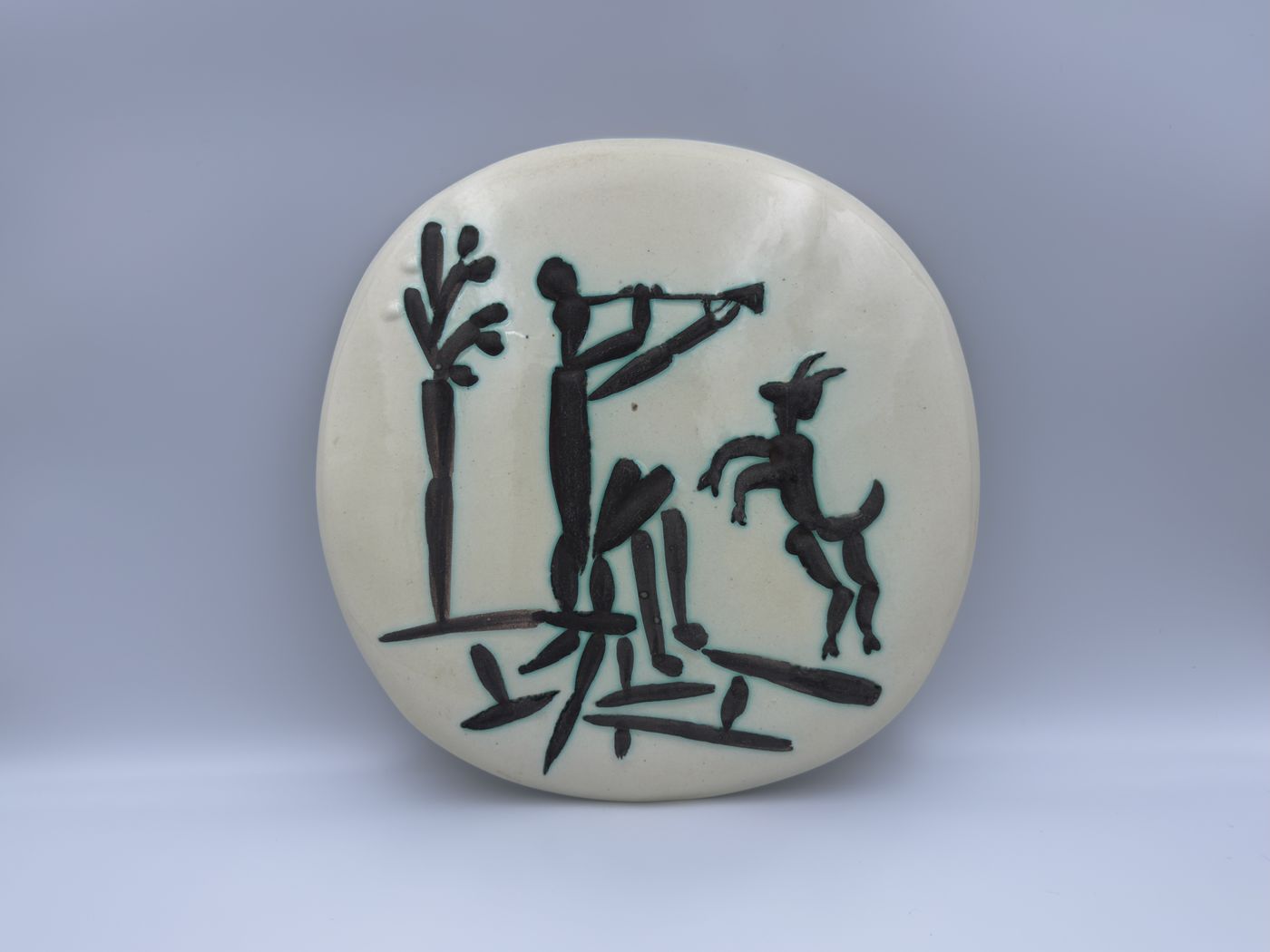
A.R. 1, Diaulos player (1947), p. 24. An authentic replica in a numbered edition of 200. In our data it has 35 public results between 2002 and 2026. Because the edition is numbered, a copy should carry a fraction ending in /200. A copy without one, or with a different denominator, needs an explanation.
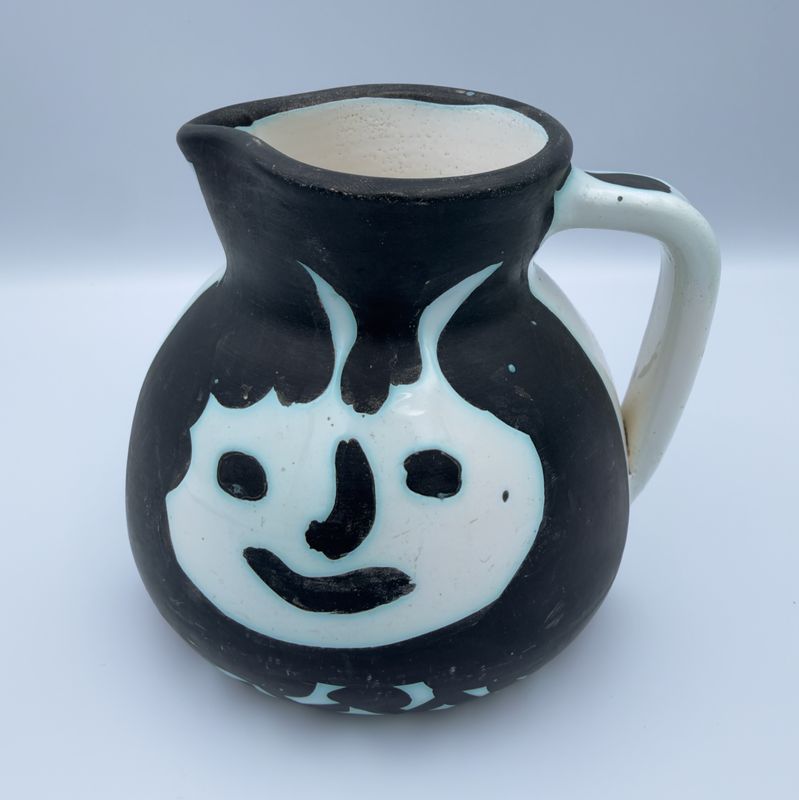
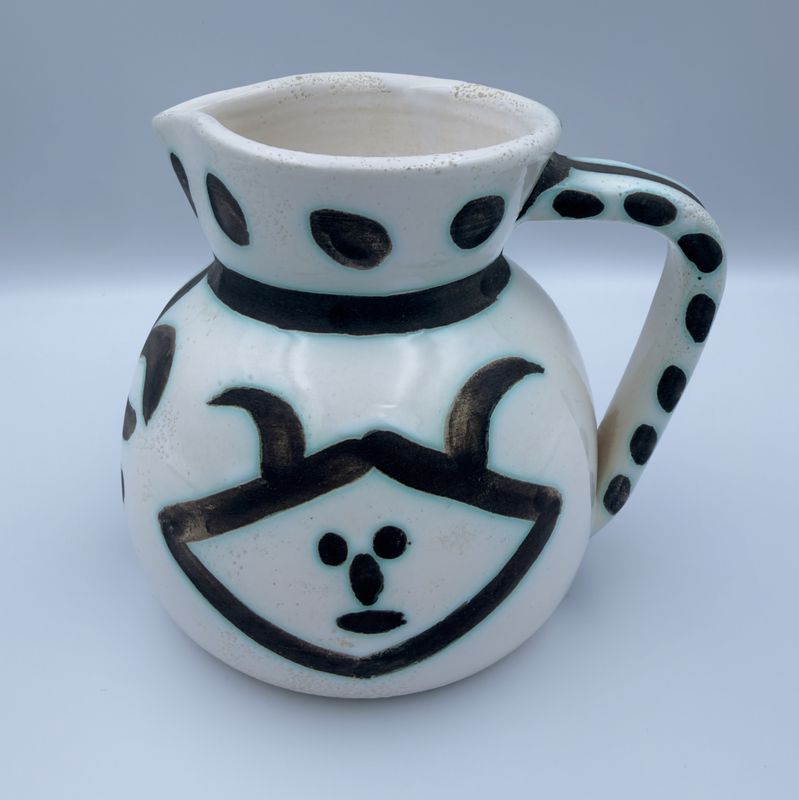
A.R. 367 and A.R. 368, both titled Heads (1956), p. 189. Two different designs: small turned pitchers in black on white, with the same title, the same year, the same technique and an edition of 500 copies each, unnumbered. Their sizes differ by only a centimetre. They are told apart by the decoration, which the catalogue illustrates. This is the clearest case of why a title, or even a title with a date, is not an identification. A.R. 367 is among the most frequently sold designs in our data, with 98 public results.
A.R. 613, Square with female dancer (March 1971), p. 294. One of the fifteen red-earthenware tiles of the original-stamp class, in a numbered edition of 500. The catalogue notes that six plaques (A.R. 616, 617, 621, 625, 629 and 630) combine the same fifteen stamps, arranged differently. The tiles look alike. The stamp's motif identifies which number a tile is.
How the number is used in research
- Identification. Match the decoration first, then the form, dimensions and colours, then the marks and number against the class and edition. A match on all of them identifies the design a piece claims to be. Our guide to identifying a Madoura ceramic walks through these checks.
- Comparables. Auction results are indexed by A.R. number. In our data, 583 of the 633 designs have at least one public result: 516 have three or more, 354 ten or more, and 154 twenty-five or more. The other 50 designs have no public result in our data. About half of these are unnumbered editions of 100 copies or entries recorded only as "few copies". A price for one design says little about another, and a past price does not set the value of a particular piece.
- Edition size and class. These come straight from the entry. Edition size goes with price in public results, but unevenly. Edition class, in our measurement, does not carry a consistent premium either way (see originals, editions and reproductions).
What not to infer from an A.R. number
- That the piece is authentic. A number in a lot description or on a dealer's label is someone's identification of the design. It is not a certificate, and documents do not settle the question either (see which provenance documents matter).
- That a piece not in Ramié is not by Picasso. Unique works fall outside the catalogue.
- That every copy matches the photograph exactly. Replicas were hand-decorated, and glazes and firing vary. The catalogue's own note on size variation is a reminder of this.
- That two numbers with the same title are interchangeable. See A.R. 367 and 368.
Two cautions about our own data. Our page references are to the English edition. We have not compared them with the French edition's pagination. Our counts come from our transcription of the catalogue, which can contain errors, so check the book itself before relying on a single entry.
How these figures were calculated
- Catalogue counts. From the Artemis Collection transcription of the 633 entries of the English edition: class, edition wording, form, dimensions and cross-references.
- Public results. Sold lots of Picasso Madoura ceramics keyed to a Ramié number in the Artemis Collection research database. Aggregator copies of house results are removed (same design, sale within four days, price within 2%), as are "style of", "after" and Italian-production titles, lots under $300 hammer, multi-object lots and exact duplicates. That leaves 9,296 lots of 583 designs sold between May 1986 and October 2026. (Depending on the data snapshot and how strictly multi-object lots are filtered, the pool holds about 9,200–9,900 sold lots; this article uses the run described here.) Unsold lots are largely not captured, so counts are of sales, not of appearances.
- Limits. Counts reflect what has been published online and collected. They undercount early decades and small regional sales.
If you are trying to match a piece to its catalogue number, you are welcome to send photographs of the front, the underside and any marks to Artemis Collection.
Sources
- Alain Ramié, Picasso: Catalogue of the Edited Ceramic Works 1947–1971 (English edition, Madoura, © Galerie Madoura 1988). Preface pp. 9–10; marks pp. 18–19; abbreviations p. 23; entries begin p. 24. Cited by page; not reproduced.
- Georges Bloch, Pablo Picasso: Catalogue of the Printed Ceramics 1949–1971 (vol. III), Kornfeld and Klipstein, Bern, 1972. Cross-referenced in Ramié entries as 'B.' (per Ramié, p. 23).
- Georges Ramié, Ceramics of Picasso, Éditions Cercle d'Art, Paris, 1974. Cross-referenced in Ramié entries as 'R.' (per Ramié, p. 23).
- Christie's press release for The Madoura Collection sale (2012), as reprinted by Artdaily. Accessed 5 November 2026. '633 different plates, bowls, vases and pitchers' between 1947 and 1971; secondary reprint.
- Musée Magnelli, musée de la céramique (Vallauris), press release for the Salle Suzanne et Georges Ramié, 2022. Accessed 5 November 2026. Chronology, including the start of the editions in 1949.
- Public auction records of Picasso Madoura ceramics, 1986–2026. Artemis Collection analysis; method in 'How these figures were calculated'.
Which documents support a Picasso Madoura ceramic's history, what auction houses actually print as provenance, and what papers cannot prove.
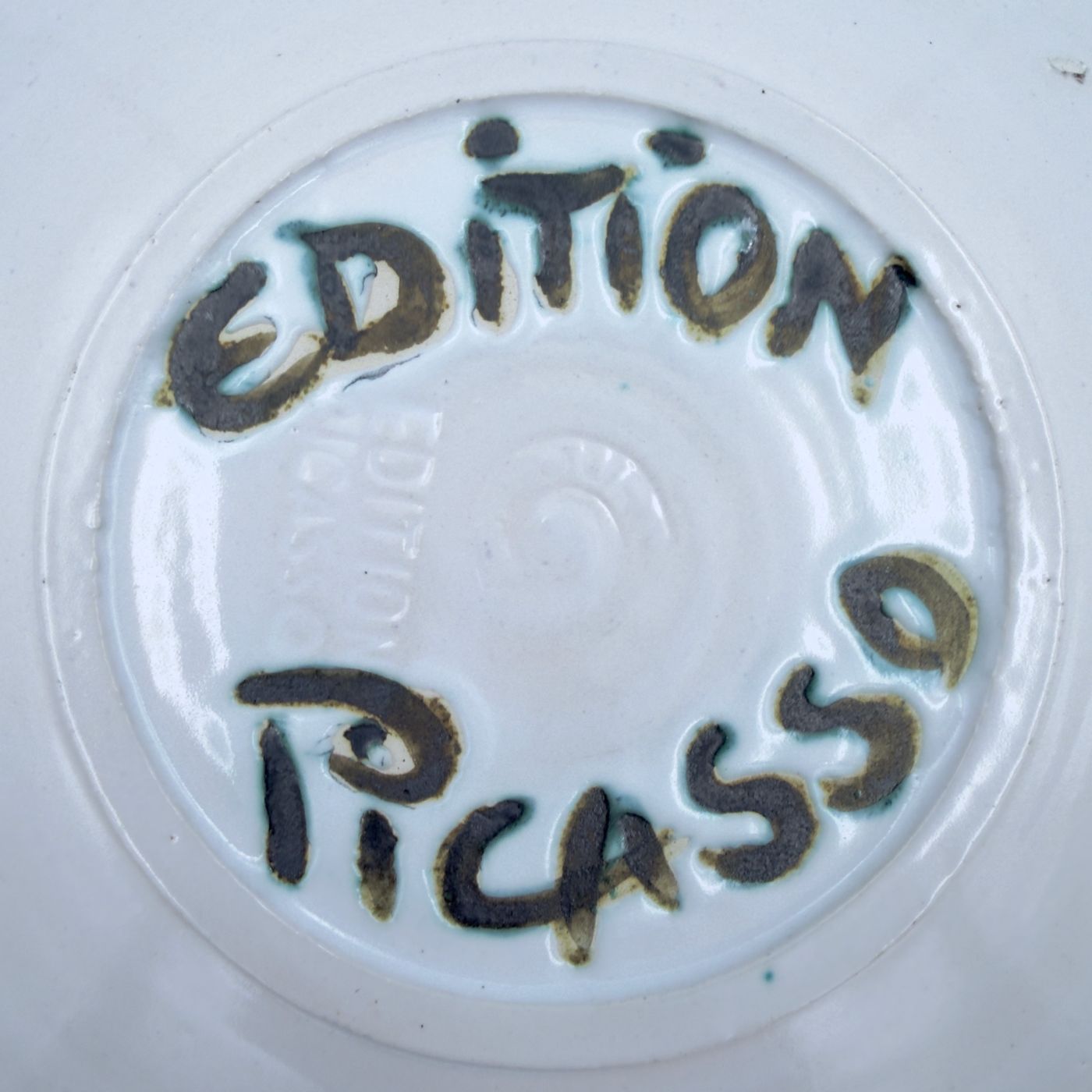
What the stamps on Picasso Madoura ceramics mean: Madoura Plein Feu, Edition Picasso, Empreinte originale, Poinçon original, numbers and codes.
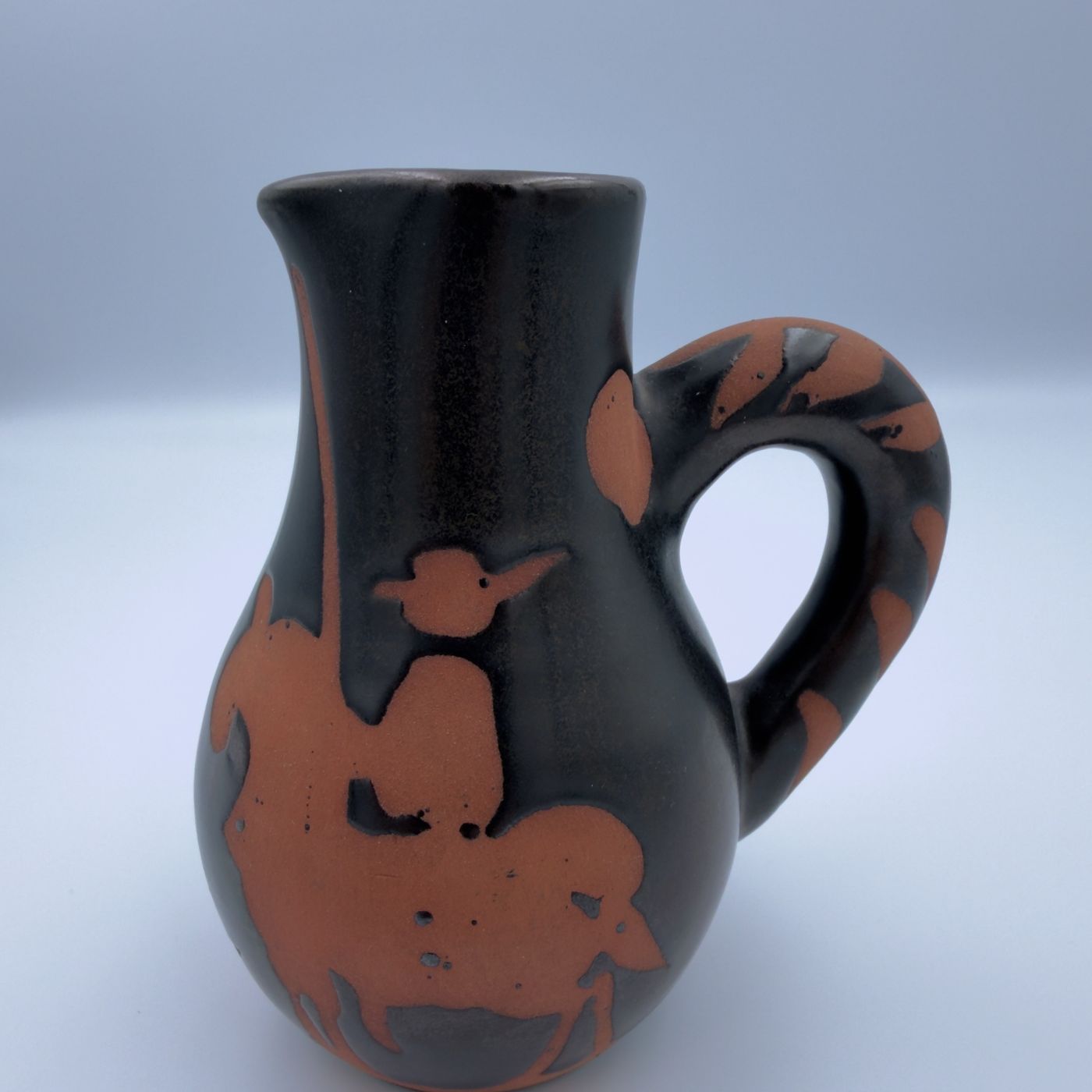
How the Madoura pottery produced Picasso's ceramic editions: the people, the three methods, materials, forms, edition sizes and numbering, with sources.