
How Picasso's Madoura Ceramic Editions Were Produced
How the Madoura pottery produced Picasso's ceramic editions: the people, the three methods, materials, forms, edition sizes and numbering, with sources.
Prepared by Artemis Collection. Figures on the editions are counts from our transcription of the Ramié catalogue; they are not appraisals.
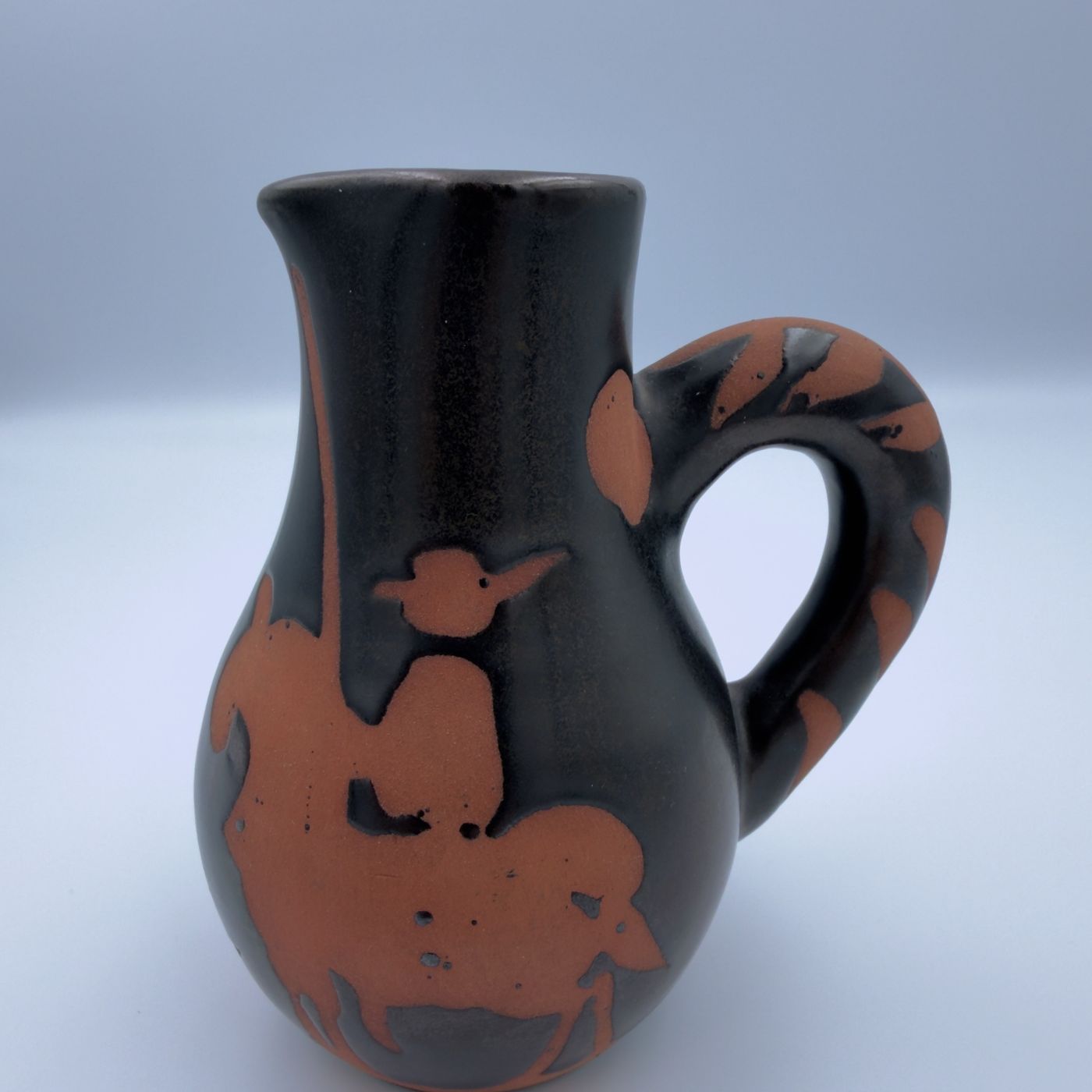
Picasso's ceramic editions were produced by the Madoura pottery in Vallauris, on the French Riviera, which Suzanne and Georges Ramié ran. Picasso made an original, and Madoura then repeated it in a limited, recorded number of copies. The pottery used three methods:
- hand-made replicas of a piece he had made, copied by the pottery's craftsmen;
- clay impressions pressed from plaster matrices engraved with his design;
- in 1971 only, stamps cut by the artist in linoleum and pressed into soft clay.
Alain Ramié's catalogue records 633 such designs, created between 1947 and 1971. Each has a fixed edition size, which for most designs falls between 25 and 500 copies.
The pottery and the people
The Musée Magnelli in Vallauris gives the chronology below. Suzanne Douly began working as a ceramist in Vallauris in 1938, renting a disused factory that became the Madoura workshop. The thrower Jules Agard joined her the same year, and she married Georges Ramié. When Georges joined the workshop in 1940, it took the name Madoura, from MAison, DOUly and RAmié. In the museum's account, Georges handled the commercial side and the firings in the wood kiln.
Picasso's first contact came in July 1946, during Vallauris's annual pottery exhibition. Sources differ on the details:
- Date. Ramié's preface dates the visit to 21 July 1946 (p. 9). The Musée Magnelli gives 26 July.
- Pieces. Ramié says Picasso modelled two pieces. The museum says three.
- How he met the Ramiés. Marilyn McCully, writing for Sotheby's, says Picasso and Françoise Gilot were introduced to the Ramiés at the beach that summer.
We have not resolved these differences. All three sources agree that Picasso returned in 1947 and began working seriously in clay at Madoura.
The museum's chronology continues:
- 1948: an electric kiln was installed (the wood kiln stayed in use until 1953), and the Ramiés bought the workshop.
- 1949: Picasso's ceramic editions began.
- 1961: the Galerie Madoura opened in Cannes.
- 1966: the Galerie Madoura held "Picasso, 20 years of ceramics at Madoura's".
- 1997: production at the Madoura workshop stopped.
- 2008: the Galerie Madoura closed.
In 2012 Alain Ramié, the Ramiés' son and the catalogue's author, sold the Madoura collection at Christie's, saying that "the pottery is closed".
Why editions, and on what terms
Ramié's preface describes the editions as Picasso's response to wanting to "repeat certain of his works". It compares the problem to editioning in printmaking, while noting that clay required different principles (pp. 9–10). McCully describes the arrangement as an agreement: in exchange for the use of the pottery's facilities and materials, Madoura would issue editions based on Picasso's models, sold as Picasso editions. The catalogue reproduces a typed declaration dated at Cannes on 9 December 1967, which Picasso approved and signed. In it he assigned to the Madoura workshops his author's rights in the ceramic editions he had given them, as their exclusive property (p. 21). Ramié writes that the collections were "edited and produced with exclusive rights by Madoura Pottery" (p. 9).
The three methods
Authentic replicas (A.R.)
Ramié defines an authentic replica as a hand-made repetition of an original. It reproduces the original's volumes and decoration "using accurate reference materials and methods" from the making of the first model (p. 23). The catalogue's photographs of a pitcher's production (p. 17) show the sequence:
- The form is thrown on the wheel.
- It is decorated by hand with the original piece beside it.
- It is fired once, then fired a second time to reach its finished state.
McCully quotes a 1953 account of Suzanne Ramié copying Picasso's forms. She also reports Georges Ramié's claim that the copies were so close that Picasso often mistook a replica for his own original.
Replicas carry "Edition Picasso" (impressed or handwritten), the "Madoura Plein Feu" stamp and, on some designs, "d'après Picasso". In our transcription, 274 designs are authentic replicas. They include almost all the pitchers, vases and other turned forms.
Original prints (O.P.)
The second method transferred an original subject engraved on a hardened plaster matrix. A fresh sheet of clay pressed onto the matrix took a positive impression of the engraved motif (p. 23). Ramié's photographs of "techniques of clay impression" (p. 15) show the steps:
- The clay is cut into sheets.
- A sheet is laid over the mould and pressed onto it.
- A thread is placed.
- The print is finished.
- The marks are impressed.
- The piece is taken out of the mould.
The pieces are stamped "Empreinte originale de Picasso". The catalogue's English edition calls them "original prints".
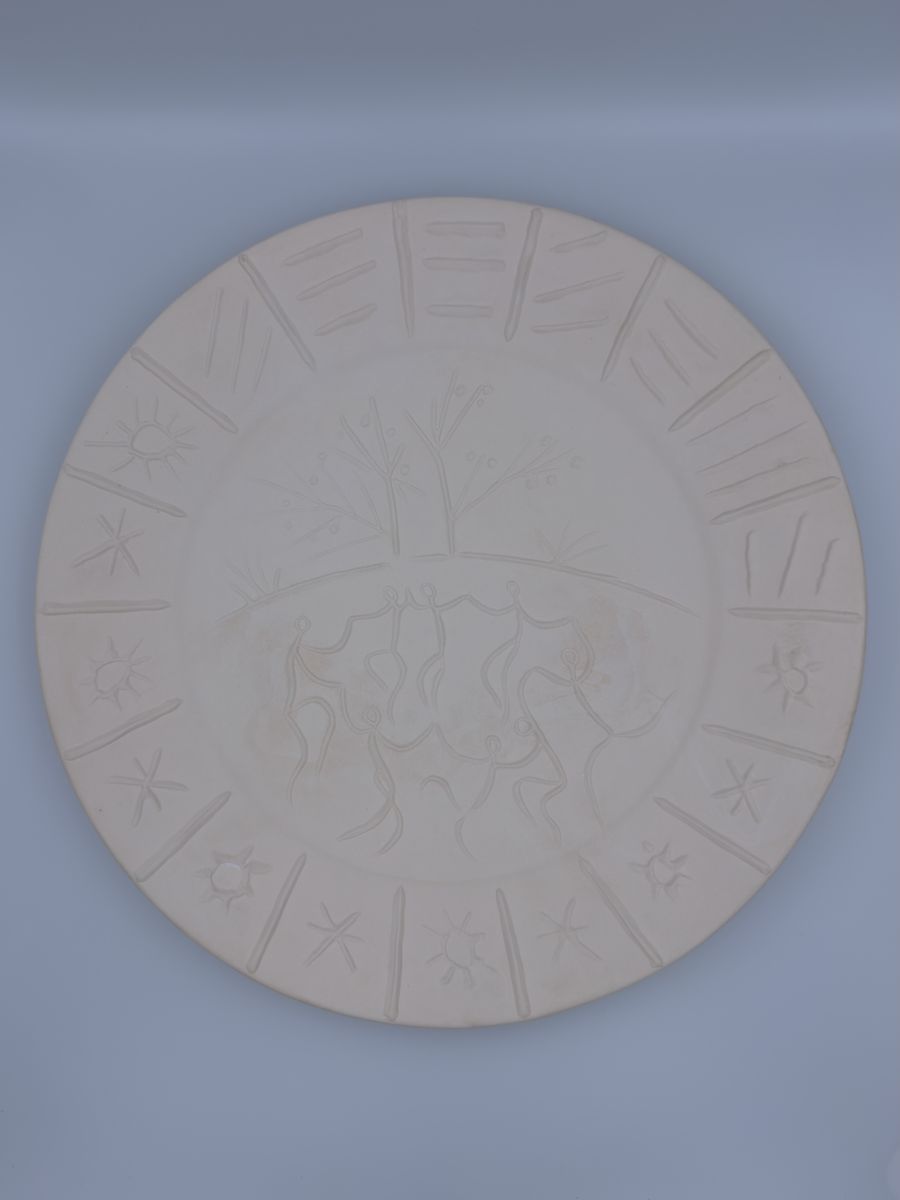
Accounts differ on how the matrix was made. Ramié describes a subject engraved on hardened plaster. McCully describes plaster moulds taken from plates or vases, with prepared clay placed on the mould and incised or built up by Picasso before an impression was taken. She attributes the mould-making to Jean Ramié, Georges Ramié's son. These descriptions may record different stages or designs. We note the difference rather than choose between them. The impressions could be left plain or decorated with colours. In our transcription, 338 designs are original prints, almost all of them plates, dishes and plaques.
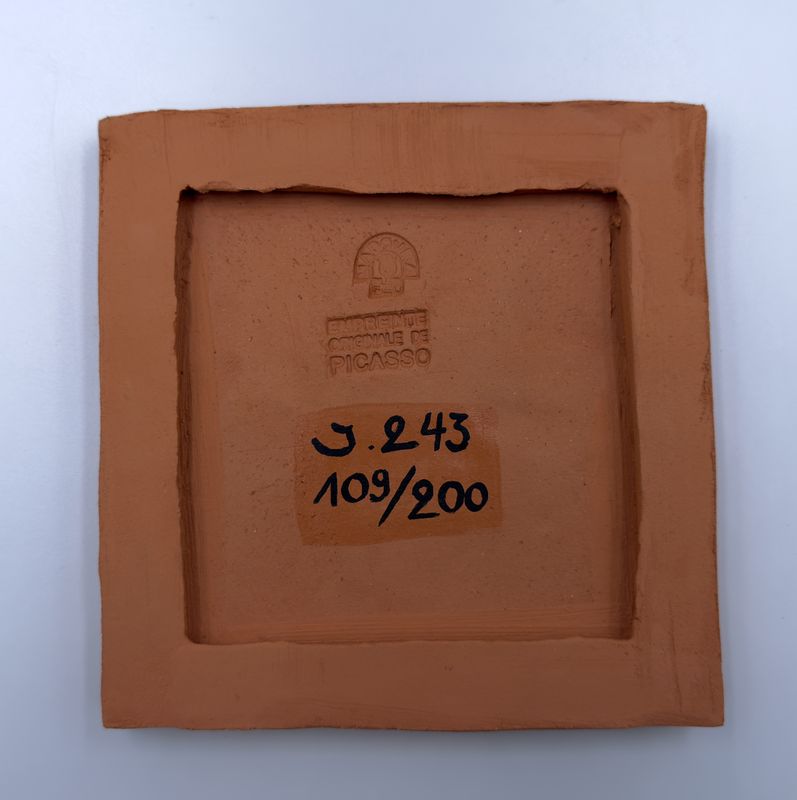
Original stamps (O.S.)
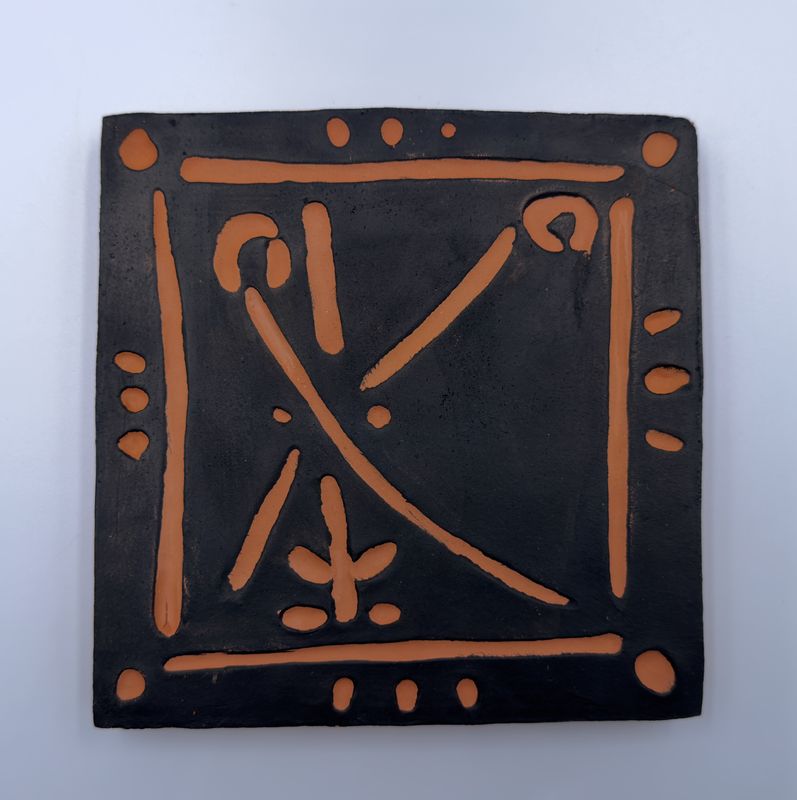
The third class, dated March 1971, consists of 21 red-earthenware tiles and plaques. Each was made by pressing into soft clay a linoleum block that Picasso had engraved (p. 23). They are stamped "Poinçon original de Picasso". Fifteen are single-stamp tiles. The catalogue notes that six plaques combine the same fifteen stamps, arranged differently (p. 294).
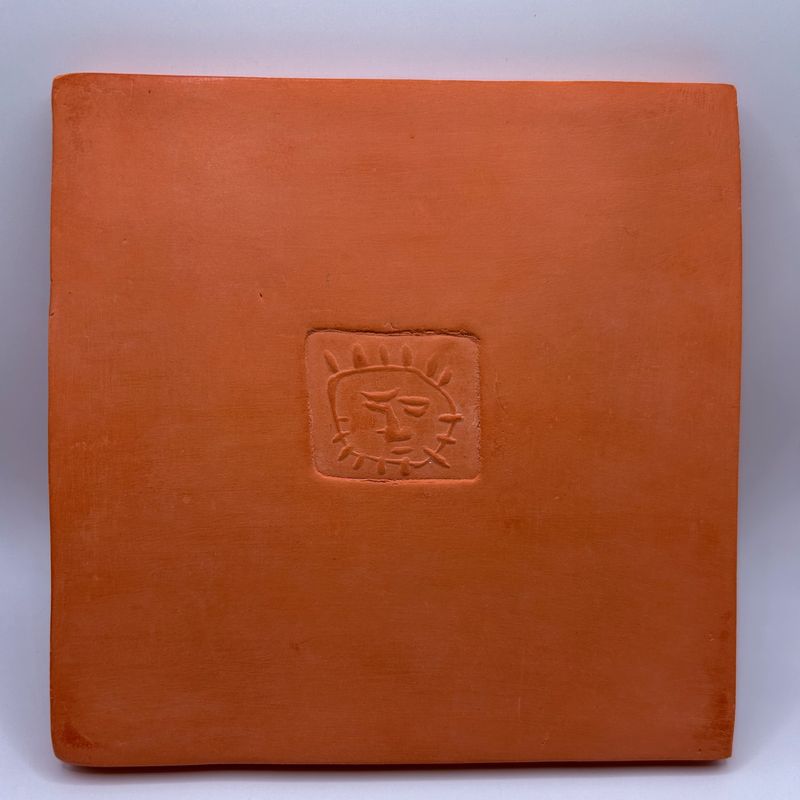
Materials and decoration
The catalogue's glossary (p. 23) explains the terms its entries use:
- Engobe: fine clay, coloured or not, used for decoration.
- Oxides: ceramic colours based on metals such as copper, cobalt, iron and manganese.
- Patina: a very diluted engobe.
- Oxidized paraffin: liquefied paraffin mixed with oxides.
- Glaze: transparent enamel. Also defined are stanniferous (tin) enamel and potter's lead.
- Chamotted clay: unfired clay mixed with fired and crushed clay.
- Boring rod: a tool for incising clay.
Our transcription of the entries' technique lines gives the following counts:
| Feature named in the technique line | A.R. designs (274) | O.P. designs (338) | All (633) |
|---|---|---|---|
| White earthenware clay | 243 | 215 | 458 |
| Red earthenware clay | 25 | 123 | 169 |
| Engobe decoration | 225 | 170 | 395 |
| Oxides | 81 | 46 | 127 |
| Paraffin (plain or oxidized) | 28 | 48 | 76 |
| Knife engraving | 99 | 8 | 107 |
| Patina | 41 | 45 | 86 |
| "Printed with engobe pad" | 0 | 29 | 29 |
All 21 original-stamp designs are in red earthenware. Knife engraving is overwhelmingly a feature of the replicas, while the original prints rely on the relief of the impression itself. The catalogue also warns that sizes vary between copies because clays shrink by different amounts in firing (p. 23).
Forms
The catalogue names the form of each design. Grouped into families, the 633 designs are:
| Form family | Designs |
|---|---|
| Dishes (round, oval, rectangular and others) | 170 |
| Plates | 145 |
| Plaques and medallions | 111 |
| Cupels, cups and bowls | 62 |
| Pitchers | 57 |
| Vases | 54 |
| Tiles | 19 |
| Ash-trays | 6 |
| Other (clay sculptures, turned pieces, a tureen) | 8 |
One further entry has no form recorded in our transcription.
Edition sizes and numbering
Edition sizes. The catalogue records each edition's size. The commonest sizes in our transcription are:
| Copies | 25 | 40 | 50 | 100 | 150 | 200 | 250 | 300 | 400 | 450 | 500 | Other or "few" |
|---|---|---|---|---|---|---|---|---|---|---|---|---|
| Designs | 21 | 6 | 40 | 256 | 40 | 74 | 14 | 52 | 10 | 13 | 75 | 32 |
The "other or few" column includes 13 designs recorded only as "few copies produced", one recorded as a single numbered copy (A.R. 158), smaller groups of 35, 60, 75, 125, 175 and 350 copies, and one entry with no size in our transcription. The catalogue adds that "there are three publisher's copies for each piece" (p. 23) but does not say how they were marked; some auction descriptions transcribe "Exemplaire éditeur" (publisher's copy) among the marks.
Numbering. Not every edition was numbered. The catalogue distinguishes "N numbered copies produced" from "N copies produced", and the proportion of numbered editions rose steadily over the period:
| Design dated | Designs | A.R. | O.P. | O.S. | Numbered editions |
|---|---|---|---|---|---|
| 1947–1949 | 94 | 82 | 12 | 0 | 13 (14%) |
| 1950–1954 | 159 | 79 | 80 | 0 | 61 (38%) |
| 1955–1959 | 188 | 48 | 140 | 0 | 122 (65%) |
| 1960–1964 | 82 | 48 | 34 | 0 | 82 (100%) |
| 1965–1971 | 110 | 17 | 72 | 21 | 109 (99%) |
Auction descriptions confirm the distinction. In 2,771 Christie's and Phillips lots, an edition number ("x/y") was recorded on 94.5% of lots of designs the catalogue lists as numbered, and on 0.7% of lots of designs it lists as unnumbered (method in our stamps and marks guide). An unnumbered piece from an early design is therefore normal.
The dates in the catalogue are the dates Picasso created each design, not the dates individual copies were made. The Musée Magnelli dates the start of the editions to 1949 (the Vallauris tourist office says the early 1950s), so edition copies of designs dated 1947–48 were presumably made later. The catalogue does not record when individual copies were produced.
What this means when you look at a piece
- Construction should match the class. A turned pitcher is a replica-class form. A plate with the design in relief from a mould is typical of an original print. A small red tile with a stamped motif belongs to the 1971 original stamps.
- Hand decoration varies. Replicas were painted by hand from the original, so small differences in brushwork and glaze between copies are expected and documented.
- Marks belong to the method. The class stamps described above, numbering where the catalogue says the edition was numbered, and the pottery stamp make a coherent set. A set that does not hang together calls for closer study. A set that does is still not proof that the piece is genuine.
Open questions
- The 1946 visit. The day (21 or 26 July) and the number of pieces modelled (two or three).
- The matrices. How the plaster matrices for the original prints were made, and by whom, in each period.
- Later copies. When the last copies of each edition were made. Ramié's 1988 preface describes the collections as "in constant evolution" for forty years, which implies that some editions were still in production after 1971, but it does not say which.
- Publisher's copies. Whether "Exemplaire éditeur" was the standard marking for the three publisher's copies of each design.
- Codes. What the handwritten letter-and-number codes on some bases record (see the marks guide).
For the categories and terms that arise from these methods, see originals, editions and reproductions. For how the catalogue is organised, see Alain Ramié catalogue numbers.
How these figures were calculated
All counts of designs, classes, clays, techniques, forms, sizes and numbering come from the Artemis Collection transcription of the 633 entries in the English edition of Ramié's catalogue. Form families group the catalogue's form names. Technique features are matched on the words of each entry's technique line. Periods use the year in each entry's date. The transcription may contain errors, and the page references let readers check the book itself.
If you would like help reading the construction and marks of a particular piece, you are welcome to send photographs to Artemis Collection.
Sources
- Alain Ramié, Picasso: Catalogue of the Edited Ceramic Works 1947–1971 (English edition, Madoura, © Galerie Madoura 1988). Preface pp. 9–10; techniques of clay impression p. 15; turning and decoration p. 17; marks pp. 18–19; Picasso's declaration of 9 December 1967 p. 21; definitions p. 23. Cited by page; not reproduced.
- Musée Magnelli, musée de la céramique (Vallauris), press release and chronology for the Salle Suzanne et Georges Ramié, 2022. Accessed 23 January 2026.
- Marilyn McCully, 'Picasso and the Ramiés in the Valley of Gold', Sotheby's, 29 March 2019. Accessed 23 January 2026.
- Vallauris Golfe-Juan Tourist Office, 'Madoura, place of art, history and creation'. Accessed 23 January 2026.
- Christie's press release for The Madoura Collection sale (2012), as reprinted by Artdaily. Accessed 23 January 2026. Secondary reprint.
Which documents support a Picasso Madoura ceramic's history, what auction houses actually print as provenance, and what papers cannot prove.
What an A.R. (Alain Ramié) number is, how to read a catalogue entry, and how to use the number to research a Picasso Madoura ceramic.
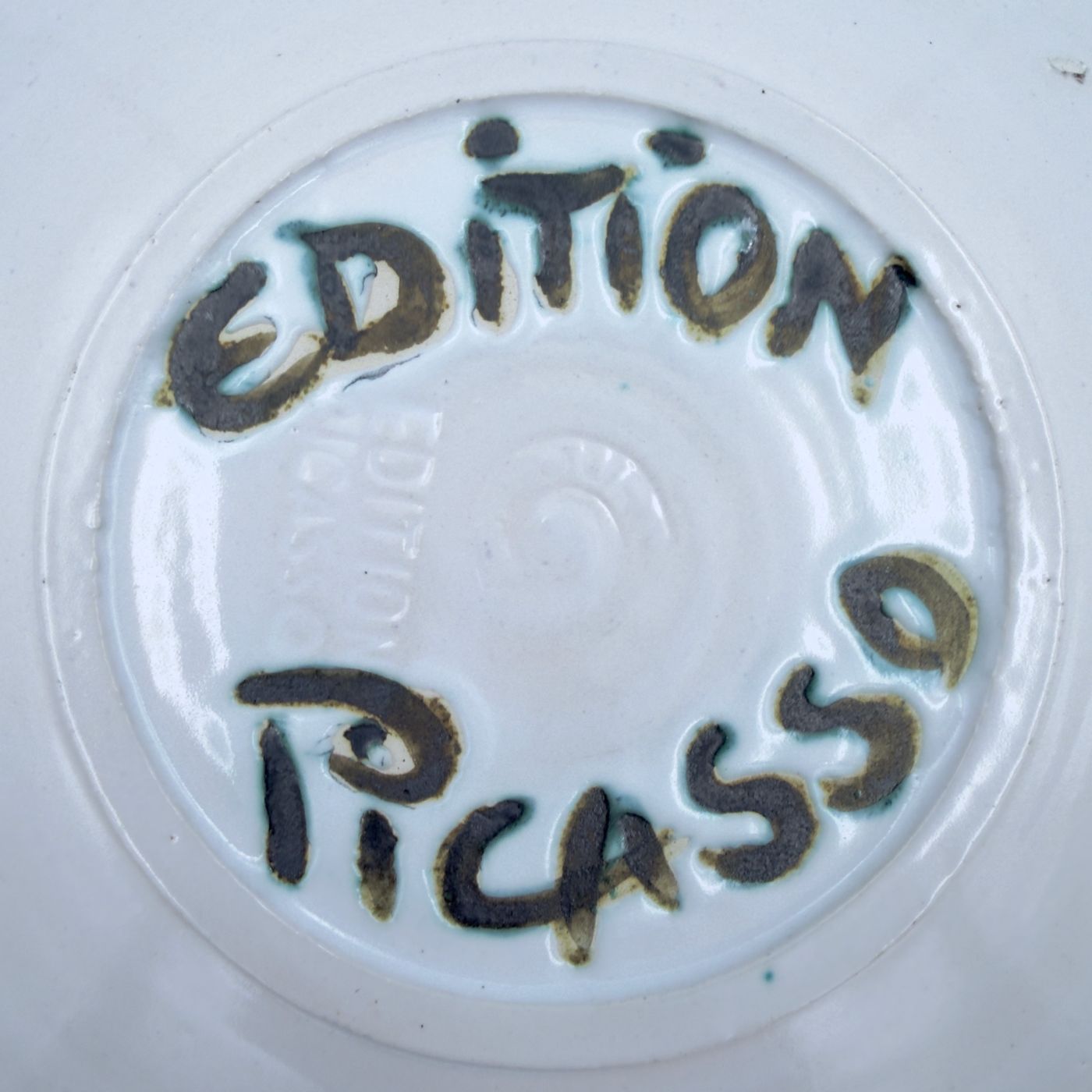
What the stamps on Picasso Madoura ceramics mean: Madoura Plein Feu, Edition Picasso, Empreinte originale, Poinçon original, numbers and codes.