

How to Choose the Right Comparable Sales When Valuing a Picasso Ceramic
Which past auction results predict a Madoura ceramic's price best? We tested nine ways of choosing comparables on 5,000+ public sales.
Prepared by Artemis Collection. Market figures are drawn from public auction records as described in the methodology note; they are not appraisals.
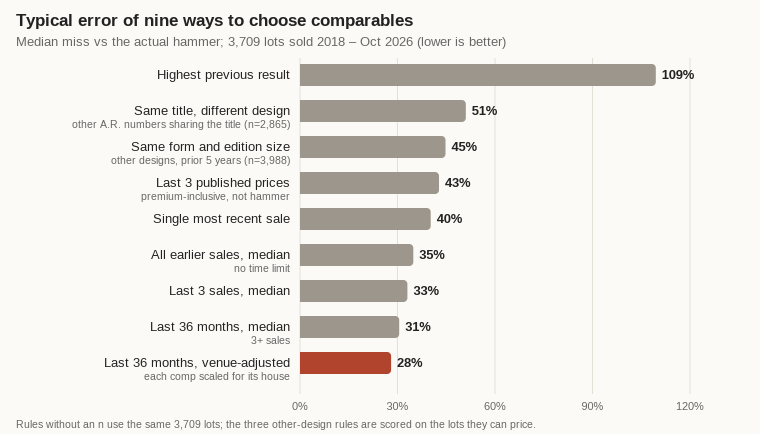
The best comparables for a Picasso Madoura ceramic are several recent hammer prices for the same Ramié design, each read with the auction house that achieved it in mind. In a test on more than 5,000 public sales between 2018 and 2026, the median of a design's sales over the previous three years, adjusted for the house each sale came from, was the most reliable of nine common ways of choosing comparables. It still missed the eventual hammer price by about 28% on a typical lot. The worst habits were the ones that feel most natural: quoting the highest result ever achieved, which on a typical lot was about twice what the piece actually made, and borrowing results from a different design that happens to share the title.
No choice of comparables turns a past price into the value of your piece. What a good choice does is give you an honest range, and tell you how wide it is.
The test
For every public sale of a Madoura ceramic from January 2018 to October 2026 (5,310 lots of 572 designs), we predicted the hammer price (the winning bid, before the buyer's premium) using only results published before that sale, under nine rules. Then we measured how far each prediction was from what actually happened. The comparison below uses the 3,709 lots that every same-design rule could price, so the rules are scored on identical ground.
| Rule | Typical miss | Within 25% | Within a factor of 1.5 | Tendency |
|---|---|---|---|---|
| Highest earlier result for the design | 109% | 15% | 23% | Lot made about half of it |
| Other designs sharing the title | 51% | 32% | 50% | None |
| Other designs of the same form and edition size | 45% | 36% | 54% | None |
| Last 3 published prices (premium-inclusive) | 43% | 39% | 57% | 25% too high |
| Single most recent sale of the design | 40% | 41% | 57% | None |
| Median of all earlier sales | 35% | 44% | 63% | 15% too low |
| Median of the last 3 sales | 33% | 47% | 66% | None |
| Median of the last 36 months (3+ sales) | 31% | 49% | 68% | None |
| The same, adjusted for each sale's house | 28% | 52% | 72% | None |
"Typical miss" is the median distance between prediction and hammer, in either direction. "Tendency" notes a systematic lean where there is one.
The rest of this article turns those results into a working method.
1. Match the Ramié number, not the title or the shape
Picasso reused titles freely. In our transcription of Ramié's catalogue, 101 titles are shared by two or more designs, covering 409 of the 633 designs. Twenty different designs are titled simply Face; nineteen are Goat's head in profile; thirteen are Picador. Their prices have little to do with one another. Among the Face designs with at least five public sales since 2015:
| Design titled "Face" | Form, edition | Sales since 2015 | Median hammer |
|---|---|---|---|
| A.R. 243 | Oval medallion, 500 numbered | 29 | $1,730 |
| A.R. 290 | Turned round cupel, 500 | 67 | $3,450 |
| A.R. 534 | Round plate, 100 numbered | 5 | $5,500 |
| A.R. 611 | Turned pitcher, 500 numbered | 32 | $7,210 |
| A.R. 288 | Turned pitcher, 500 | 69 | $10,010 |
| A.R. 448 | Round dish, 100 numbered | 7 | $15,860 |
| A.R. 446 | Round dish, 100 numbered | 9 | $19,000 |
Using other designs that share the title missed the hammer by about half on a typical lot, the worst rule after "highest result". Matching the shape instead does little better: other designs of the same form and edition size missed by about 45%. A comparable is only a comparable if it carries the same A.R. number. Our guide to Ramié catalogue numbers explains how to find it, with the classic case of the two pitchers both titled Têtes (A.R. 367 and 368).
Watch for variants. Some lots are catalogued as a variant of a design ("variante", or "see A. R." in a Sotheby's title). A variant can sell very differently from the standard design; we show an example where a lot catalogued as a variant, and carrying a different stamp, made 1.8 times its neighbour in the same sale in the same Picasso ceramic, two different prices. Treat variants as a separate, thinner record.
2. Compare hammer with hammer
Auction houses publish results including the buyer's premium; estimates, reserves and the seller's commission are based on the hammer. Mixing the two is the commonest arithmetic error we see. Using the last three published prices as if they were hammer prices predicted about 25% too high on a typical lot (the hammer came in about 20% below the prediction), and its error was 43% against 33% for the same three sales converted to hammer. The premium has also changed over time (Christie's, for example, charged 25% from late 2007, 26% from February 2022, 27% from September 2025 and 28% from September 2026), so convert each result at the rate in force on its date. Our article on the real cost of selling at auction walks through the conversion.
3. Use several sales, and recent ones
- One sale is one draw. The single most recent result missed by about 40%. Its age mattered once it was more than five years old: a last sale under two years before missed by about 37–40%, one five to ten years old by 52%, and one more than ten years old by 101% (only 26 cases).
- Three is a meaningful improvement on one. The median of the last three sales missed by 33%, the last five by 31%.
- A time window beats an ever-growing list. The median of every earlier sale, with no time limit, ran about 15% below the eventual price, because older results reflect older price levels. A 36-month window removed that lean (31% miss). A 24-month window performed almost identically where it had enough sales.
How many sales are enough? With three or more in the last three years, the median is a reasonable centre. With fewer, read our separate article on valuing a design with few recent sales.
4. Allow for the house
The same design sells at different levels at different houses. When the single most recent sale came from the same house as the lot being predicted, it missed by 32%; when it came from a different house, by 44%. Using the last three sales at the same house missed by about 30%, though only about half of lots have three earlier same-house sales of their design.
The better general fix is to adjust each comparable for its house before taking the median. We scaled each result by its house's typical level over the previous five years, relative to all houses, and then rescaled to the house where the piece would sell. That gave the best result in the test: a 28% typical miss, within 25% of the hammer on just over half of lots and within a factor of 1.5 on almost three in four (72%). The house levels themselves are discussed in what is my Picasso ceramic worth (Christie's has run at about 1.3 times other houses combined for the same designs since 2015). An adjustment of this kind describes where prices have been, not what a given house will achieve for a given piece.
5. Do not anchor on the record
The highest result a design has ever achieved is the number owners find first and remember longest. It is the worst predictor in the test by a wide margin: the typical lot sold for about half of its design's highest earlier result, and only one lot in eight came within 25% of it. A record usually combines an exceptional example, a strong sale and two determined bidders. It describes the top of the range, not its middle.
A worked example: A.R. 162, Picador pitcher
Suppose an owner of a Picador pitcher (A.R. 162, red earthenware with black glaze, 500 copies) wanted a guide at the start of 2026. In our records the design sold publicly 15 times in the previous three years (January 2023 – December 2025), at ten houses.
- The median hammer of the 15 was about $3,790. That is the centre of the evidence.
- The highest of the 15 was about two and a half times that median, and the lowest about 0.6 times. Quoting either end would mislead.
- The single most recent sale, in Paris in December 2025, was about $2,800 at hammer: a real result, and on its own a misleading guide.
- The last three sales had a median of about $2,800, the last five about $4,730, some 70% higher. How many results you include changes the answer that much; a defined time window is better than an arbitrary count.
- By house: the two Christie's results were £3,200 hammer (London, September 2023, lot 30: published £4,032) and £3,500 (London, May 2025, lot 67: published £4,410), each against an estimate of £1,500–2,000. Four Sotheby's results had a median of about $4,640, and single results at Rago, Piasa and LAMA ran from about $3,800 to $5,500. Results at Phillips, Artcurial and three regional rooms sat between about $2,200 and $3,000.
A reasonable reading is that the design's recent public record clusters around $3,000–4,700 at hammer, with the higher end achieved at the major houses' dedicated sales, and that an individual piece's place in that range would depend on its condition and the quality of its decoration. That is a range for discussion, not a valuation.
A checklist
- Confirm the A.R. number; ignore results for other designs with the same title.
- Note any variant, and keep variants separate.
- Convert every result to hammer, using the premium in force on its date.
- Use all sales of the design in the last three years; if there are fewer than three, see valuing a design with few sales.
- Group them by house, and compare like with like.
- Note the highest and lowest, but centre on the median.
- Read each lot description for condition, restoration and decoration before deciding where your piece sits.
- Remember what is missing: lots that failed to sell are rarely published.
Our guide to whether auction estimates predict selling prices shows how to use a house's estimate alongside these comparables; in our test, combining the two was more reliable than either alone.
If you would like us to assemble the comparable record for your piece, Artemis Collection can review photographs and documentation and give an informal opinion of value. It is not a formal appraisal.
How these figures were calculated
- Dataset. Public auction results for Picasso Madoura ceramics carrying an A.R. (Ramié) number, compiled by Artemis Collection from auction houses' published results and result aggregators (queried read-only on 7 November 2026). Superseded duplicates and lots identified as sold by Artemis Collection are excluded. Aggregator copies of house records, "style of", "after" and multi-object lots, lots under $300 hammer and likely mis-catalogued lots (more than four times, or under a fifth of, the design's other sales) are removed: 9,209 sold lots of 583 designs, 1986–2026.
- Hammer. Derived from published premium-inclusive prices using each house's dated buyer's-premium schedule; reported directly by Rago and LiveAuctioneers. US dollars at the exchange rate of the sale (recomputed on 7 November 2026 for sterling and euro sales), not adjusted for inflation.
- Backtest. Targets: every lot sold 1 January 2018 – 29 October 2026 (5,310 lots, 572 designs). Each rule used only sales dated before the target's sale date. Same-design rules are compared on the 3,709 targets that all of them could price (at least five earlier sales and three in the previous 36 months). "Typical miss" = median absolute log error, expressed as a percentage; "within 25%" = hammer between 0.75 and 1.25 times the prediction; "within a factor of 1.5" = between two-thirds and 1.5 times; "tendency" = median ratio of hammer to prediction where it differs from 1 by more than 10%.
- Rule definitions. Venue adjustment: each house's median ratio of hammer to its design's median, over the five years before the target year (houses with at least 30 such lots; others treated as 1.0); comparables are divided by their house's factor and the median multiplied by the target house's factor. Same title: other A.R. numbers with an identical English title in Ramié, sales in the previous five years, median of design medians (2,865 targets). Same form and edition size: other designs with Ramié's form and an edition-size band (25–50, 51–100, 101–150, 151–200, 201–300, 301–450, 451–500 copies), previous five years, at least three designs (3,988 targets).
- Shared titles. Counted on our transcription of the 633 entries in Ramié's English edition; titles compared exactly, ignoring case.
- Worked example. All public sales of A.R. 162 in our records dated 1 January 2023 – 31 December 2025 (15 lots). The two Christie's results were checked on the house's lot pages; hammer is the published price ÷ 1.26, the premium in force at those dates.
- Limits. Sold lots only. The test measures prediction of public auction hammer prices; it does not measure private-sale prices or net proceeds. Figures describe the past and are not a valuation of any object.
Sources
- Public auction records of Picasso Madoura ceramics, 1986–2026, compiled by Artemis Collection. Results published by the auction houses named in the text; see 'How these figures were calculated'.
- Christie's, Picasso Ceramics Online (London), Picador (A.R. 162), lot 30, closed 26 September 2023. Estimate £1,500–2,000; price realised £4,032. Accessed 7 November 2026.
- Christie's, Picasso Ceramics (London), Picador (A.R. 162), lot 67, closed 22 May 2025. Estimate £1,500–2,000; price realised £4,410. Accessed 7 November 2026.
- Ramié, Alain. Picasso: Catalogue of the Edited Ceramic Works 1947–1971. Vallauris: Galerie Madoura, 1988. Titles, forms and edition sizes; 101 titles are shared by two or more of the 633 designs (our transcription).
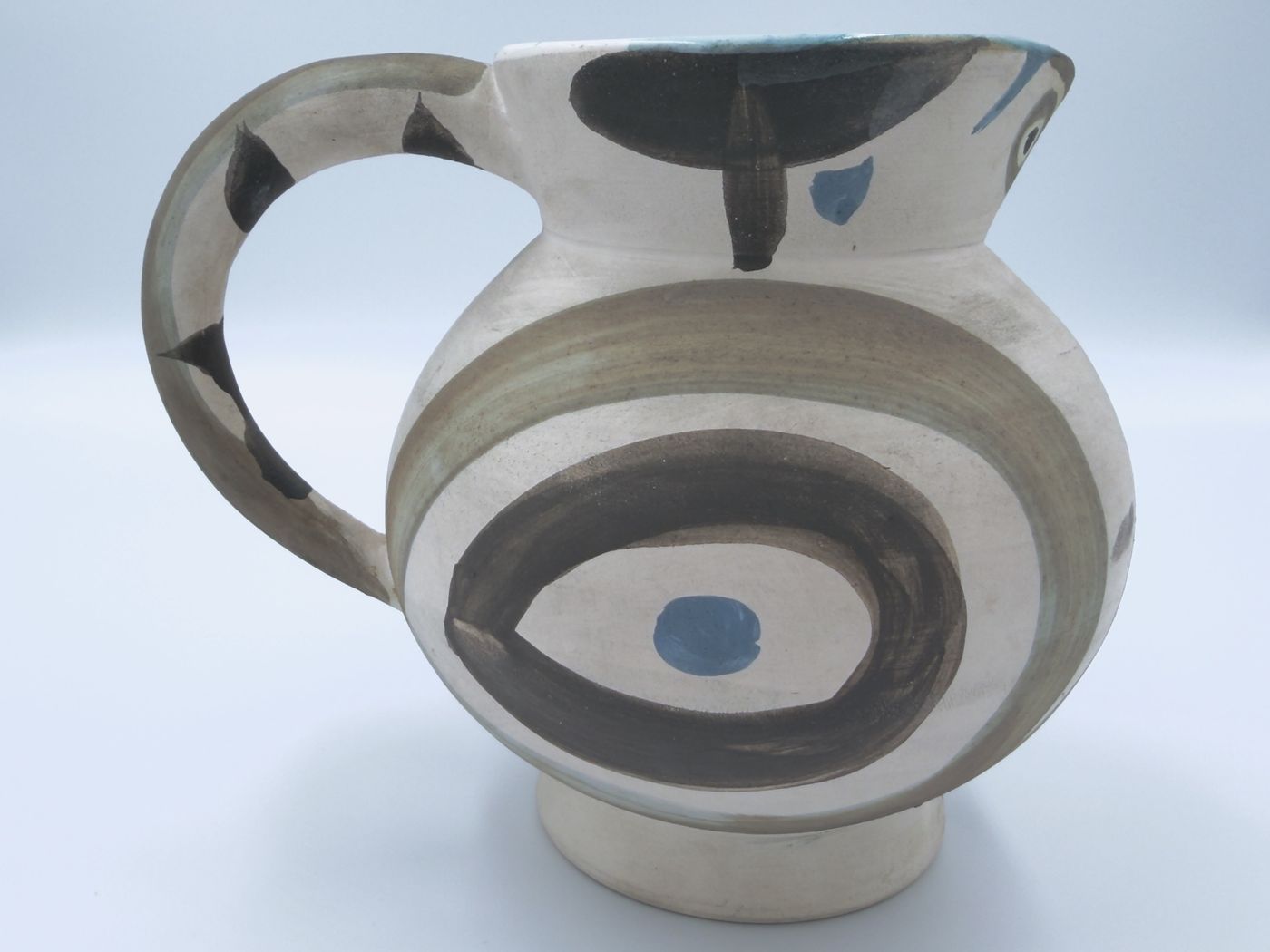
A practical checklist for photographing and documenting a Picasso Madoura ceramic: the views, marks, measurements, condition and papers a specialist needs.

Size is the strongest catalogue predictor of Madoura prices: what extra centimetres add within each form, and where size stops adding value.
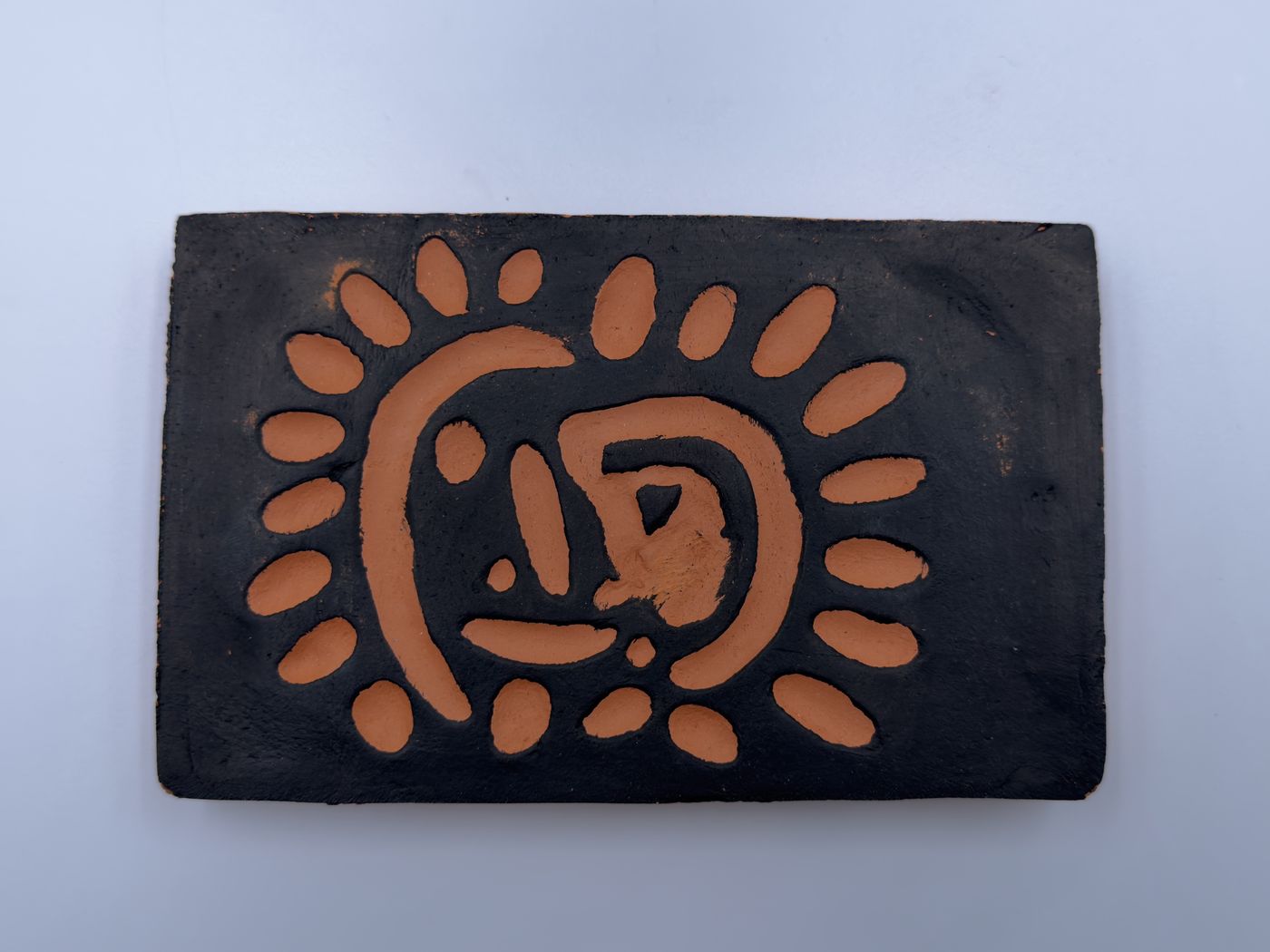
How chips, cracks, firing flaws and restoration affect Picasso Madoura ceramics, how auction houses describe condition, and what public results show.