

How Do You Value a Rare Picasso Ceramic When There Are Few Recent Sales?
Four in ten Madoura designs have sold publicly twice or less in five years. How to value one: sister designs, older sales, estimates, and what to avoid.
Prepared by Artemis Collection. Market figures are drawn from public auction records as described in the methodology note; they are not appraisals.
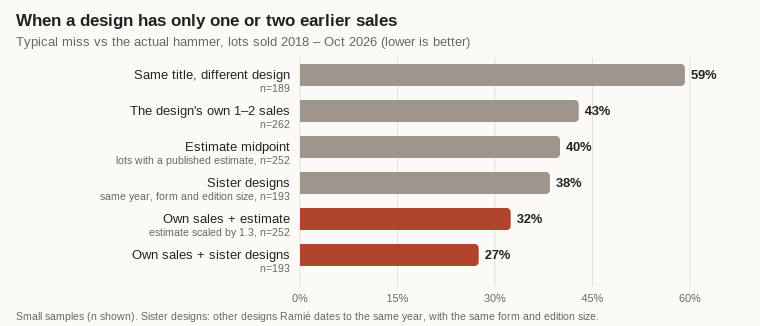
When a Madoura design has few public sales, value it by widening the evidence in a fixed order, not by reaching for the nearest number. Start with the design's own sales, however few and however old, converted to hammer and adjusted for when and where they happened. Then add its sister designs: the other pieces Picasso made at the same time, in the same form and edition size, often for the same service or series. Then weigh the auction house's estimate. Combine them, and accept a wider range than you would for a well-traded design.
In our tests on public results, when a design had only one or two earlier sales, those sales on their own missed the eventual hammer price by about 43% on a typical lot. Combined with sister designs, the miss fell to about 27%; combined with the house's estimate, to about 32%. Two shortcuts did worst: results for other designs that share the title, and broad averages for "Picasso plates" or "Picasso ceramics".
How common is a thin record?
More common than owners expect. Of the 633 designs in Ramié's catalogue of the edition ceramics:
| Public sales of the design in our records | All time | Last 10 years | Last 5 years |
|---|---|---|---|
| None | 50 | 59 | 121 |
| 1–2 | 95 | 127 | 154 |
| 3–5 | 92 | 114 | 168 |
| 6–9 | 85 | 124 | 92 |
| 10 or more | 311 | 209 | 98 |
In the last five years, 275 designs, about four in ten, have sold publicly twice or not at all. The thinly traded designs are not a random sample. Most are plaques, dishes and cupels rather than pitchers and vases, and they are disproportionately the editions Ramié records simply as "N copies produced" or "few copies produced" rather than as numbered: about three in five of the designs with two or fewer sales ever, against one in three of the rest. A few copies may never have reached the market at all, or may sell privately.
Our article on Ramié catalogue numbers explains how to confirm which design you have; that step matters even more when there are few results to compare.
How much a thin record can be trusted
We ran two tests. In the first, we took designs with plenty of sales and pretended they had few: for each sale since 2018, we predicted its hammer price from a random handful of the design's sales in the previous ten years, and repeated the draw many times.
| Earlier sales used | Typical miss | Within 25% of the hammer | Middle 80% of outcomes (hammer ÷ prediction) |
|---|---|---|---|
| 1 | 47% | 35% | 0.54 – 2.45 |
| 2 | 40% | 40% | 0.57 – 2.09 |
| 3 | 39% | 40% | 0.61 – 2.18 |
| 5 | 36% | 43% | 0.64 – 2.09 |
| 10 | 33% | 45% | 0.67 – 2.03 |
With a single earlier sale, the actual result for the next example ranged, in the middle 80% of cases, from about half to nearly two and a half times that sale. Each extra sale narrows the range, with the biggest gain from the first to the second.
In the second test we looked at real thin designs: the 262 lots sold from 2018 onward whose design had only one or two earlier public sales. One earlier sale missed by about 51% on a typical lot; two by about 36%. That is the starting point that the methods below try to improve on.
Step 1: the design's own sales, converted and dated
Use every public sale of the design you can find, at hammer (premium-inclusive results converted at the premium in force on the day), and note the house and the date of each.
Older sales need adjusting for the market at the time. We built a price index for Madoura ceramics that allows for which designs happened to sell in each year. In nominal US dollars, results in 2005 were about half their 2015 level, and 2010 about 58% of it; since 2015 the index has moved between about 0.91 and 1.30 of the 2015 level, with no sustained trend. Unadjusted, results whose sale dates averaged more than ten years before the lot being valued under-predicted its price by about a quarter on a typical lot; adjusted by the index, that lean disappeared and the typical miss fell from 53% to 41%. For sales from the last few years the adjustment makes little difference.
The house matters too. In our wider test, a single earlier sale from the same house missed by about a quarter less than one from a different house (32% against 44%) (see choosing comparable sales). With a thin record you rarely have the choice, but you should know which kind of result you are looking at.
Step 2: sister designs
Picasso often worked in series. Ramié catalogues services of plates and bowls made in the same year to a common form, and groups of plaques and dishes made within days of one another. We defined a design's sister designs as the other designs that Ramié dates to the same year, in the same form and the same edition size.
On their own, sister designs predicted a lot's hammer price with a typical miss of about 35–42%, whether the design had no earlier sales or many. Where a design had only one or two sales of its own, combining its own sales with the median of its sisters (an even geometric average) cut the typical miss to about 27% (193 lots), and brought about half within 25% of the hammer.
Sister designs work because they share most of what drives price: the same period of Picasso's work, the same form and size, the same technique, the same number of copies, often the same decorative idea. They are not interchangeable, and some series contain a stand-out design, so read the individual results as well as the median.
Do not substitute a design that merely shares the title. In the same tests, other designs with the same title missed by 53–61%, worse than using the design's own single sale. Twenty designs are titled Face; their prices differ more than tenfold. Broader groupings fare little better: other designs of the same form and edition size, regardless of year, missed by about 36–47%. And an average for Picasso ceramics as a whole, or for "Picasso plates", is no guide to a particular design at all: individual designs' median prices run from under $2,000 to over $100,000 (see what is my Picasso ceramic worth). When there are no comparable sales for the work or a close sister, there is no reliable price, only a wide range.
Step 3: the estimate, read with care
A specialist proposing an estimate has usually seen the object, and may know the house's own records, including lots that did not sell, and the sister designs. For thin designs, the estimate midpoint on its own missed by about 40%, partly because houses set estimates low: hammer prices for these lots ran at a median of about 1.4 times the mid-estimate. Scaled up to allow for that habit and combined with the design's own sales, the estimate brought the typical miss to about 32% (252 lots).
An estimate for a rarely seen design can also be anchored on an old result. The case study below shows an estimate that sat below hammer prices achieved five years earlier. Our article on whether auction estimates predict selling prices shows how to read an estimate against the design's record.
A case study: the 1947 "Fish" service
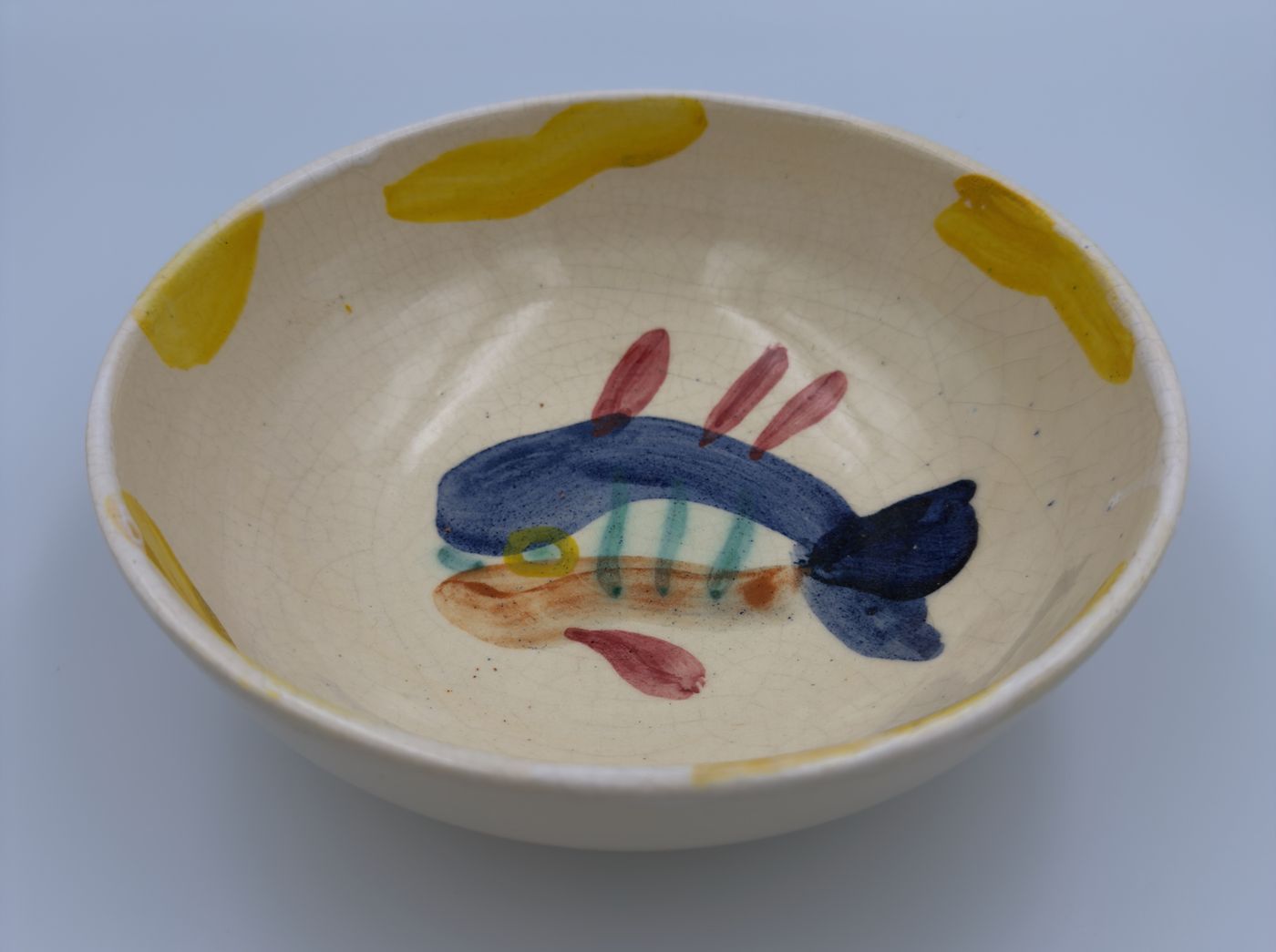
Ramié catalogues the "Fish" service of 1947 as 26 entries, A.R. 3 to A.R. 28: a large dish, twelve bowls lettered A to L, twelve plates lettered M to X, and a tureen, each recorded as "300 copies produced" (not numbered). Christie's descriptions record a letter and a number painted under each piece, for example "Madoura Plein Feu / G / 39 / Edition Picasso" on a bowl (A.R. 10).
Each individual design is thinly traded. No bowl or plate in the service has more than three single-piece public results in our records. Taken together, though, the sisters give a usable record:
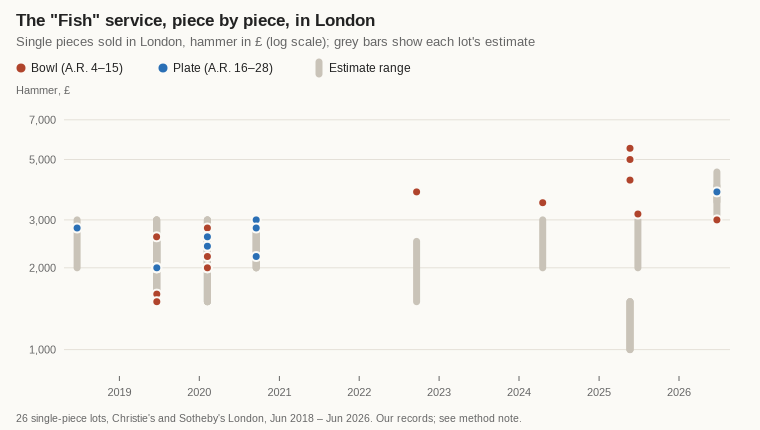
- 2019–2020: a consistent level. In Christie's London online sales between June 2019 and September 2020, seventeen single bowls and plates sold for between £1,500 and £3,000 at hammer, plates generally a little above bowls. For example, bowl D (A.R. 7) made £2,000 with premium (£1,600 hammer) in June 2019; plate N (A.R. 17) £2,500 (£2,000) the same week; bowl G (A.R. 10) £2,500 (£2,000) and bowl H (A.R. 11) £3,500 (£2,800) in February 2020. That matched the complete service sold in New York in May 2019 (A.R. 4–28, 25 pieces): $62,500 with premium, a $50,000 hammer, about $2,000 a piece.
- May 2025: a jump the estimates did not anticipate. Three bowls offered in Christie's London, each estimated at £1,000–1,500, made £6,930, £5,292 and £6,300 with premium: hammer prices of £5,500 (A.R. 10), £4,200 (A.R. 15) and £5,000 (A.R. 4), using Christie's A.R. numbers. (The painted letters its descriptions record for these three pieces, I, A and H, do not follow the letters of the 2019–2020 examples: A.R. 10 was marked G in February 2020. The painted letter is a workshop mark, not a design identifier, and the identification here rests on Christie's A.R. numbers.) The estimates were below the hammer prices that sister bowls had made five years earlier.
- June 2026: not a new floor. A bowl F (A.R. 9) estimated at £3,000–4,000 made £3,810 with premium, a £3,000 hammer.
What the case shows:
- The sisters are the evidence. Someone valuing A.R. 10 from its own record alone would have had two results, five years apart (£2,000 at hammer in February 2020, £5,500 in May 2025) and a factor of nearly three apart. The twelve bowls and twelve plates together showed a clear level in 2019–2020, and that both bowls and plates traded in a fairly narrow band.
- Old results can understate. The 2019–2020 level was a poor guide to May 2025. A thin record ages quickly, and the index adjustment above would not have captured a jump specific to one service.
- One strong sale is not a new level either. The May 2025 results were followed by a more modest one. Three results in one sale share the room's conditions; they count as one draw of the sale effect, not three.
- A complete set is a different object. The 2019 complete service made about $2,000 a piece at hammer, in line with single pieces that year. Whether a set or single pieces will do better depends on the sale and the buyers; neither should be assumed.
A procedure for a rarely sold design
- Confirm the design, its form, technique and edition size from Ramié. Check whether it belongs to a service or series.
- Collect every public sale of the design, at hammer, with house and date. Adjust older results for the market of their time, or at least read them in that light.
- Collect the sister designs' recent results (same year, form and edition size; same service or series where there is one), and take their median.
- Combine the design's own evidence with the sisters'. If there are no own sales, the sisters are the main guide.
- Ask for, and read, the estimate, allowing for the house's habit of estimating low or high.
- State a range, not a point, and widen it in proportion to how thin the evidence is. With one or two own sales, a range from roughly two-thirds to one and a half times the central figure covers only about two outcomes in three.
- Ignore same-title designs and category averages.
Owners of rarely seen designs are often best served by a sale route that can find the few interested buyers: a specialist sale where comparable pieces are offered, or a private approach. Our article on auction versus private sale discusses the trade-off.
If you own a design that rarely appears at auction, Artemis Collection can review photographs and documentation, assemble the public record for the design and its sisters, and give an informal opinion of value. It is not a formal appraisal.
How these figures were calculated
- Dataset. Public auction results for Picasso Madoura ceramics carrying an A.R. (Ramié) number, compiled by Artemis Collection from auction houses' published results and result aggregators (queried read-only on 6 November 2026). Superseded duplicates and lots identified as sold by Artemis Collection are excluded; aggregator copies of house records, "style of", "after" and multi-object lots, lots under $300 hammer and likely mis-catalogued lots (more than four times, or under a fifth of, the design's other sales) are removed: 9,209 sold lots of 583 designs, May 1986 – October 2026. Multi-object lots (such as complete services) are excluded from all statistics; the 2019 complete service is cited only as a case.
- Record counts. Sales per design counted on the cleaned pool, to 29 October 2026; "last 5 years" from November 2021, "last 10 years" from November 2016. Edition wording from our transcription of Ramié (English edition).
- Hammer. Derived from published premium-inclusive prices using each house's dated buyer's-premium schedule; for the Christie's lots cited, 25% (2019–2020), 26% (May 2025) and 27% (June 2026). US dollars at the exchange rate of the sale (recomputed on 6 November 2026 for sterling and euro sales); the index is nominal.
- Simulation. For each lot sold 2018 – October 2026 whose design had at least ten sales in the previous ten years, a prediction from the median of k randomly drawn earlier sales of the design (k = 1, 2, 3, 5, 10), five draws per lot and k (16,740 predictions per k).
- Thin-record tests. Lots sold 2018 – October 2026 whose design had one or two earlier public sales (262 lots). Sister designs: other A.R. numbers with the same Ramié year, form and edition size, sales in the previous five years, median of design medians (193 lots with sisters available). Estimate: the lot's published mid-estimate (252 lots), multiplied by 1.3 (the typical hammer-to-mid-estimate ratio since 2015) when combined. Combinations are geometric means. "Typical miss" = median absolute log error, as a percentage.
- Index. Annual effects from a regression of log hammer on year with design fixed effects, sales from 2000 onward; for the adjustment test, the index was re-estimated using only sales before each target's year, and older results were scaled to the last complete year.
- Fish service. Single-piece lots of A.R. 4–28 sold at Christie's and Sotheby's in London, June 2018 – June 2026 (26 lots; the tureen and the large dish excluded). Results cited individually were checked on Christie's lot pages.
- Limits. Sold lots only; small samples in the thin-record tests (n given); Ramié's year, form and edition size are a proxy for a series, not a definition of one. These figures describe past public results and are not a valuation of any object.
Sources
- Public auction records of Picasso Madoura ceramics, 1986–2026, compiled by Artemis Collection. Results published by the auction houses named in the text; see 'How these figures were calculated'.
- Ramié, Alain. Picasso: Catalogue of the Edited Ceramic Works 1947–1971. Vallauris: Galerie Madoura, 1988. A.R. 3–28, the 'Fish' service (1947): dish, twelve bowls, twelve plates and a tureen, 300 copies each.
- Christie's, Picasso Ceramics (New York), Service poisson (A.R. 4-28), lot 35, closed 15 May 2019. Complete service. Estimate $35,000–55,000; price realised $62,500. Accessed 6 November 2026.
- Christie's, Picasso Ceramics Online (London), Service poisson (A.R. 7), lot 55, closed 21 June 2019. Estimate £1,500–2,500; price realised £2,000. Accessed 6 November 2026.
- Christie's, Picasso Ceramics Online (London), Service poisson (A.R. 17), lot 31, closed 20 June 2019. Estimate £2,000–3,000; price realised £2,500. Accessed 6 November 2026.
- Christie's, Picasso Ceramics Online (London), Service poisson (A.R. 10), lot 52, closed 7 February 2020. Estimate £1,500–2,500; price realised £2,500. Accessed 6 November 2026.
- Christie's, Picasso Ceramics Online (London), Service poisson (A.R. 11), lot 11, closed 7 February 2020. Estimate £1,500–2,500; price realised £3,500. Accessed 6 November 2026.
- Christie's, Picasso Ceramics (London), Service poisson (A.R. 10), lot 5, closed 22 May 2025. Estimate £1,000–1,500; price realised £6,930. Accessed 6 November 2026.
- Christie's, Picasso Ceramics (London), Service poisson (A.R. 15), lot 6, closed 22 May 2025. Estimate £1,000–1,500; price realised £5,292. Accessed 6 November 2026.
- Christie's, Picasso Ceramics (London), Service poisson (A.R. 4), lot 7, closed 22 May 2025. Estimate £1,000–1,500; price realised £6,300. Accessed 6 November 2026.
- Christie's, Picasso Ceramics (London), Service poisson (A.R. 9), lot 585, closed 23 June 2026. Estimate £3,000–4,000; price realised £3,810. Accessed 6 November 2026.
A practical checklist for photographing and documenting a Picasso Madoura ceramic: the views, marks, measurements, condition and papers a specialist needs.
Which past auction results predict a Madoura ceramic's price best? We tested nine ways of choosing comparables on 5,000+ public sales.

Size is the strongest catalogue predictor of Madoura prices: what extra centimetres add within each form, and where size stops adding value.