

Does Edition Size Affect the Value of Picasso Prints?
Edition size and price across 1,886 Picasso print sales: small editions, proofs and low numbers compared like for like, with images issued twice.
Prepared by Artemis Collection. Market figures are drawn from public auction records as described in the methodology note; they are not appraisals.
Less than most owners expect, and not in the direction people usually assume. Among the editions Picasso most often issued, the size of the edition made no measurable difference: editions of 30 or fewer sold, like for like, at about the same price as the standard edition of 50. Above about 60 impressions it does matter. Holding the signature, period, technique and image size equal, prints from editions of 61 to 120 sold at roughly 0.7 times the price of comparable prints from editions of 31 to 60, editions of 121 to 300 at about 0.56 times and editions of more than 300 at under 0.3 times. The largest gaps come from images issued twice, in a small signed edition and a large edition with a printed signature, where edition size and signature change together. A proof, a low impression number or a small edition does not, on this evidence, earn a premium of its own.
What "edition size" means on a Picasso print
The figure after the slash (for example 12/50) is the size of the numbered edition. It is rarely the whole story.
- Proofs sit outside the numbered edition. Artist's proofs (A.P., épreuve d'artiste) and the bon à tirer, the impression approved as the standard for the printer, are additional to it.1 Picasso's later editions of 50 are often described with 15 to 20 artist's proofs besides.
- Some editions came on two papers. The Vollard Suite, published in 1939, was printed in 50 impressions on large paper and 260 on smaller sheets;2 the 1913 edition of the Saltimbanques is catalogued as 250 on Van Gelder paper with a further 27 or 29 on Japan paper.
- One image can exist in several editions. Some lithographs were issued in a small signed and numbered edition and in a large edition for a book, a periodical or a cause, with the signature printed in the stone.
- States are not editions. Picasso often reworked a plate or stone; a catalogue raisonné may record an edition of only one state, or editions of several.3
California's statute on fine prints asks a dealer to state the maximum number of signed or numbered impressions, the number of unsigned or unnumbered impressions, the number of proofs outside the regular edition and the total size of the edition.4 That is the right list of questions to ask about any Picasso print.
The editions in the record
We read 1,886 sold, single-sheet original Picasso prints whose catalogue entry states an edition size (from 2,293 lots that cite a Bloch, Geiser/Baer or Mourlot number; method below).
| Stated edition size | Lots | Typical examples |
|---|---|---|
| 30 or fewer | 43 | early or rare editions, special papers |
| 31 to 60 | 1,333 | the editions of 50 published by the Galerie Louise Leiris; most lithographs of 1945–1960 |
| 61 to 120 | 79 | editions of 75 and 100 |
| 121 to 300 | 375 | the Vollard Suite (260), the Saltimbanques (250), linocut and lithograph editions of 150–200 |
| More than 300 | 56 | lithographs printed in 1,000 or more for books, periodicals and benefit editions |
An edition of 50 accounts for 1,304 of these lots, 69% of the total. For most owners, "how big was the edition?" has the answer "about the same as nearly every other Picasso print".
Simple averages, and what happens when you hold other things equal
Median hammer prices since 2015 by edition size are not in the order a collector might expect: editions of 30 or fewer, $13,700 (24 lots); 31 to 60, $8,000 (763); 61 to 120, $6,800 (36); 121 to 300, $8,000 (192); more than 300, $2,900 (20). These numbers mix very different prints. The editions of 121 to 300 are dominated by the Vollard Suite, whose plates of the 1930s are in demand; the large editions are mostly lithographs with printed signatures.
To separate edition size from these other differences, we compared prints with the same signature status, period of creation, technique, colour, image size, proof status and sale period, in a single regression across all the lots.
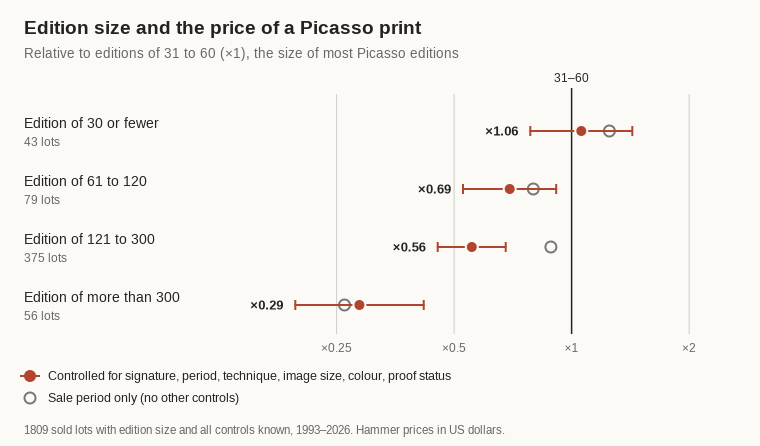
| Edition size | Lots | Sale period only | Controlled (95% interval) |
|---|---|---|---|
| 30 or fewer | 43 | 1.25 | 1.06 (0.78–1.43) |
| 31 to 60 | 1,333 | 1 (reference) | 1 (reference) |
| 61 to 120 | 79 | 0.80 | 0.69 (0.53–0.91) |
| 121 to 300 | 375 | 0.89 | 0.56 (0.45–0.68) |
| More than 300 | 56 | 0.26 | 0.29 (0.20–0.42) |
Two things stand out. First, a small edition carries no reliable premium: the controlled estimate for editions of 30 or fewer is 1.06 with an interval from 0.78 to 1.43. Second, the discount for editions of 121 to 300 only appears once period is held equal, because those editions are concentrated in Picasso's most sought-after decades. The result is not driven by the Vollard Suite: leaving out the Vollard Suite and the Saltimbanques gives 0.43, and using only works made after 1945 gives 0.40.
The model explains under half of the variation in price (R² 0.43). Which image it is matters more than any of these characteristics.
The same image in two editions
The clearest evidence comes from images that sold from editions of different sizes. Three lithographs of 1957–1960 were issued in a signed and numbered edition of 200 and in an edition of 1,000 with the signature printed in the stone (Christie's describes the 1,000 of Le Vieux Roi as published for the benefit of the Nice newspaper Le Patriote).
| Work | Signed and numbered edition of 200 | Edition of 1,000, printed signature | Ratio of medians |
|---|---|---|---|
| Le Vieux Roi (Bloch 869, Mourlot 317) | median $5,300 (4 lots, 2010–2012) | median $1,800 (14 lots, 2003–2026) | 2.9 |
| La Danse des faunes (Bloch 830, Mourlot 291) | median $9,500 (3 lots, 2006–2024) | median $1,300 (7 lots, 2003–2026) | 7.3 |
| L'Écuyère (Bloch 999, Mourlot 333) | median $6,500 (3 lots, 2010–2014) | median $1,800 (5 lots, 2003–2024) | 3.6 |
Hammer prices, converted to US dollars at the sale date. Ranges within each group are wide: the 1,000 edition of Le Vieux Roi sold for between about $800 and $5,700.
These are large differences, but they combine edition size with the pencil signature (see Do signed Picasso prints sell for more?). Across all 44 works that sold from two editions of clearly different size, the smaller edition's median price was 1.27 times the larger's, and higher in 59% of works. Where both editions had the same signature status (28 works), the ratio was 1.10, and the smaller edition sold higher in only 54% of works, close to a coin toss. Where the signature also differed (16 works), it was 1.65.
Proofs and low numbers
Two common beliefs about edition numbers did not hold in this record.
- Artist's proofs. Across 167 works with both a pencil-signed proof and a pencil-signed numbered impression, the proof's median price was 0.97 times the numbered impression's, and lower in 55% of works. The same pattern holds across artists in Phillips sales, as described in our guide to selling prints and limited-edition multiples. A proof is part of the same printing, not a superior one.
- Low impression numbers. Within editions of 31 to 60, impressions numbered in the first third (1/50 to 16/50) sold for a median 0.95 times impressions numbered in the last third of the same work (67 works), and higher in only 42% of works. The number records the order of signing or numbering, not necessarily the order of printing.
What edition size does not tell you
Edition size describes how many sheets were authorised, not the condition, margins, paper or impression quality of yours, and not whether the image is one collectors want. A good impression of a sought-after image from an edition of 260 can sell for more than a tired impression of a minor image from an edition of 50. Use the edition size to make sure you are comparing like with like (same work, same edition, same signature), not as a shortcut to a value.
How these figures were calculated
- Source: public auction records for Pablo Picasso prints in the Artemis Collection research database, queried read-only on 8 November 2026 (catalogue descriptions from thirteen auction houses, led by Galerie Kornfeld, Christie's, Phillips, Ketterer Kunst, Grisebach and Sotheby's). Sold lots from November 1993 to October 2026. Lots identified as sold by Artemis Collection itself, and duplicate records of the same lot, are excluded.
- Which lots: single-sheet original prints whose description cites a Bloch, Geiser/Baer or Mourlot number; reproductions, posters, "after Picasso" prints, books, portfolios and multi-sheet lots excluded. Edition size is the numbered edition stated in the description (the denominator of "12/50", or "from the edition of 250"); proofs are assigned the size of the edition they sit outside. The Vollard Suite small-paper edition, catalogued variously as 250 or 260 (or about 300 with other papers), is treated as one edition.
- Controlled comparison: a regression of log hammer price on edition-size band, signature class, proof or numbered impression, technique family, period of creation, image size band, colour and sale period, with intervals clustered by work (1,809 lots with every field known). "Sale period only" is the same regression with edition band and sale period alone.
- Same image, two editions: works (same Bloch number) sold from two stated edition sizes where the larger is at least twice the smaller; we compared median prices of the smallest and largest edition.
- Prices: hammer price in US dollars, derived from the published premium-inclusive price using the buyer's premium schedule in force at each house on the sale date, at the sale-date exchange rate; not adjusted for inflation.
- Classification: read from each house's wording by keyword rules, checked by hand on 100 random lots. Edition statements were missing or ambiguous for about 18% of lots, which are left out of the edition comparisons.
- Limits: sold lots only; condition, paper and impression quality not controlled; small groups for the smallest and largest editions. Past results do not establish the value of any other print.
-
Tate, Art Terms, "Edition": artist's proofs marked "AP"; bon à tirer proofs "provide a standard to guide the printer". Accessed 8 November 2026. ↩
-
Cleveland Museum of Art, "Vollard Suite: Minotaur Caressing a Sleeping Woman" (2000.20), edition "50 on large paper, 260 on small". Accessed 8 November 2026. ↩
-
Georges Bloch, Pablo Picasso: catalogue de l'œuvre gravé et lithographié, 4 vols (Bern: Kornfeld et Klipstein, 1968–1979); Fernand Mourlot, Picasso lithographe, 4 vols (Monte Carlo: André Sauret, 1949–1964). Library of Congress and Bibliothèque nationale de France catalogue records, 8 November 2026. ↩
-
California Civil Code §1744(a)(10), read via california.public.law on 8 November 2026. ↩
Sources
- California Civil Code §1744 (sale of fine prints and multiples), via california.public.law. Disclosure of signed, stamped or estate-stamped names, posthumous status and edition composition. Accessed 8 November 2026.
- Tate, Art Terms: Edition. Artist's proofs and bon à tirer. Accessed 8 November 2026.
- Cleveland Museum of Art, Vollard Suite: Minotaur Caressing a Sleeping Woman (2000.20). 100 prints of 1930–36 published by Vollard in 1939; edition 50 on large paper, 260 on small. Accessed 8 November 2026.
- Library of Congress catalogue: Georges Bloch, Pablo Picasso, catalogue de l'œuvre gravé et lithographié (Kornfeld et Klipstein, 1968–1979). Four volumes; volume III the ceramics, volume IV 1970–1972. Record read 8 November 2026.
- Bibliothèque nationale de France catalogue: Fernand Mourlot, Picasso lithographe (André Sauret, 1949–1964). Four volumes covering 1919–1963. Record read 8 November 2026.
Auction prices for 2,182 original Picasso prints by technique, before and after allowing for period, edition, signature, size and colour.
Selling a print or multiple: original or reproduction, what signatures, numbers and proof marks mean, catalogue references, condition and where to sell.
Same-work comparisons of 2,293 Picasso print sales: how pencil-signed, unsigned, stamp-signed and plate-signed impressions compare at auction.