

Do Signed Picasso Prints Sell for More? What Comparable Sales Show
Same-work comparisons of 2,293 Picasso print sales: how pencil-signed, unsigned, stamp-signed and plate-signed impressions compare at auction.
Prepared by Artemis Collection. Market figures are drawn from public auction records as described in the methodology note; they are not appraisals.
Yes, on the evidence of public auction results, and by a wide margin. Where the same catalogued Picasso print has sold both with and without the artist's pencil signature, the impressions without it fetched roughly half as much: about 0.44 times the price of pencil-signed impressions of the same work once the year of sale is taken into account, and less in four out of five works compared. A posthumous stamped signature and a signature printed in the image were also worth clearly less than a pencil signature. Two cautions matter as much as the headline. On a Picasso print the signature often marks a different printing, edition or proof, so it rarely changes on its own. And comparing all signed with all unsigned lots exaggerates the gap for some kinds of signature, because they sit on different groups of works.
Four kinds of "signed" on a Picasso print
Auction catalogues use "signed" for several different things. Read the exact words.
| Wording in a catalogue | What it means | Who put the name there |
|---|---|---|
| "signed in pencil" (or crayon, ink), "signiert", "signé au crayon" | Picasso signed the sheet by hand after printing | Picasso |
| "signed in the plate", "signed in the stone", "with the printed signature", "im Stein signiert" | the signature was drawn on the matrix and prints with the image, on every impression | Picasso, but printed, not autograph |
| "with the stamped signature", "stamp-signed", "Signaturstempel" | a stamped facsimile of the signature, usually applied to editions published after his death in 1973 | the publisher or estate |
| "Collection Marina Picasso" or "Maya Ruiz-Picasso" inkstamp on the reverse | a collector's or estate mark showing the sheet came from Picasso's estate; it is not a signature | the heir3 |
Unsigned impressions are also normal for some editions. Plates published in illustrated books and proofs taken for the printer were usually never meant to carry a pencil signature, and the Saltimbanques plates of 1904–1905, printed by Louis Fort and published by Ambroise Vollard in 1913, are almost always catalogued without one.4
California's law on fine prints draws the same lines: a seller must say whether a multiple was signed by the artist, and if not, whether the name was placed on the matrix, stamped or estate-stamped, and whether the impression is posthumous.2 The Print Council of America notes that signing and numbering impressions became, from the late nineteenth century, one of the ways of establishing a market value for prints.1
How often each kind appears in the record
We read the catalogue entries of 2,293 sold, single-sheet original Picasso prints that cite a catalogue raisonné number (Bloch, Geiser/Baer or Mourlot), sold at thirteen auction houses between 1993 and October 2026 (method below).
| Signature as catalogued | Share of lots |
|---|---|
| Signed by hand (pencil, crayon or ink) | 78% |
| Not signed (stated unsigned, or no signature recorded in a full catalogue entry) | 11% |
| Stamped signature | 9% |
| Signature printed in the plate or stone only | 1% |
| Estate or family stamp, no signature | 1% |
The mix depends heavily on the edition. In this record 92% of Vollard Suite impressions (the hundred plates of 1930–1936 that Vollard published in 1939) sold with a pencil signature, and 96% of 347 Series impressions (1968); but 91% of the 156 Series, Picasso's last etchings, published after his death, carry the stamped signature, and only 6% of Saltimbanques impressions have a pencil signature.567
Same work, different signature
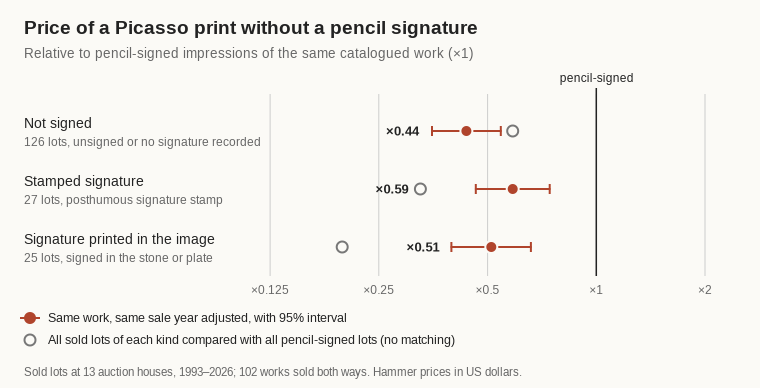
The fair comparison is between impressions of the same work, sold in the same market. For every work catalogued under the same Bloch number (or a Baer or Mourlot number we could link to it) that sold both with a pencil signature and in another way, we compared prices. The chart shows the result of a model that compares each impression only with impressions of the same work and adjusts for the year of sale.
| Compared with pencil-signed impressions of the same work | Works | Lots without pencil signature | Median ratio | Lower in | Adjusted for sale year (95% interval) |
|---|---|---|---|---|---|
| Not signed | 74 | 113 | 0.48 | 81% of works | 0.44 (0.35–0.55) |
| Stamped signature | 16 | 20 | 0.73 | 88% | 0.59 (0.46–0.74) |
| Signature printed in the plate or stone | 5 | 20 | 0.54 | all 5 | 0.51 (0.40–0.66) |
| Estate or family stamp only | 7 | 8 | 0.62 | 86% | 0.53 (0.41–0.70) |
"Median ratio" is, for each work, the median price without a pencil signature divided by the median price with one; the table gives the median across works. The ranges are wide. For a quarter of the works the unsigned impressions sold for less than 0.29 times the signed ones, and for another quarter for more than 0.86 times. The estate-stamp and plate-signed rows rest on very few works.
Two checks on the "not signed" row. Counting only lots that the house explicitly called unsigned gives a median ratio of 0.41 across 18 works; counting only full catalogue entries that mention no signature gives 0.53 across 62 works. Both point the same way.
Why the simple comparison misleads
Comparing every stamp-signed lot with every pencil-signed lot, without matching the work, suggests that a stamped signature costs two-thirds of the value (0.33). Matched by work, the ratio is about 0.59 to 0.73. The difference is not the signature: stamped signatures cluster on the 156 Series and on other editions published after 1973, whose images sell for less than the average signed Picasso print in any case. The same happens with plate-signed lithographs (0.20 unmatched, about 0.51 matched), many of which come from editions of a thousand or more.
For lots with no signature at all, the unmatched figure (0.59) happens to be closer to the matched one (0.44 to 0.48), but that is coincidence, not confirmation. The lesson for an owner is that a general statement like "unsigned Picasso prints sell for a third of signed ones" is not a basis for valuing a particular sheet. The relevant comparison is with impressions of the same work.
When the signature marks a different printing
On many Picasso prints the presence of a pencil signature tells you which printing you have. Whether the size of that printing matters is a separate question, examined in does edition size affect Picasso print values.
- The Saltimbanques. A few early impressions of Picasso's etchings and drypoints of 1904–1905, on different paper from the later edition, carry his pencil signature; the main edition was printed in 1913 for Vollard, and auction houses catalogue it (250 on Van Gelder paper, plus a few on Japan paper) without a signature.4 In our record a pencil-signed early impression of Salomé (Bloch 14) sold at Galerie Kornfeld for about $88,000 in September 2025 and about $117,000 in September 2026 (hammer, converted), while impressions from the unsigned 1913 edition sold at Christie's and Phillips for between $5,600 and $9,500. That gap is mostly about the printing, not the pencil.
- The 347 Series, 1968. The plates were published in signed and numbered editions; proofs from Picasso's estate, some of them taken before the plates were steel-faced, appear with a stamped signature and the estate's inkstamp. Matched by plate, those stamp-signed proofs (only 6 works) sold for a median 0.80 times the pencil-signed impressions: rarer, but not signed by Picasso.
- Editions issued after Picasso's death. A group of earlier copper plates, known as the "Caisse à remords", was printed in 1961 and published by the Galerie Louise Leiris only in 1981, with a stamped signature (19 lots in our record describe this history); the 156 Series was published in 1978.7 These are authorised editions from the original plates and are catalogued as such, but they are posthumous, which the description should say.
- Large lithograph editions with a printed signature. Several lithographs of 1957–1960 exist in a small signed and numbered edition and a much larger edition with the signature printed in the stone. That case is about edition size as much as signature, and is discussed in Does edition size affect the value of Picasso prints?.
Only where the same edition contains signed and unsigned impressions does the signature isolate itself from everything else. When we restrict the comparison to impressions with the same stated edition size, the discount for a sheet without a pencil signature narrows to about 0.64 (0.52–0.80; 34 works), still large, and stamped signatures stay at about 0.64 (13 works).
What this means for your print
- Copy the wording exactly. Note whether the signature is in pencil, in the image, stamped, or absent, and whether there is an inkstamp on the reverse. A photograph of the lower margin and of the back is more useful than a description.
- Identify the catalogue number. Bloch, Geiser/Baer (etchings, drypoints, aquatints and linocuts) or Mourlot (lithographs) numbers let you find impressions of the same work.8 Our guide to selling prints and limited-edition multiples lists the abbreviations, and our comparison of Picasso lithographs, etchings and linocuts explains which catalogue covers which technique.
- Compare like with like. Look for sales of the same work with the same signature status and, if possible, the same edition or state. Prices for signed impressions of the same work are the wrong yardstick for an unsigned sheet, and the reverse.
- Do not try to "improve" a print. A signature added by anyone other than the artist is a forgery. An unsigned impression from an unsigned edition is a complete, honest object and is valued as such.
Pencil-signed proofs are a separate question: across all artists, Phillips sales show a signed proof selling at about the same price as a signed numbered impression of the same work, and Picasso's prints follow the same pattern (see the edition-size article).
How these figures were calculated
- Source: public auction records for Pablo Picasso prints in the Artemis Collection research database, queried read-only on 2 November 2026: lots with a catalogue description at Galerie Kornfeld, Christie's, Phillips, Ketterer Kunst, Grisebach, Sotheby's, Van Ham, Lempertz, Artcurial, Ponte, Clars, Millon and Heritage. Sold lots from 30 November 1993 to 22 October 2026. Lots identified as sold by Artemis Collection itself, and duplicate records of the same lot, are excluded.
- Which lots: single-sheet original prints whose description cites a Bloch, Geiser/Baer or Mourlot number (2,293 lots, 1,030 works). Excluded: reproductions, posters, "after Picasso" and offset or photomechanical prints; illustrated books, portfolios, sets and lots with several sheets; ceramics, drawings and other objects. Picasso's own variations on other artists ("d'après Cranach", "d'après Manet") are originals and were kept.
- Classification: signature, edition annotation and technique were read from each house's own wording (English, French, German and Italian) by keyword rules, then checked by hand on 100 randomly drawn lots; the rules were corrected for the errors found, and the second check of 40 lots found no signature misclassification. "Not signed" combines lots stated to be unsigned with full catalogue entries that record no signature; houses that publish only a short title were not used for signature status.
- Work identity: the Bloch number, or a Baer or Mourlot number linked to Bloch through lots that cite both. A catalogue number can cover several states, papers and printings; we did not separate states.
- Prices: hammer price in US dollars, derived from the published premium-inclusive price using the buyer's premium schedule in force at each house on the sale date, converted at the sale-date exchange rate. Not adjusted for inflation; the adjusted comparisons control for the year of sale instead.
- Model: for the adjusted figures, log hammer price was regressed on a separate intercept for each work, a separate intercept for each sale year and the signature class, using only works that sold in at least two classes (451 lots, 102 works); intervals are clustered by work.
- Limits: sold lots only (unsold lots are not reliably recorded); condition, paper, margins and provenance were not controlled; small samples for estate stamps and printed signatures. Past results do not establish the value of any other print.
-
Print Council of America, "What Is an Original Print?", accessed 2 November 2026. ↩
-
California Civil Code §1744(a)(2) and (7), read via california.public.law on 2 November 2026. ↩
-
The Marina Picasso stamp is catalogued by Phillips, Galerie Kornfeld, Grisebach and Ketterer Kunst as Lugt 3698, the number in Frits Lugt's repertory of collectors' marks (Fondation Custodia). We could not read the online Lugt entry itself. ↩
-
The Metropolitan Museum of Art, "The Frugal Repast", 1904, printed 1913, printer Louis Fort, publisher Ambroise Vollard (collection record, read via the Met Open Access API, 2 November 2026). Edition figures and signature status from auction-house catalogue descriptions. ↩↩
-
Cleveland Museum of Art, "Vollard Suite: Minotaur Caressing a Sleeping Woman" (2000.20): "a group of 100 prints executed in 1930–36 and published by the art dealer Ambroise Vollard in 1939"; edition "50 on large paper, 260 on small". Accessed 2 November 2026. ↩
-
The Metropolitan Museum of Art, "Conversation, 347 Suite", 1968, printed by Aldo and Piero Crommelynck, published by Galerie Louise Leiris (read via the Met Open Access API, 2 November 2026). ↩
-
As described in auction catalogues: 78 of the 104 156 Series lots in our record state publication by the Galerie Louise Leiris in 1978. We found no museum record to cite for the publication date. ↩↩
-
Georges Bloch, Pablo Picasso: catalogue de l'œuvre gravé et lithographié, 4 vols (Bern: Kornfeld et Klipstein, 1968–1979); Bernhard Geiser and Brigitte Baer, Picasso peintre-graveur (Bern, 1933–1996); Fernand Mourlot, Picasso lithographe, 4 vols (Monte Carlo: André Sauret, 1949–1964). Bibliographic details from the Library of Congress and Bibliothèque nationale de France catalogues, 2 November 2026. ↩
Sources
- Print Council of America, What Is an Original Print?. Signing and numbering as conventions for establishing market value; editions authorised by the artist. Accessed 2 November 2026.
- California Civil Code §1744 (sale of fine prints and multiples), via california.public.law. Disclosure of signed, stamped or estate-stamped names, posthumous status and edition composition. Accessed 2 November 2026.
- The Metropolitan Museum of Art, The Frugal Repast (1904, printed 1913). Printer Louis Fort, publisher Ambroise Vollard; read via the Met Open Access API, 2 November 2026.
- The Metropolitan Museum of Art, Conversation, 347 Suite (1968). Printers Aldo and Piero Crommelynck, publisher Galerie Louise Leiris; read via the Met Open Access API, 2 November 2026.
- Cleveland Museum of Art, Vollard Suite: Minotaur Caressing a Sleeping Woman (2000.20). 100 prints of 1930–36 published by Vollard in 1939; edition 50 on large paper, 260 on small. Accessed 2 November 2026.
- Library of Congress catalogue: Georges Bloch, Pablo Picasso, catalogue de l'œuvre gravé et lithographié (Kornfeld et Klipstein, 1968–1979). Four volumes; volume III the ceramics, volume IV 1970–1972. Record read 2 November 2026.
- Library of Congress catalogue: Geiser and Baer, Picasso peintre-graveur (Bern, 1933–1996). Vols 1–2 by Bernhard Geiser, vols 3–7 and addendum by Brigitte Baer. Record read 2 November 2026.
- Bibliothèque nationale de France catalogue: Fernand Mourlot, Picasso lithographe (André Sauret, 1949–1964). Four volumes covering 1919–1963. Record read 2 November 2026.
Auction prices for 2,182 original Picasso prints by technique, before and after allowing for period, edition, signature, size and colour.
Selling a print or multiple: original or reproduction, what signatures, numbers and proof marks mean, catalogue references, condition and where to sell.
Edition size and price across 1,886 Picasso print sales: small editions, proofs and low numbers compared like for like, with images issued twice.