

Toshiko Takaezu Closed Forms: Identification, Characteristics and Collecting
What a Toshiko Takaezu closed form is, how the series differ, what documentation and condition mean, and what 821 public auction results show.
Prepared by Artemis Collection. Market figures are drawn from public auction records as described in the methodology note; they are not appraisals.
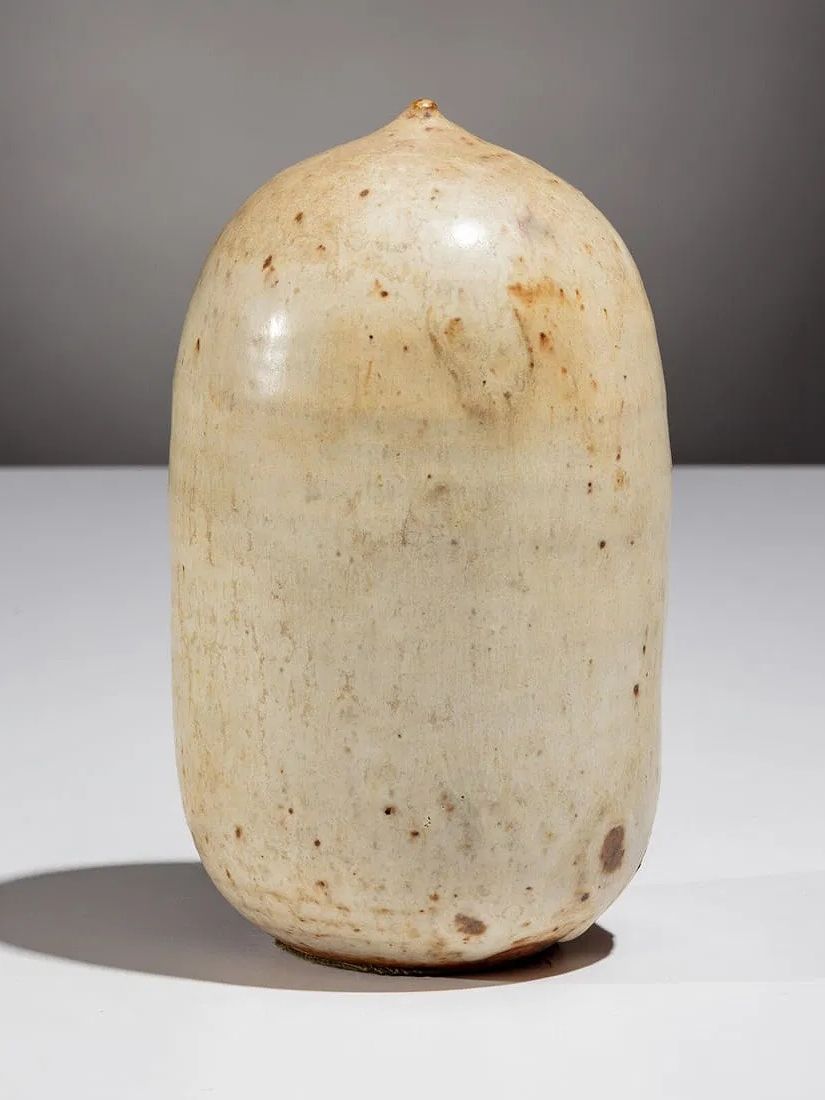
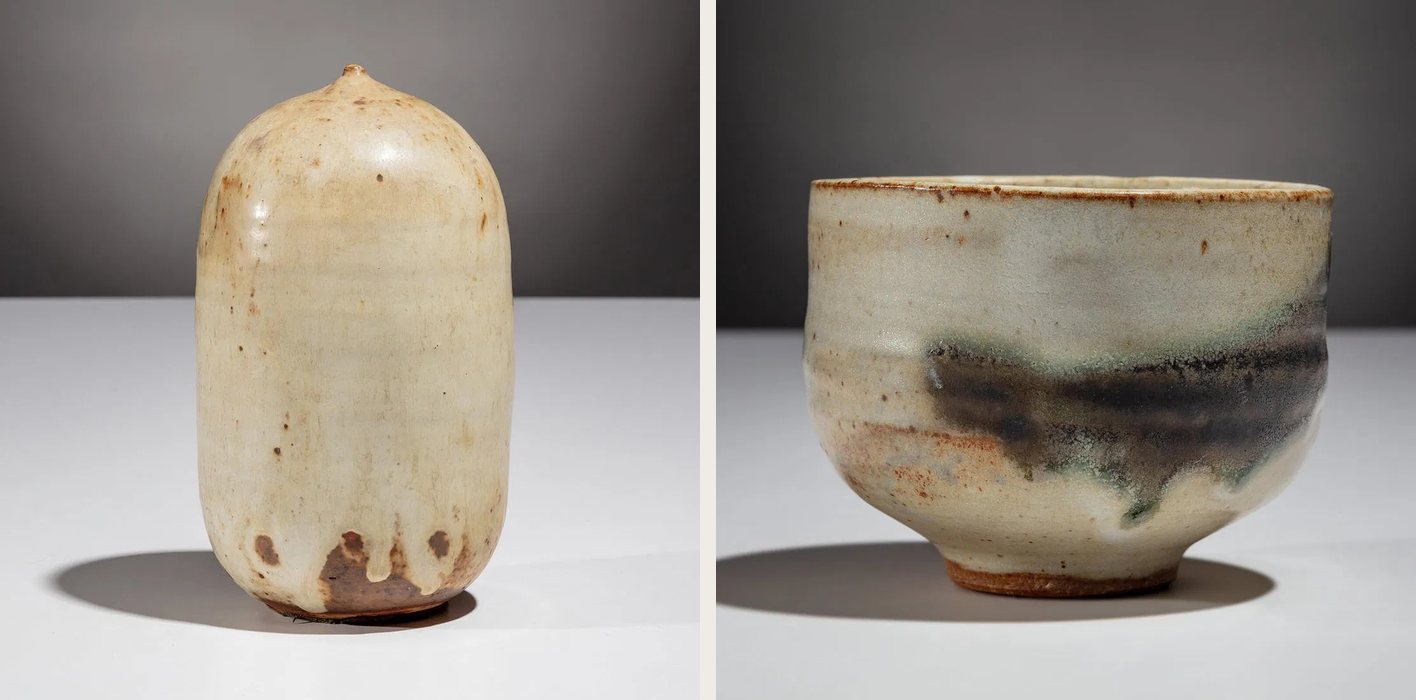
A Toshiko Takaezu closed form is a thrown and hand-finished stoneware or porcelain vessel that the artist closed at the top, leaving at most a tiny opening, so that it can no longer function as a container and becomes a surface for glaze and a volume enclosing a dark interior. Many contain a small fired clay bead that rattles when the piece is moved. In the public auction record they are the most valuable part of her ceramic output by a wide margin, and within the closed forms, size is the clearest single price signal: in 246 measured closed forms sold at auction since 2021, the median hammer price rises from about $6,000 for pieces under 8 inches tall to about $42,000 for pieces 18 inches and over (method below). How closed forms compare in price with her open bowls and vessels is measured in Takaezu closed forms versus open vessels.
This guide covers what the forms are, how the named series differ, what can and cannot be established about a particular piece, condition, and what the public market data show.
Who Toshiko Takaezu was
Takaezu was born in Pepeekeo, Hawaii, on 17 June 1922, to immigrant parents from Japan, and died in Honolulu on 9 March 2011. She studied ceramics with Claude Horan at the University of Hawaii and then, from 1951 to 1954, with Maija Grotell at Cranbrook Academy of Art in Michigan. An eight-month stay in Japan in 1955–56 included time at the Bizen studio of Toyo Kaneshige and study of the tea ceremony and Zen Buddhism. She taught at the Cleveland Institute of Art (1955–64) and at Princeton University (1967–92), and from 1975 worked from her studio in Quakertown, New Jersey.1
Her work is held by, among others, the Metropolitan Museum of Art, the Smithsonian American Art Museum, the Art Institute of Chicago, the Museum of Fine Arts, Boston, LACMA and the Honolulu Museum of Art.1 In 2006–09 she offered groups of works to museums that already held her work, to form core collections; the New Jersey State Museum, for example, received twenty-nine works in 2007.2 The touring retrospective Toshiko Takaezu: Worlds Within opened at the Noguchi Museum in March 2024 and travelled to Cranbrook, the Museum of Fine Arts, Houston, the Chazen Museum of Art and the Honolulu Museum of Art (to July 2026).5
What makes a form "closed"
The Takaezu Foundation's chronology dates her first fully closed form to 1958, after a decade of bottle forms with ever-narrower necks; the Cleveland Museum of Art places the start of the series in the 1950s, shortly after her Japan trip and while she taught in Cleveland, and notes that closed forms were her primary output for nearly fifty years.23
Three features define the type:
- A closed or nearly closed top. The Foundation describes a "nipple-like opening" left so that gases could escape in firing. Some pieces have no visible opening at all. A pinhole or small knob at the top is therefore expected, not a defect.13
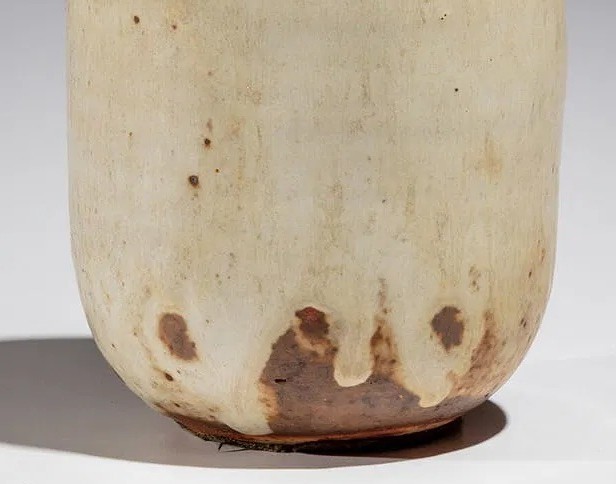
- A rattle, often but not always. Before closing a form she frequently dropped in a small bead of clay wrapped in paper; the paper burned away in the kiln and the fired bead rattles when the piece is moved. The Smithsonian's text says "often", so a silent closed form is not anomalous on that ground alone.34 Auction houses usually add "(with rattle)" to the title when a bead is present; 202 of the 309 closed forms in our post-2021 sample carry the phrase, so the absence of a rattle is common too.
- Glaze as painting. The Foundation's essay describes the closed form as merging the thrown shape with glazed surface painting, the glaze applied by dripping, splashing, pouring and brushing; she rotated smaller pieces by hand while glazing.1
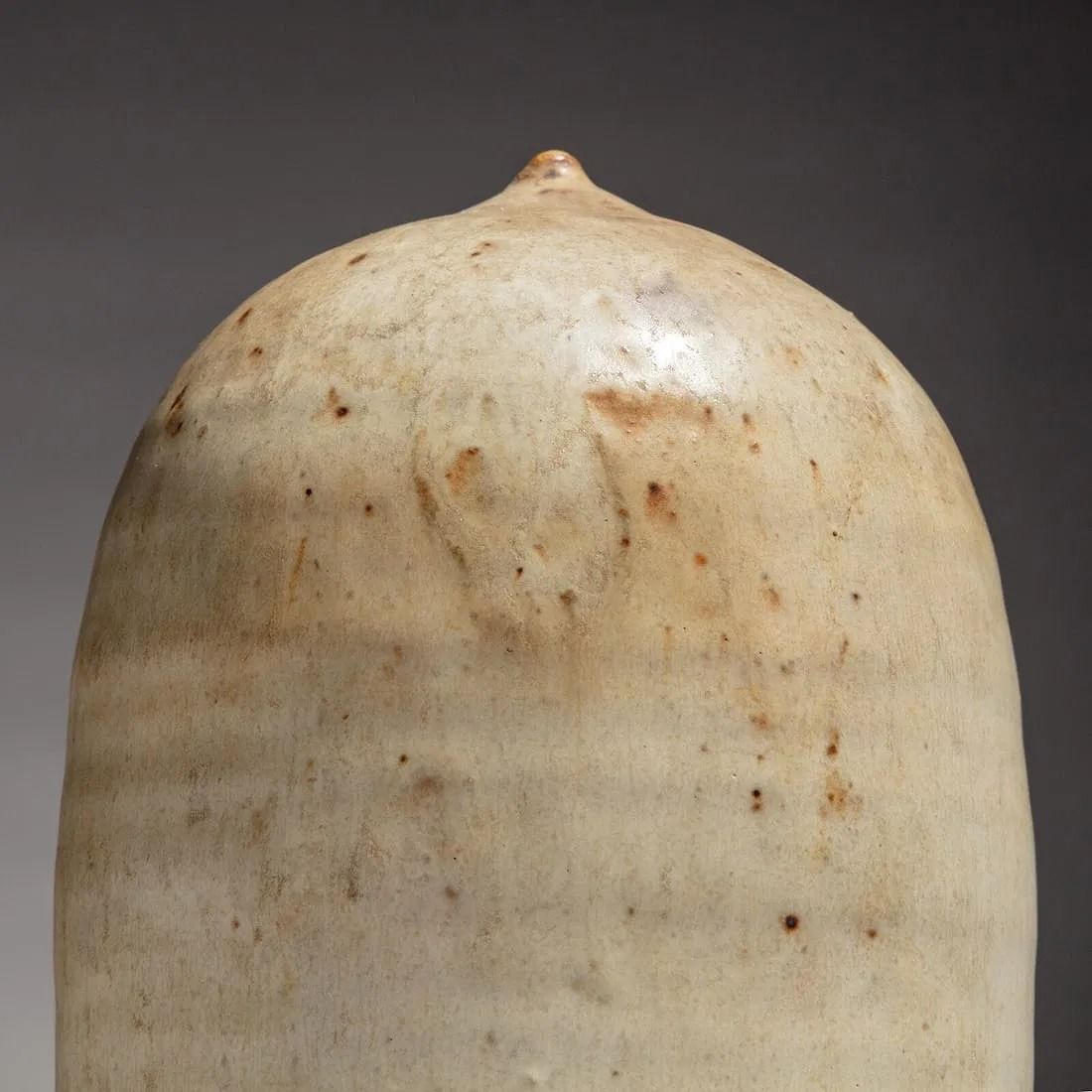
The Smithsonian's catalogue entry for one porcelain example describes the making: a pot thrown on the wheel, then coiled and hand-built into a nearly closed spheroid.4 The Foundation notes that the forms were sometimes wheel-thrown and sometimes hand-built, in stoneware or porcelain, and that the largest reached up to six feet.1
Series and names you will see in catalogues
| Name | What it refers to | Documentation |
|---|---|---|
| Moon (moon pot) | Spherical closed forms; the chronology's earliest reference is a small Moon pot in 1969 | Foundation essay and chronology |
| Tree | Tall, upright cylindrical closed forms; Tree-Man Forest (ceramic, 1982–88) was later cast in bronze | Foundation essay and chronology |
| Momo | Slit-open sculptural forms that show the dark interior | Foundation essay |
| Star Series | Fourteen large closed forms named after constellations and ancient monuments, shown together in 2005 | Foundation chronology |
| Gaea | Clay spheres set in hammocks, first made in 1979 | Foundation chronology |
| Bells | Ceramic bell forms; bronze bells were also cast | Foundation chronology; auction titles |
| "Ocean Edge", "Makaha Blue", "Alchemy Gold" and similar | Names that appear in auction titles, usually tied to a glaze palette | Auction catalogues only; we have not found an authoritative definition |
Titles in the market are inconsistent. The same kind of object is catalogued as "Closed Form", "Untitled (with rattle)", "Moonpot" or "Untitled (Closed Form)" depending on the house and the decade. A name in an auction title is the cataloguer's description, not necessarily the artist's title.
Identifying a closed form: what can and cannot be established
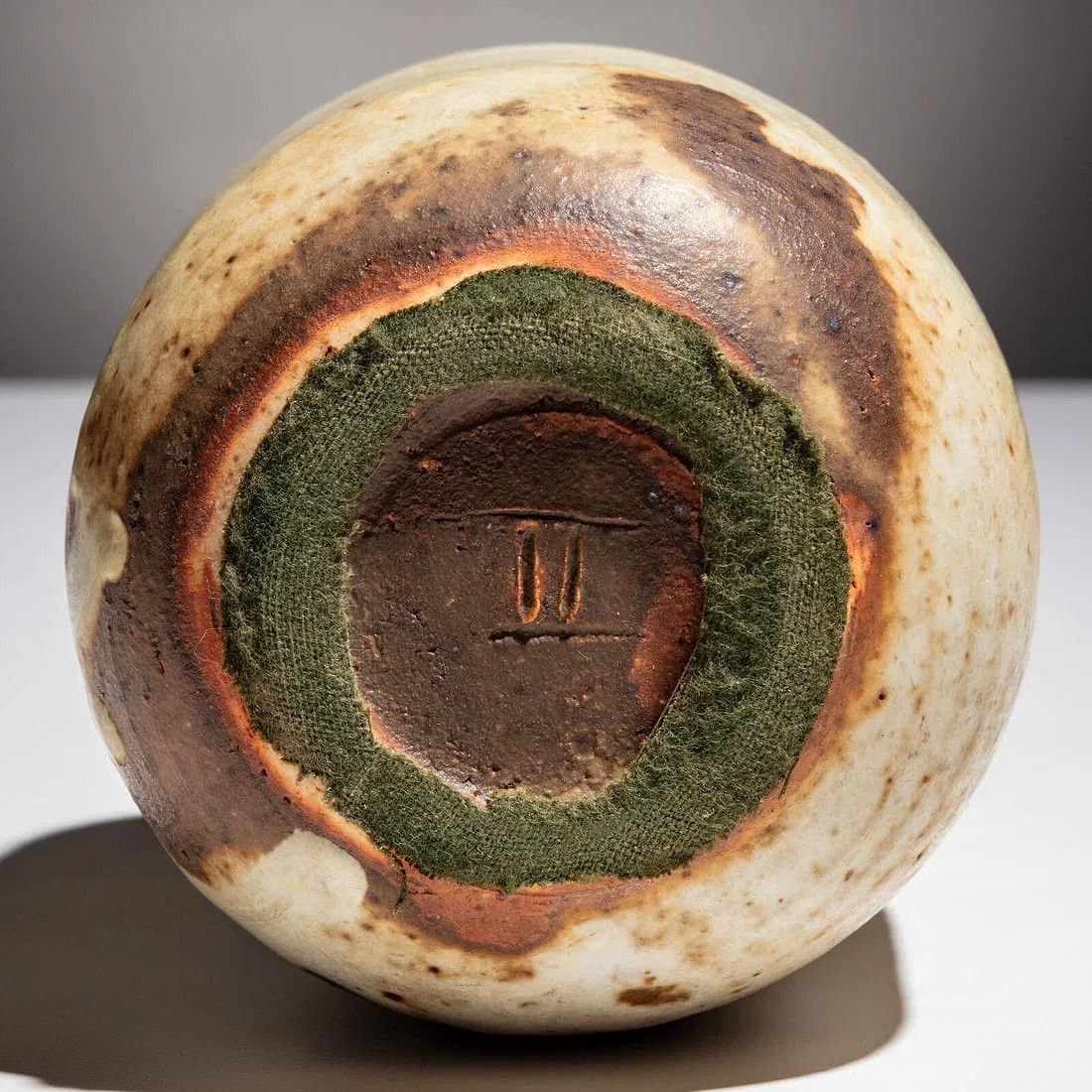
The Takaezu Foundation states that it does not authenticate artwork.6 We are not aware of a published catalogue raisonné of her ceramics, and we have not found an authoritative published guide to her marks. Auction catalogues describe marks individually; a Phillips entry, for example, records an "incised artist's mark" on the underside of a closed form.7 Treat any mark as one piece of evidence among several, never as proof on its own.
What a buyer or owner can document:
- Measurements: height and greatest diameter, in inches and centimetres. Size matters to price more than anything else in the data below, and only about three in five public lots record it.
- The underside: a clear photograph of the foot and any mark, including how the mark was made (incised, stamped, painted).
- The top and any opening, and whether a bead can be heard when the piece is gently tilted.
- Provenance: purchase from the artist or her studio, a gallery invoice, an exhibition label, a gift record, an auction record with sale and lot number. Where a piece came directly from the artist, as a gift or a studio purchase, a contemporaneous letter, receipt or photograph recording it is worth keeping with the piece. See which documents matter for provenance for how to organise papers (written for Picasso ceramics, but the principles carry over).
Condition: what to look for
Closed forms are robust in shape but have a few characteristic points of vulnerability:
- The foot and lower edge, where chips from handling occur.
- The top and opening, which can be knocked.
- Cracks, including firing cracks that were present when the piece left the kiln. Catalogue notes sometimes distinguish these ("in the making") from later damage; ask which applies.
- Restoration, which can be hard to see on a heavily glazed surface. Ask the seller or house directly whether the piece has been restored, and get the answer in writing.
- The rattle. Do not shake a closed form to test it; a gentle tilt is enough. The bead is loose inside a fired vessel.
Handle with two hands, supporting the base, and keep pieces away from edges and from each other.
What the public auction record shows
We assembled every public Takaezu auction result in the Artemis database and removed duplicate records (see the method note). The result is 821 sold lots, 2003 to October 2026, of which 741 were sold since 2021. Rago-hosted sales account for 708 of those 741, so the data are mostly a record of one auction house; Phillips, Bonhams, Christie's and Clars make up the rest.
By form, sold since 2021 (hammer price, USD)
| Form (from the lot title) | Lots | Median | Middle half of results |
|---|---|---|---|
| Closed form, incl. moons and bells | 309 | $8,000 | $4,500–14,000 |
| "Untitled", form not stated | 61 | $7,000 | $4,500–12,500 |
| Garden seat | 11 | $9,000 | $8,000–13,000 |
| Vase, bottle or vessel | 49 | $2,800 | $1,450–5,250 |
| Bowl | 84 | $1,000 | $707–2,150 |
| Plate or charger | 26 | $975 | $688–1,500 |
| Tea bowl | 69 | $750 | $500–1,100 |
| Group lots (two or more objects) | 103 | $1,200 | $832–2,200 |
Closed forms by height, sold since 2021
| Height | Lots | Median hammer | Middle half |
|---|---|---|---|
| Under 8 in. | 167 | $6,000 | $4,000–10,000 |
| 8 to under 12 in. | 32 | $9,250 | $6,818–15,000 |
| 12 to under 18 in. | 18 | $19,500 | $11,750–27,500 |
| 18 in. and over | 29 | $42,000 | $20,500–69,000 |
The two largest bands are small samples; read them as a direction, not as price levels. The top band is also sensitive to classification: counting the rattle-containing garden seats as closed forms lowers its median to about $35,000. Size is also bound up with date, series and glaze, all of which matter and none of which this table controls for.
Closed forms by year (median hammer): 2021, $3,200 (27 lots); 2022, $6,000 (46); 2023, $8,837 (81); 2024, $9,000 (64); 2025, $11,217 (36); 2026 to October, $8,500 (55). Medians before 2021 rest on eleven or fewer lots a year. The mix of sizes and the number of large dedicated sales changes from year to year, so this is not a price index, and it says nothing about future prices.
The top of the market is set by large Moons and other monumental forms. Moon, about 21 inches in diameter, hammered at $430,000 in A Quiet Revolution: The Ceramics of Toshiko Takaezu (13 April 2023), a sale held jointly by Rago, Wright and LAMA; Wright reported the premium-inclusive price as $541,800, a world record for the artist at the time.8 The next-highest single lots in our data hammered between $75,000 and $140,000 and were all large closed forms, Moons or bells. Eighteen of the 309 closed forms sold since 2021 hammered at $50,000 or more; the typical result is far lower.
Collecting considerations
- Buy the object, not the label. Size, surface, condition and documentation tell you more than a series name in a title.
- Compare like with like. A small closed form, a tea bowl and a large Moon are different markets. Use results for pieces of similar form and height, and remember that the hammer price excludes the buyer's premium (about 25–29% on top in these Rago-hosted records).
- Read estimates for what they are. For closed forms with published estimates at Rago (321 lots), 60% hammered above the high estimate and 16% below the low; the median result was 1.4 times the mid-estimate. An estimate is a pricing strategy for the sale, not a valuation. See how to read an auction listing.
- Ask about condition in writing, including restoration, before bidding or buying.
- Keep the paperwork with the piece. It is the part of a work's history most easily lost. See documenting a Takaezu for sale.
- Look at the surface as closely as the size. Matched sales show glaze colour moving prices at a given height; see how size, surface and glaze influence Takaezu prices.
For owners thinking about a sale, our companion guide covers how to sell a Toshiko Takaezu ceramic. Artemis Collection buys and consigns works, gives informal opinions of value (not formal appraisals), and welcomes confidential inquiries from owners considering a sale or consignment; we will review photographs and documentation.
How these figures were calculated
- Source: public auction results for Toshiko Takaezu held in the Artemis Collection research database (house lot data, mostly Rago and its affiliated houses, plus Phillips, Bonhams, Christie's and Clars), queried on 9 November 2026. No private sale or Artemis transaction is included, and no figure relates to any particular owner.
- Duplicates: the database marks duplicate captures of the same lot (including copies carried by affiliated or aggregator sites) as superseded, and those rows are excluded. Rows still sharing a lot URL were merged into one lot: 870 distinct lots, 821 sold (49 unsold or without a price were excluded).
- Prices: hammer price in US dollars, nominal (not adjusted for inflation). The hammer is the published premium-inclusive result divided by the house's dated buyer's-premium rate.
- Form: classified from the lot title by keyword (closed form, rattle, moon, bell, tea bowl, bowl, plate, vase, and so on); lots naming two or more objects are grouped separately. The classification is a heuristic and some "Untitled" lots are certainly closed forms.
- Height: parsed from the published dimensions; spheres given only by diameter use the diameter. 246 of 309 closed forms sold since 2021 have a usable measurement.
- Estimates: hammer compared with the published low and high estimate of the same lot; sold lots only (unsold lots are not reliably captured, so sell-through is not measured).
- Limits: one house dominates; titles are inconsistent; condition, glaze and series are not controlled. Medians describe past public results and do not establish the value of any other piece.
-
Toshiko Takaezu Foundation, "About Toshiko", essay by Glenn Adamson and biography, accessed 9 November 2026. ↩↩↩↩↩
-
Toshiko Takaezu Foundation, "Chronology" (Jeffery Spahn), accessed 9 November 2026. ↩↩
-
Cleveland Museum of Art, accession 2010.236, catalogue text, accessed 9 November 2026. ↩↩↩
-
Smithsonian American Art Museum, Untitled, 2006.26.6, catalogue text, accessed 9 November 2026. ↩↩
-
The Noguchi Museum, Toshiko Takaezu: Worlds Within, exhibition page with tour venues, accessed 9 November 2026. ↩
-
Toshiko Takaezu Foundation website, footer statement, accessed 9 November 2026. ↩
-
Phillips, Closed Form (Ocean Edge), lot detail page, accessed 9 November 2026. ↩
-
Wright, "2023 Year in Review", accessed 9 November 2026. The hammer figure is from the public lot result in our database; $430,000 plus a 26% premium equals the $541,800 Wright reports. ↩
Sources
- Toshiko Takaezu Foundation, About Toshiko (essay by Glenn Adamson; biography). Biography, closed form, series, technique, collections. Accessed 9 November 2026.
- Toshiko Takaezu Foundation, Chronology (Jeffery Spahn). Dates: first closed form 1958, Moon pots, Star Series, gifts to museums. Accessed 9 November 2026.
- Toshiko Takaezu Foundation, home page (footer statement on authentication). States that the Foundation does not authenticate artwork. Accessed 9 November 2026.
- Cleveland Museum of Art, Toshiko Takaezu, closed form, accession 2010.236. Closed vessels begun in the 1950s; clay bead wrapped in paper. Accessed 9 November 2026.
- Smithsonian American Art Museum, Toshiko Takaezu, Untitled, 2006.26.6. Throwing and hand-building; paper-and-clay rattles. Accessed 9 November 2026.
- The Noguchi Museum, Toshiko Takaezu: Worlds Within (2024–2026 touring exhibition). Venues and dates of the retrospective. Accessed 9 November 2026.
- Wright, 2023 Year in Review. Moon sold for $541,800 (premium-inclusive), described as a world record for the artist, April 2023. Accessed 9 November 2026.
- Phillips, Toshiko Takaezu, Closed Form (Ocean Edge), lot detail. Example of a catalogue describing an incised artist's mark on the underside. Accessed 9 November 2026.
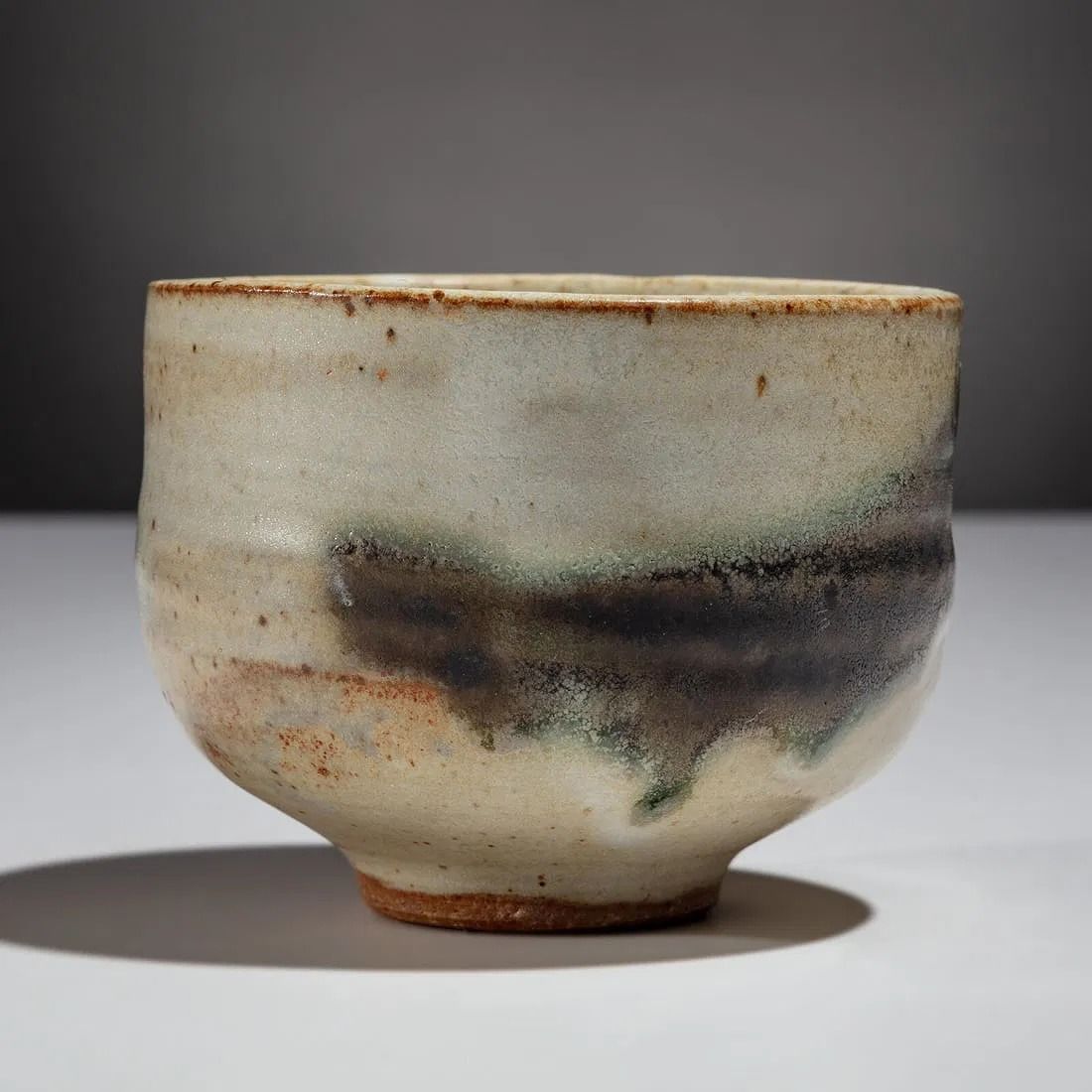
Selling a Toshiko Takaezu closed form, bowl or tea bowl: what drives price in public results, where her work sells, what to document and how to ship it.
Matched public results for Takaezu closed forms: what height adds, why porcelain and rattles matter less than assumed, and what blue glaze is worth.
Size-matched and same-sale comparisons of Takaezu closed forms with bowls, tea bowls and bottles: how wide the price gap is, and where it narrows.