

How to Sell a Toshiko Takaezu Ceramic
Selling a Toshiko Takaezu closed form, bowl or tea bowl: what drives price in public results, where her work sells, what to document and how to ship it.
Prepared by Artemis Collection. Market figures are drawn from public auction records as described in the methodology note; they are not appraisals.
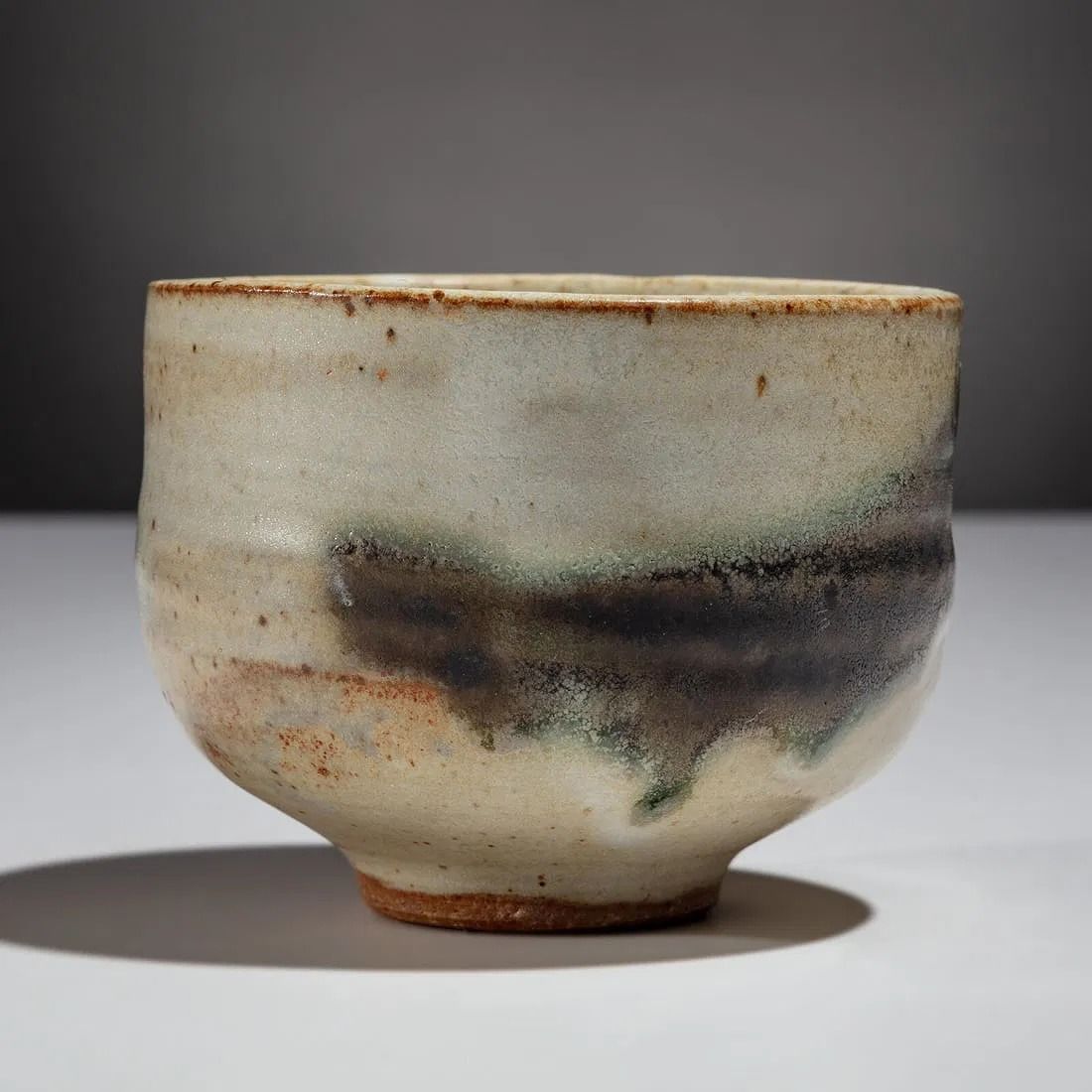
The usual route for a Toshiko Takaezu ceramic is a specialist design or craft auction, a dealer who buys outright, or a consignment through either. Whichever you choose, the work's form and size will shape the price more than anything else: in public auction results since 2021, closed forms (her sealed vessels, often with a clay rattle inside) had a median hammer price of $8,000, against $1,000 for bowls and $750 for tea bowls, and the 29 closed forms 18 inches or taller had a median of $42,000, a small sample. Before approaching anyone, measure the piece, photograph it properly and gather whatever paperwork you have.
Step 1: work out what you have
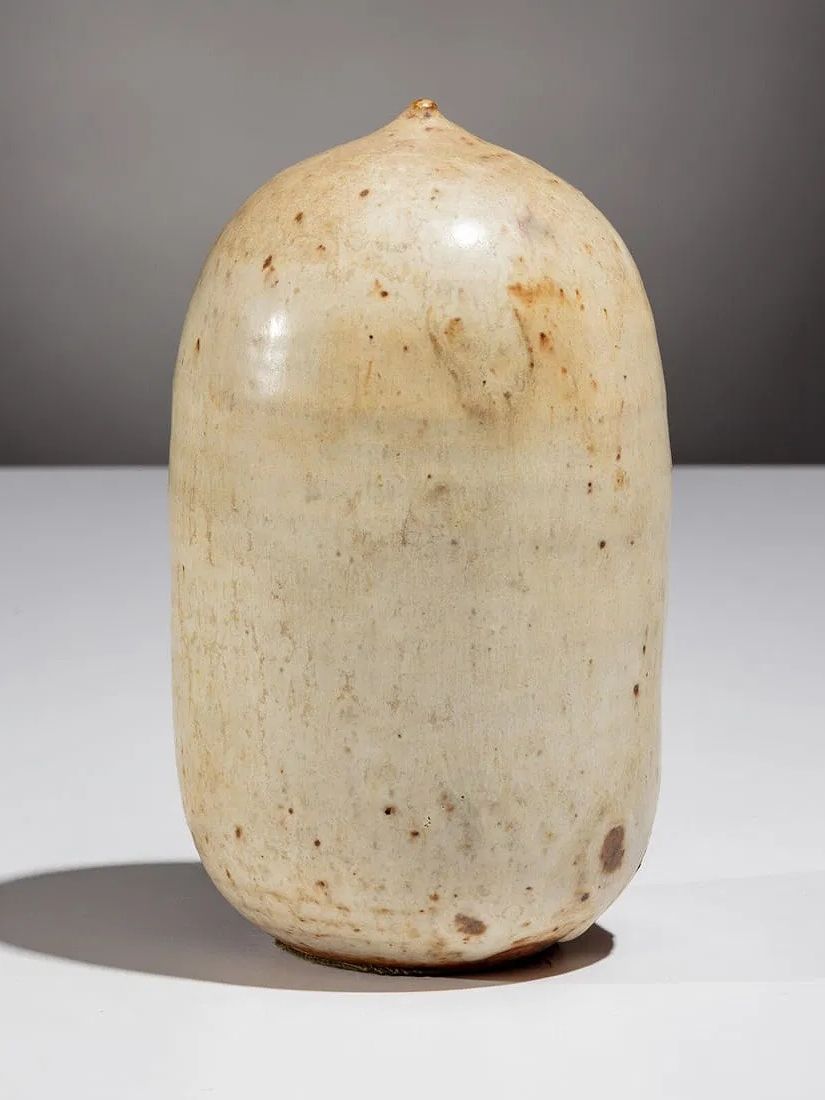
Takaezu made functional pots (bowls, tea bowls, plates, teapots, vases) throughout her career and, from the late 1950s, the closed forms for which she is best known. A closed form has a closed top with at most a tiny opening, and many contain a small fired clay bead that rattles when the piece is tilted.12 Large spherical closed forms are catalogued as Moons; tall cylindrical ones relate to her Tree series. Our reference guide to Takaezu closed forms explains the types and series.
Measure:
- height, and the greatest width or diameter, in inches and centimetres;
- for a sphere, the diameter.
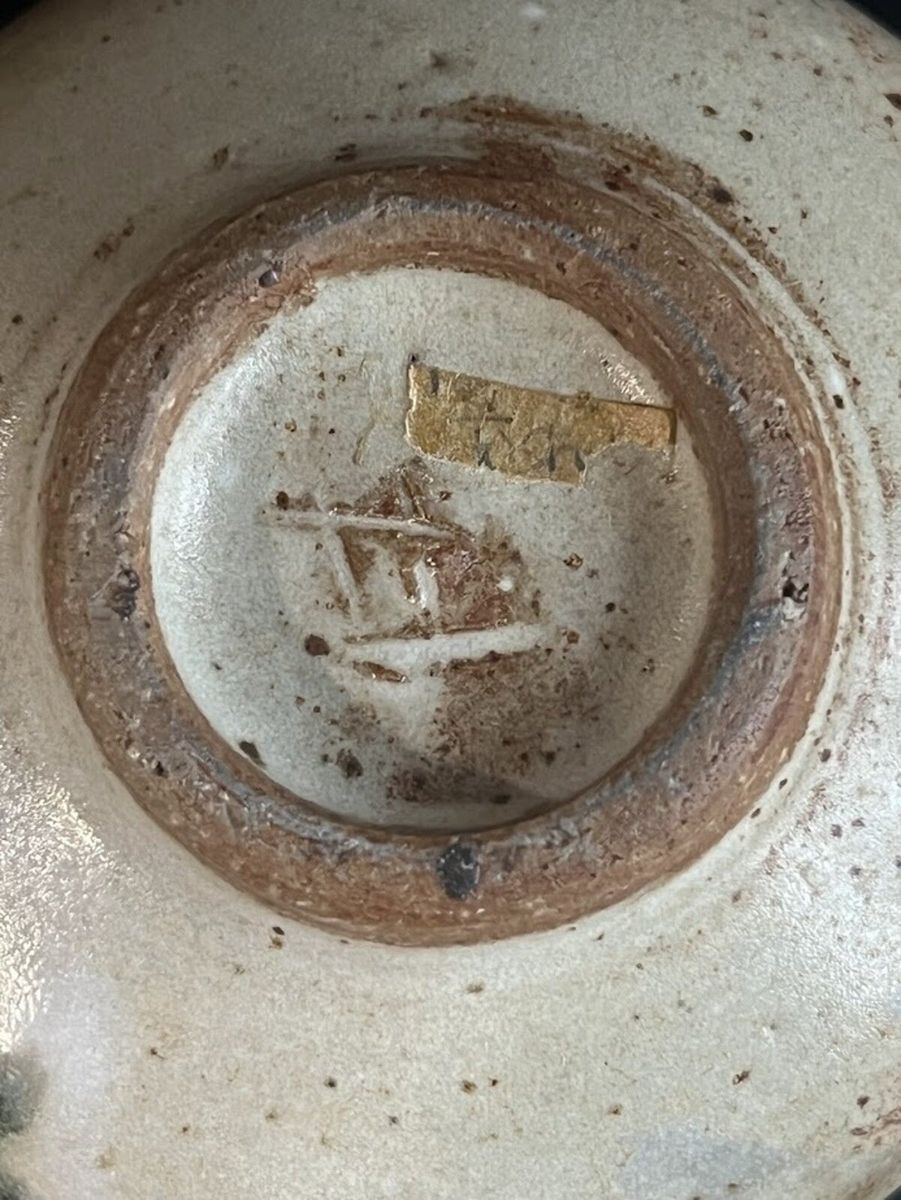
Then look underneath. Catalogues describe marks individually; a Phillips entry, for example, records an "incised artist's mark" on the underside of a closed form.4 Note what you see and how it was made, but do not treat a mark as proof of authorship. The Toshiko Takaezu Foundation states that it does not authenticate artwork, and we know of no published catalogue raisonné of her ceramics.3 In practice, a buyer or auction house will judge a piece on the object itself together with its history.
What drives price in the public record
Our analysis of 821 sold Takaezu lots (2003 to October 2026; method below) shows four things an owner should know.
1. Form separates the markets. Since 2021:
| Form | Lots | Median hammer | Middle half of results |
|---|---|---|---|
| Closed form, incl. moons and bells | 309 | $8,000 | $4,500–14,000 |
| Vase, bottle or vessel | 49 | $2,800 | $1,450–5,250 |
| Bowl | 84 | $1,000 | $707–2,150 |
| Plate or charger | 26 | $975 | $688–1,500 |
| Tea bowl | 69 | $750 | $500–1,100 |
| Group lot of two or more pieces | 103 | $1,200 | $832–2,200 |
2. Among closed forms, size matters most. Median hammer for measured closed forms sold since 2021: under 8 inches, $6,000 (167 lots); 8 to under 12 inches, $9,250 (32); 12 to under 18 inches, $19,500 (18); 18 inches and over, $42,000 (29). The larger bands are small samples, and size travels with date, series and glaze, but the direction is consistent. Matched same-sale comparisons of size, surface and glaze and of closed forms against open vessels go further.
3. The very top is rare. The record of $430,000 hammer ($541,800 with premium) was set by a large Moon in a dedicated Takaezu sale in April 2023.5 Only 18 of 309 closed forms sold since 2021 hammered at $50,000 or more. Do not read the record as a guide to a typical piece.
4. Smaller pieces are often sold in groups. Bowls, tea bowls and plates are frequently offered two or more to a lot. A single small bowl may be grouped with others by an auction house, or be of more interest to a dealer than to a sale.
None of these medians is a valuation of your piece. Surface, glaze, condition and documentation can move a result well above or below the typical figure for its size.
Step 2: assemble documentation
Useful documents, in rough order of strength:
- a receipt, letter or record from the artist, her studio or a gallery that sold her work;
- exhibition labels or catalogue entries;
- an earlier auction record (house, sale date, lot number);
- family records: photographs showing the piece in a home over time, letters, an inventory or insurance schedule.
Keep originals; send copies. If there is nothing on paper, say so plainly. Many sound pieces have thin documentation, and it is better to know early. What each kind of evidence can and cannot establish, with examples from public sales, is in documenting a Takaezu for sale.
Step 3: photograph and describe condition
Take clear photographs in daylight or soft, even light against a plain background: front, back, each side, the top and opening, the underside with any mark, and close-ups of any damage. Our photography checklist is written for Picasso ceramics but applies equally here.
Describe condition honestly: chips (often at the foot or the top), cracks, glaze losses, and any restoration you know of. Note whether a closed form rattles; tilt it gently, do not shake it. A firing crack that happened in the kiln is not the same as later damage, and a good catalogue will say which it is. For how condition affects value generally, see damage, restoration and value.
Step 4: choose how to sell
At auction. Takaezu's public market is concentrated: of 741 lots sold since 2021 in our data, 708 were in sales hosted by Rago (including sales run with its affiliates), with the rest at Phillips, Bonhams, Christie's and Clars. Auction gives competitive bidding and a public price, at the cost of time (consignment to settlement commonly takes several months) and fees. The seller pays a commission and may be charged for photography, insurance, shipping and unsold lots; terms are agreed with each house. See the real cost of selling at auction for how hammer price, buyer's premium and net proceeds differ.
Estimates are not valuations. For closed forms with published estimates at Rago (321 lots), 60% hammered above the high estimate, 23% within the range and 16% below the low estimate; the median result was 1.4 times the mid-estimate. Across all Takaezu forms at Rago (666 lots), 24% fell below the low estimate. A low estimate attracts bidding; it can also leave a piece selling cheaply in a thin sale. Discuss the reserve (the confidential minimum) with the house before you sign.
To a dealer, outright. A dealer pays a price agreed in advance, usually faster and with no auction fees deducted, but takes the market risk and will price that in. Ask how the offer was arrived at.
On consignment with a dealer. The dealer offers the piece to clients at an agreed price and takes an agreed commission when it sells. Get the price, commission, duration and insurance arrangements in writing.
Step 5: pack and ship carefully
Closed forms are heavy for their size, and the largest are difficult to move.
- Use a professional fine-art shipper or packer for anything valuable, and confirm insurance in transit.
- Double-box: wrap the piece, float it in a well-padded inner box, and place that in a larger outer box with padding on all sides.
- Never pack material inside the opening of a closed form, and do not tape directly onto glaze.
- Support the piece from the base when lifting, with two hands.
Next step
Artemis Collection buys and consigns works, including Takaezu ceramics, gives informal opinions of value, and welcomes confidential inquiries from owners considering a sale or consignment. If you send photographs of the piece (all sides, the top and the underside), its measurements and whatever documentation you have, we will review them. We do not provide formal appraisals.
How these figures were calculated
- Source: public auction results for Toshiko Takaezu in the Artemis Collection research database, queried 3 November 2026. No private sale or Artemis transaction is included.
- Cleaning: duplicate captures of the same lot (including copies carried by affiliated or aggregator sites) are marked as superseded in the database and excluded; rows still sharing a lot URL were merged, leaving 870 lots, of which 821 sold (2003 to October 2026).
- Prices: hammer price in US dollars, nominal. The hammer is the published premium-inclusive result divided by the house's dated buyer's-premium rate; premiums added about 25–29% to the hammer in these records.
- Form and size: form classified from the lot title by keyword; group lots separated. Height parsed from published dimensions (diameter for spheres); 246 of 309 closed forms since 2021 had a measurement. The largest height band is sensitive to classification: counting the rattle-containing garden seats as closed forms lowers its median to about $35,000.
- Estimates: hammer compared with the same lot's published low and high estimate; sold lots with estimates only (2003–2026 for Rago). Unsold lots are not reliably captured, so sell-through rates are not given.
- Limits: one auction house dominates; titles are inconsistent; glaze, series and condition are not controlled. Past results do not establish the value of another piece.
-
Toshiko Takaezu Foundation, "About Toshiko", accessed 3 November 2026. ↩
-
Cleveland Museum of Art, accession 2010.236, catalogue text, accessed 3 November 2026. ↩
-
Toshiko Takaezu Foundation website, footer statement, accessed 3 November 2026. ↩
-
Phillips, Closed Form (Ocean Edge), lot detail page, accessed 3 November 2026. ↩
-
Wright, "2023 Year in Review", accessed 3 November 2026; hammer from the public lot result in our database. ↩
Sources
- Toshiko Takaezu Foundation, home page (footer statement on authentication). The Foundation does not authenticate artwork. Accessed 3 November 2026.
- Toshiko Takaezu Foundation, About Toshiko. Closed form opening, rattles, media, scale. Accessed 3 November 2026.
- Cleveland Museum of Art, Toshiko Takaezu, closed form, accession 2010.236. Clay bead wrapped in paper inside closed forms. Accessed 3 November 2026.
- Wright, 2023 Year in Review. Record price for Moon, April 2023, premium-inclusive. Accessed 3 November 2026.
- Phillips, Toshiko Takaezu, Closed Form (Ocean Edge), lot detail. Catalogue describing an incised artist's mark on the underside. Accessed 3 November 2026.
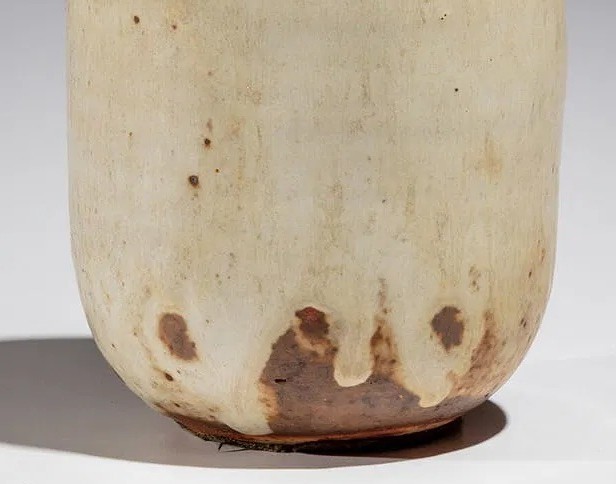
Matched public results for Takaezu closed forms: what height adds, why porcelain and rattles matter less than assumed, and what blue glaze is worth.
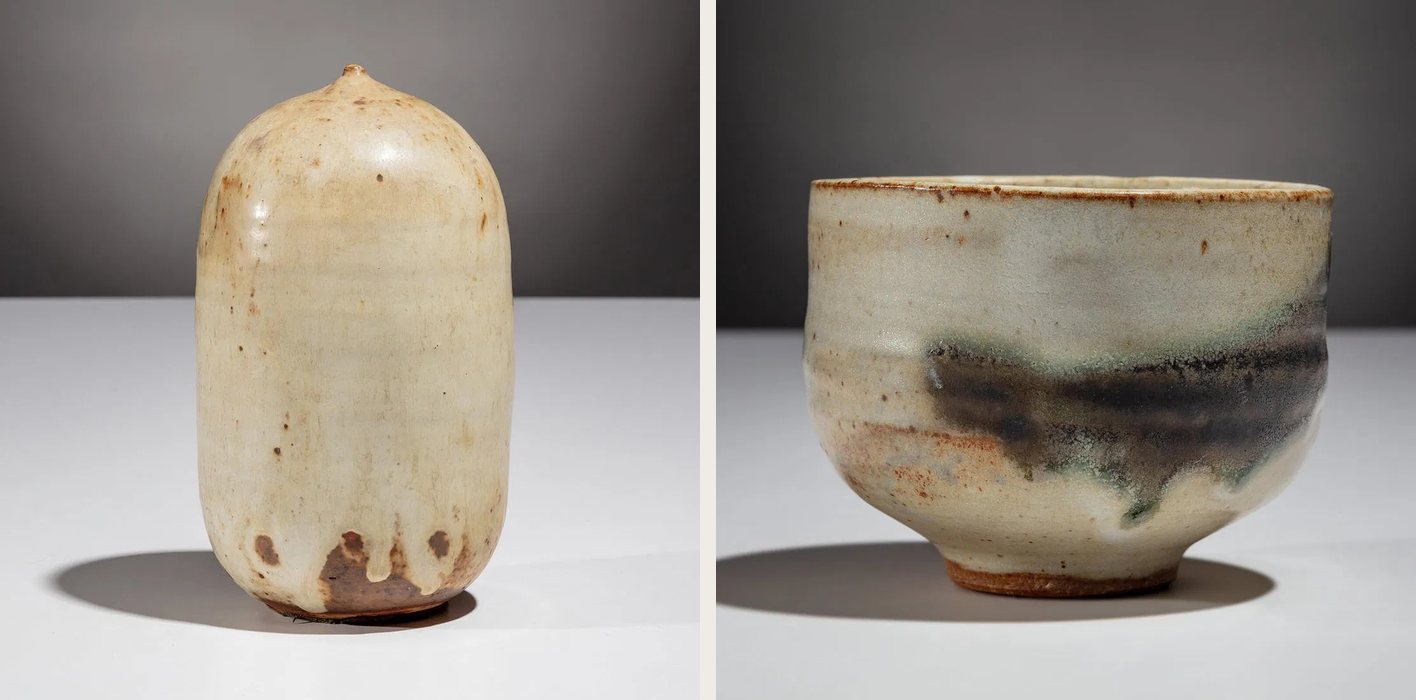
Size-matched and same-sale comparisons of Takaezu closed forms with bowls, tea bowls and bottles: how wide the price gap is, and where it narrows.
What a Toshiko Takaezu closed form is, how the series differ, what documentation and condition mean, and what 821 public auction results show.