

Documenting a Toshiko Takaezu Work for Sale: Lessons From Actual Transactions
What 803 public Takaezu lot records document, what marks, provenance and earlier sales can and cannot prove, and what to gather before selling.
Prepared by Artemis Collection. Market figures are drawn from public auction records as described in the methodology note; they are not appraisals.
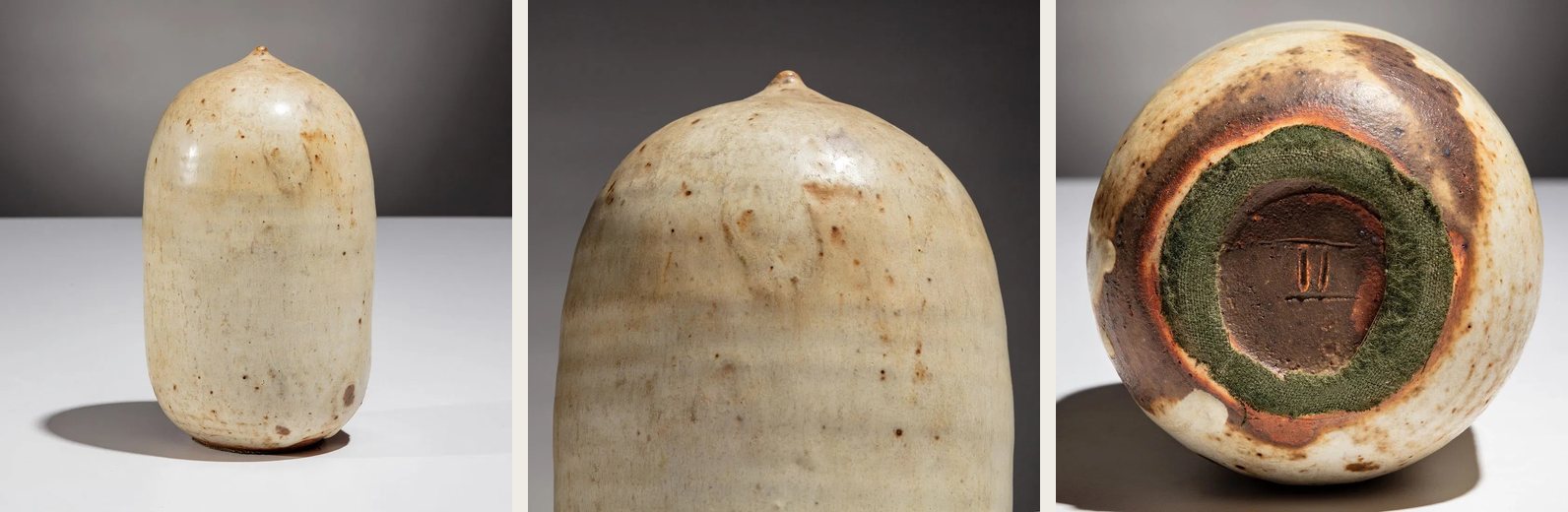
A Toshiko Takaezu ceramic is documented by two kinds of evidence: the object itself (its form, size, material, glaze, the incised mark and its condition) and its history (who owned it, where it was exhibited or published, and how it has been sold before). No single document settles authorship. The Toshiko Takaezu Foundation states that it does not authenticate artwork, and we know of no published catalogue raisonné of her ceramics, so buyers and auction houses weigh the object and its history together.1
Public auction records show what the market actually writes down. In 803 Takaezu lot pages from Rago, Wright, LAMA and Toomey (2001 to October 2026), every record gives dimensions and material, 92% record a mark, and 86% give an approximate date and a provenance line. Fewer than one in ten cite literature or exhibition history, and none states condition on the page. Once form, size, material and sale year are taken into account, we could measure no premium for any particular kind of provenance; lots with no provenance line at all sold about a fifth lower. This guide sets out what each kind of evidence can and cannot establish, using real lots, and what an owner should assemble before selling.
What each kind of evidence can and cannot establish
| Evidence | What it can establish | What it cannot establish |
|---|---|---|
| The object: form, clay, glaze, making | Consistency with Takaezu's documented forms and techniques; the main basis of any judgement | Authorship on its own; she taught for decades and trained live-in apprentices, and auction records include works catalogued only as "in the manner of" or "attributed" |
| Incised "TT" mark | That the piece carries the mark catalogues expect (92% of lot records note one) | Authorship: a mark can be absent from genuine works and added to others |
| Measurements | Identity: which object this is, matched against earlier records | Date or authorship |
| "Acquired directly from the artist" | A plausible origin, especially with a letter, receipt or photograph from the time | Much on price: it is the most common provenance in the record (52% of lots) |
| Gallery invoice or label | A dated link to the market of her lifetime (Perimeter, Charles Cowles and others appear in lot records) | That the invoice belongs to this object, unless it describes it closely |
| Exhibition or publication | That this object, or one like it, was shown or illustrated; check whether a catalogue "illustrates this example" or only "related examples" | Value: exhibited small works sell like other small works |
| Earlier auction record | Identity and a dated price, publicly visible to every later buyer | Today's value; and earlier descriptions often differ |
| Condition report | The house's opinion of condition before sale | Everything: the houses' own terms say reports may not cover all faults |
| Museum records | How institutions describe comparable works | Anything about a different object |
| The Foundation | Biography, chronology, rights in images | Authentication, which it does not provide |
What public lot records actually contain
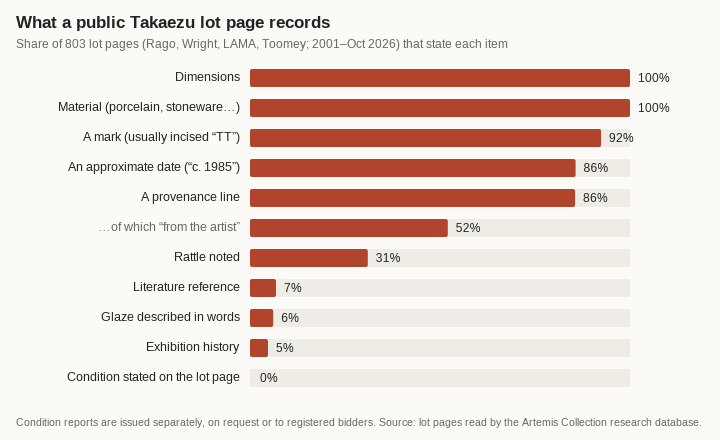
Four points stand out.
Old records are thin. Of the 62 lot pages from 2001 to 2020 that we could read, 21% gave any provenance and 23% an approximate date; from 2023 onward more than 90% give both. If your piece last sold before about 2021, the old catalogue entry probably says very little, and a new one will need the history you can supply.
The date is an estimate. Almost every record dates a work "c. 1985" or similar. Museums do the same: the Cleveland Museum of Art dates its tall White Form "c. 1990–95" and the Smithsonian American Art Museum dates its closed form "ca. 1980s".23 A dated letter or receipt narrows that; a cataloguer's "circa" does not.
Marks are recorded, not interpreted. Nearly every mark is an incised "TT" on the underside. 27 records add a letter or another mark ("TT S", "TT P", "TT K"), and 12 describe a glazed rather than an incised signature. We have found no published key to the added letters and would not infer anything from them.
Glaze is rarely put into words. Only 6% of records describe the glaze; the catalogue photograph does that work. That is one reason your own photographs matter (see how size, surface and glaze relate to price).
Does documentation change the price?
We compared sold prices for 526 single objects sold since 2021 after accounting for form, largest dimension, material and sale year (method below). Against lots "acquired from the artist":
| Provenance or record | Lots | Price relative to "from the artist" | 95% range |
|---|---|---|---|
| Private collection only (place named) | 105 | about the same (×0.99) | ×0.86–1.15 |
| Named collection or estate | 32 | ×0.88 | ×0.69–1.13 |
| Gallery or dealer of her lifetime | 30 | ×1.22 | ×0.99–1.51 |
| Earlier auction, including benefit auctions | 21 | ×1.16 | ×0.89–1.51 |
| No provenance line | 49 | ×0.78 | ×0.64–0.94 |
| Exhibition history cited (any provenance) | 23 | ×1.28 | ×0.95–1.73 |
| Literature cited | 42 | ×0.96 | ×0.78–1.17 |
| No mark recorded | 26 | ×0.87 | ×0.63–1.19 |
Only the "no provenance line" difference is clearly distinguishable from no difference, and even that includes lots in single-owner sales where the provenance sits in the sale title rather than the lot record. The honest reading is that, in this market, documentation mainly does two other jobs: it lets a house accept and catalogue a piece with confidence, and it lets buyers recognise the object. It does not, on average, add a measurable premium to a work that is otherwise comparable.
Two high results show that a missing element is not fatal when the object and the context are strong. Green Moon (with rattle), 24 inches high, dated 1993, records no mark and no provenance line on its page; it hammered at $85,000 in Rago's Masterworks of Craft from Jane & Leonard Korman sale on 9 November 2023 (lot 126), where the collection was named in the sale title.4 A 33-inch closed form, c. 1985, with no recorded mark hammered at $75,000 at Rago on 7 October 2026 (lot 204); it was "sold with a photograph of the artist next to the present work", and its provenance was given as acquired directly from the artist.5 It still sold below its $80,000–120,000 estimate.
Lessons from objects that sold twice
Some objects appear twice in the record. Comparing the two catalogue entries shows how the description of the same piece changes, and why an owner should keep the earlier one.
| Object | First sale | Second sale | What changed in the record | Hammer |
|---|---|---|---|---|
| Moon, c. 1970, with stand | LAMA, 24 Oct 2021, lot 152: "Full Moon", "hand-built glazed ceramic", 12¾ × 11¼ in. | Rago, 22 Feb 2024, lot 188: "Moon (with rattle)", "glazed stoneware, patinated iron", 12 × 11½ in. | Title, material and dimensions changed; two exhibitions (1975, 1987) added; the earlier sale became part of the provenance | $15,000 → $38,000 |
| Kazan, c. 1970 | LAMA, 24 Oct 2021, lot 154: 25 × 21 × 23 in., "Signed to base 'TT'" | Rago, 22 Feb 2024, lot 193: "Kazan (Closed Form)", 26 × 22 in. dia., incised signature | Dimensions re-measured; a 1987 Honolulu exhibition added | $7,500 → $16,000 |
| Closed form, porcelain, 8½ × 5½ in. | Rago, 22 Sep 2018, lot 1518: "Moonpot", no provenance | Rago, 18 Jan 2020, lot 724: "Closed Form", provenance cites the 2018 lot | Title changed; earlier sale recorded | $1,400 → $2,200 |
| Vase, c. 1975 | Wright, 3 Aug 2023, lot 238: 6½ × 7⅛ in., estimate $3,000–5,000 | Rago, 17 Oct 2024, lot 151: 6½ × 7 in., estimate $1,000–1,500 | Earlier sale recorded; estimate cut | $1,200 → $884 |
| Large charger, c. 1972 | Rago, 19 Nov 2025, lot 242 | Rago, 18 Feb 2026, lot 144 | Identical entry, three months apart | $800 → $700 |
The lessons are practical:
- Titles and measurements drift. "Full Moon" became "Moon (with rattle)"; a 25-inch height became 26. Rago Wright's terms say that any description of dimensions is approximate.9 Identify an object by photographs, measurements and provenance together, never by title alone.
- Earlier sales become provenance. Recent Rago-group catalogues cite an earlier sale by house, date and lot number. Every later buyer can see what the piece made before.
- Do not read the price change as the effect of the paperwork. The two LAMA-to-Rago objects more than doubled between 2021 and 2024 while gaining exhibition history, but closed-form prices in general roughly doubled over the same years in our data. Two cases cannot separate the two effects.
- A buy-in is visible too. We found 17 lots recorded without a sale (unsold or withdrawn) that reappeared later with the same measurements and provenance; 15 sold at the second attempt, 14 of the 17 with a lower estimate. One porcelain closed form with a deep blue glaze, 5 inches high, was offered by Rago in February 2025 at $4,000–6,000 with no result shown (lot 172), then hammered at $22,000 at the same estimate in October 2025 (lot 160).6
Exhibited and published works
Exhibition history appears mostly on large and early works, and it does not make a small work large. Two small stoneware closed forms, c. 1965, each recorded as exhibited in Toshiko Takaezu: Worlds Within at the Noguchi Museum (2024) and at David Zwirner, Los Angeles, and each cited to page 24 of the exhibition catalogue, sold at Rago on 13 May 2026 for $4,000 (lot 170, 5½ inches high) and $2,200 (lot 173, 4⅛ inches) against estimates of $3,000–5,000.7 At the other end, Makaha Blue, a porcelain form 47¾ inches high, illustrated in a Perimeter Gallery catalogue and exhibited in 1997 and 2000, hammered at $100,000 in the Korman sale.4
Read a literature line carefully: 17 records say a publication "illustrates this example"; 38 cite only "related" or "similar" examples, which says nothing about the object being sold.
What accompanies a piece
Seventeen lot records mention something sold with the object: copies of gallery or museum invoices (Perimeter Gallery, Akar, Ferrin Gallery, the Racine Art Museum, earlier Rago invoices), exhibition catalogues, a 1988 exhibition poster, a photograph of the artist beside the work, and display stands or bases. One record notes an original paper label on the underside, reading "INV 41 Cranberry Closed Form 1988", with the signature "likely underneath".8 Labels and added material on the foot are part of the object's history. Photograph them, do not remove them, and tell the buyer what they cover.
Condition is documented separately
Rago Wright's terms describe the lot page as including title, approximate date, dimensions, materials, provenance, exhibition history and literature, and say that condition reports are available before the sale, may not cover all faults, restoration or alteration, and, like catalogue descriptions, are statements of opinion rather than fact. The terms also warn that images may not show condition clearly and that colours can look different on screen. Their Authorship Warranty runs for two years and covers only the creator named in bold capitals, not the supplementary description.910 An owner should therefore keep a separate, dated condition record of their own: chips, cracks, glaze losses, firing flaws and any restoration they know of. Our guide to damage, restoration and value covers the vocabulary.
An owner's documentation file
Before approaching a dealer or auction house, assemble:
- Measurements: height and greatest width or diameter, in inches and centimetres, measured without any stand (record the stand separately).
- Photographs in even daylight: the whole piece from four sides, the top and any opening, the underside with the mark, and close-ups of any damage, labels or added material. Note the colour of the glaze in words too, because screens differ.
- The rattle: whether a bead can be heard when the piece is tilted gently (never shaken).
- Provenance papers: letters, receipts, invoices, gift notes, photographs with the artist, with dates and names.
- Exhibition and publication references, with page numbers, and whether the publication shows this piece.
- Earlier auction records: house, sale, date, lot number and a saved copy (PDF or print) of the lot page, because online pages change.
- A dated condition note in your own words.
The guide to selling a Takaezu covers the next steps, and Takaezu closed forms explains the forms and series. For how documents support (but do not prove) an attribution generally, see which documents matter for provenance.
How these figures were calculated
- Source: public Takaezu lot pages from Rago, Wright, LAMA and Toomey & Co. (one auction platform, Rago Wright), as parsed into the Artemis Collection research database, queried read-only on 9 November 2026. 803 lot pages from 2001 to October 2026 were readable; duplicates captured twice have been removed. No private sale and no Artemis transaction is included.
- Shares: a field counts as present if the lot page states it. "From the artist" covers "acquired directly from the artist", gifts from the artist and similar wording.
- Price comparison: 526 single objects sold 2021 to October 2026 with a measurement and a form classifiable as closed form, bowl or plate, or vase, bottle or similar vessel. Log hammer price was regressed on form group, the logarithm of the largest dimension, porcelain or not, Moon or not, sale year and the provenance and record indicators shown; the table gives the exponentiated coefficients with heteroscedasticity-robust 95% ranges. Associations, not causes.
- Prices: hammer price in US dollars, nominal, from each house's published result divided by its dated buyer's-premium rate (premiums added 25–28% in these records). Premium-inclusive results quoted from lot pages are labelled as such.
- Repeat sales and re-offers: matched on identical published measurements, material and provenance, or on a provenance line citing the earlier lot, and checked against the catalogue photographs.
- Limits: one auction platform dominates; condition is not on the lot pages and is not controlled; a missing field may reflect cataloguing practice rather than the object. Past results do not establish the value of another piece.
-
Toshiko Takaezu Foundation website, footer statement, accessed 9 November 2026. ↩
-
Cleveland Museum of Art, White Form, 2010.236, open-access record, accessed 9 November 2026. ↩
-
Smithsonian American Art Museum, Untitled, 2006.26.6, accessed 9 November 2026. ↩
-
Rago, Masterworks of Craft from Jane & Leonard Korman, 9 November 2023, lots 126 and 127 (lot 126, lot 127); lot 126 result $107,100 including premium. ↩↩
-
Rago, Post War & Contemporary Ceramics, 7 October 2026, lot 204; result $96,000 including premium. ↩
-
Rago, Post War & Contemporary Ceramics, 19 February 2025, lot 172, and 10 October 2025, lot 160. The February page shows an estimate and no result; we treat it as unsold or withdrawn. ↩
-
Rago Wright, LLC, Auction Terms of Sale, last updated 2 March 2026, accessed 9 November 2026. ↩↩
-
Rago, "Bidding" help page, accessed 9 November 2026. ↩
Sources
- Toshiko Takaezu Foundation, home page (footer statement). "The Toshiko Takaezu Foundation does not authenticate artwork." Accessed 9 November 2026.
- Toshiko Takaezu Foundation, Chronology. Dates of the first closed form (1958) and of exhibitions cited in lot records. Accessed 9 November 2026.
- Cleveland Museum of Art, Toshiko Takaezu, White Form, c. 1990–95, accession 2010.236 (open-access record). Dated as a range; provenance "Given to John Paul Miller by the artist"; no inscription recorded. Accessed 9 November 2026.
- Smithsonian American Art Museum, Toshiko Takaezu, Untitled, ca. 1980s, 2006.26.6. Dated "ca. 1980s"; credit line "Gift of the artist"; dimensions given as irregular. Accessed 9 November 2026.
- Rago Wright, LLC, Auction Terms of Sale (last updated 2 March 2026; covers Rago, Wright, LAMA and Toomey & Co.). Lot descriptions, condition reports, approximate dimensions, on-screen colour, Authorship Warranty. Accessed 9 November 2026.
- Rago, Bidding (help page). Registered account holders can view condition reports. Accessed 9 November 2026.
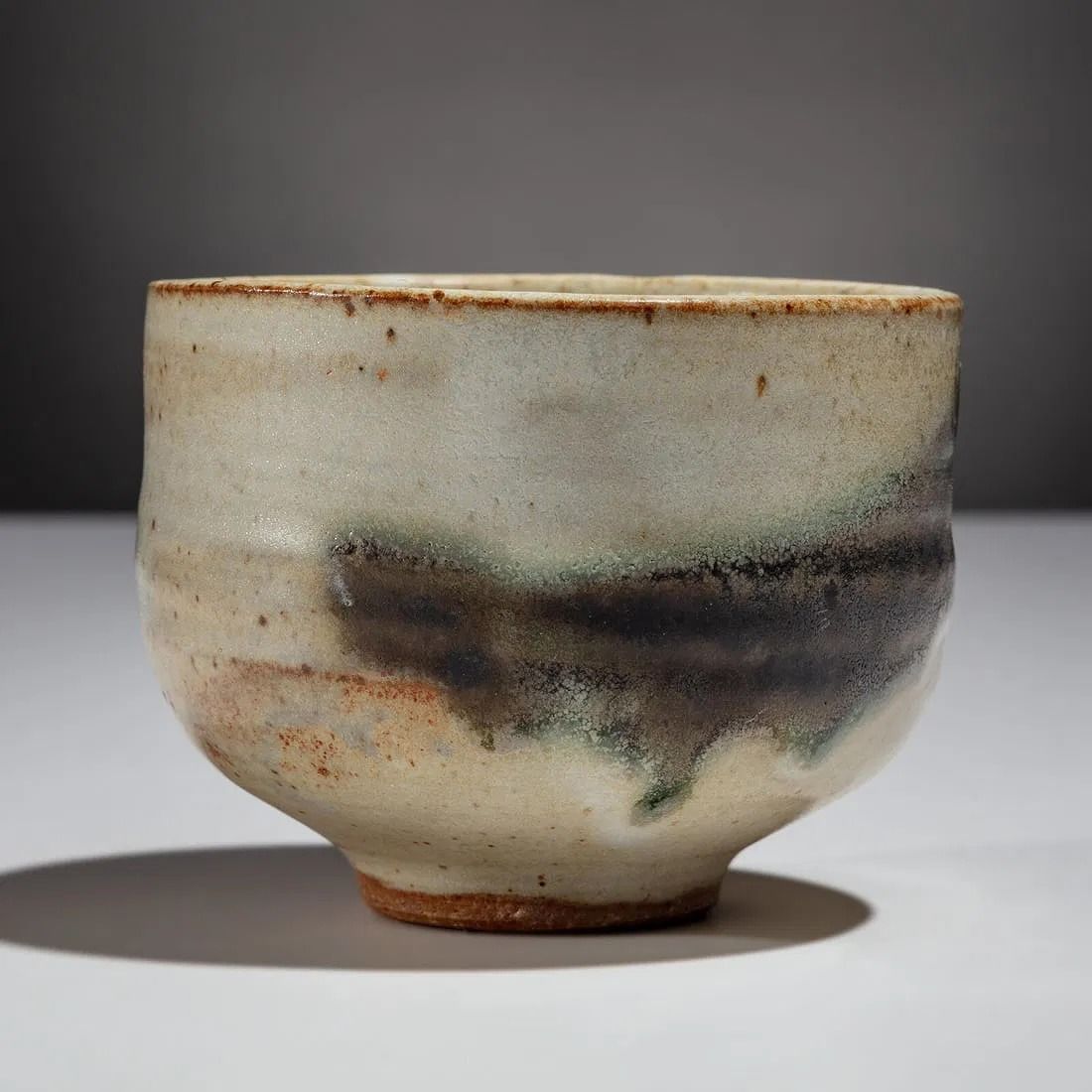
Selling a Toshiko Takaezu closed form, bowl or tea bowl: what drives price in public results, where her work sells, what to document and how to ship it.
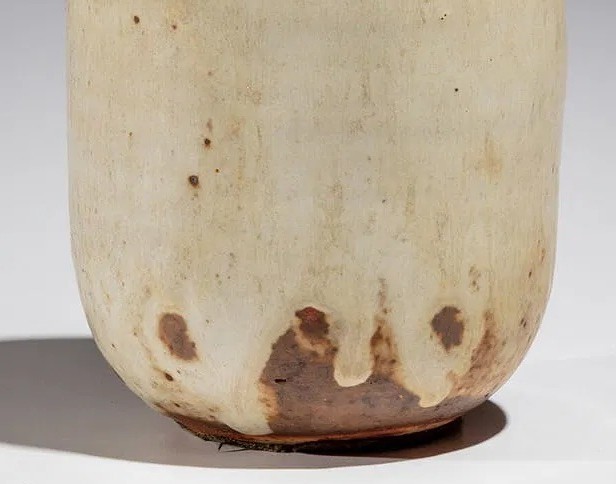
Matched public results for Takaezu closed forms: what height adds, why porcelain and rattles matter less than assumed, and what blue glaze is worth.
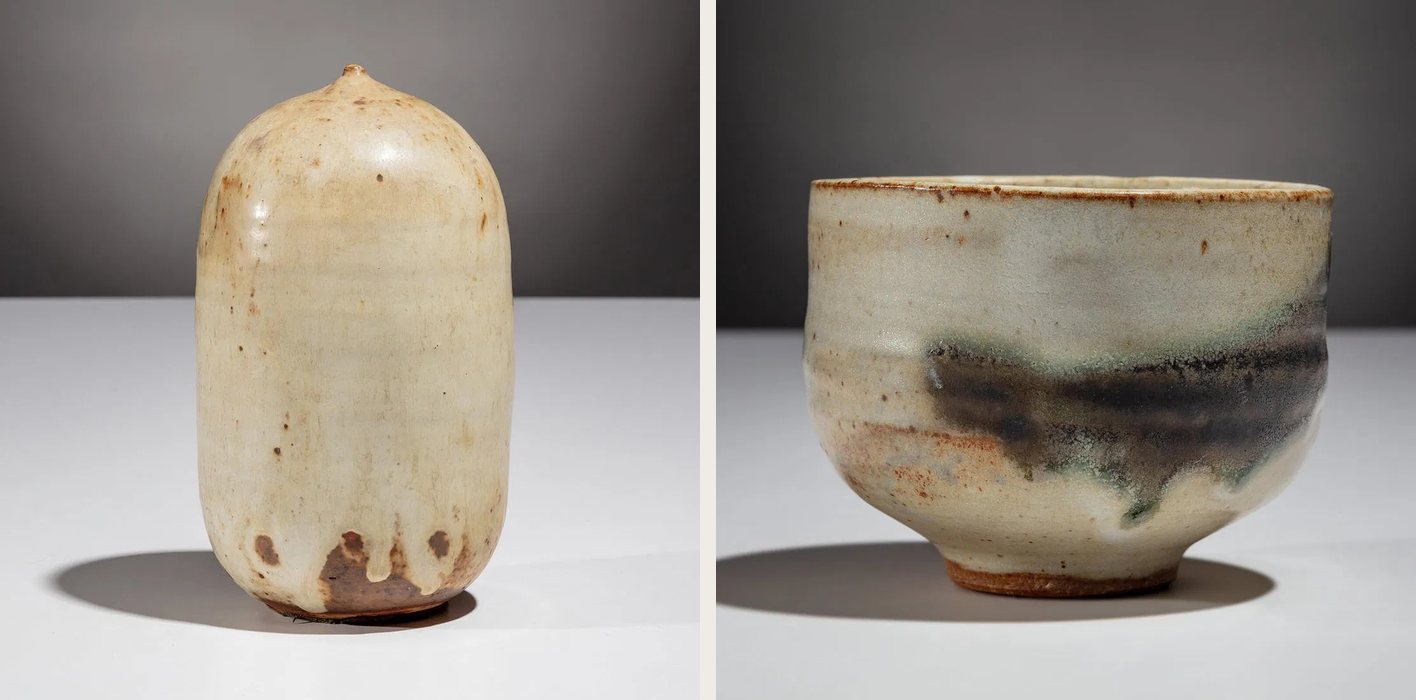
Size-matched and same-sale comparisons of Takaezu closed forms with bowls, tea bowls and bottles: how wide the price gap is, and where it narrows.