

How Size, Surface and Glaze Influence Takaezu Ceramic Prices
Matched public results for Takaezu closed forms: what height adds, why porcelain and rattles matter less than assumed, and what blue glaze is worth.
Prepared by Artemis Collection. Market figures are drawn from public auction records as described in the methodology note; they are not appraisals.
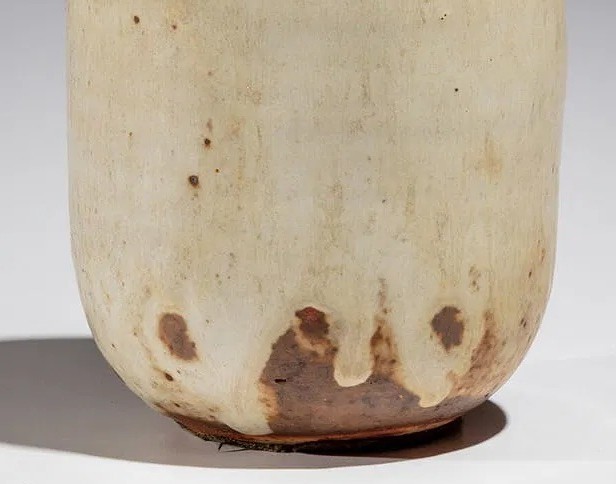
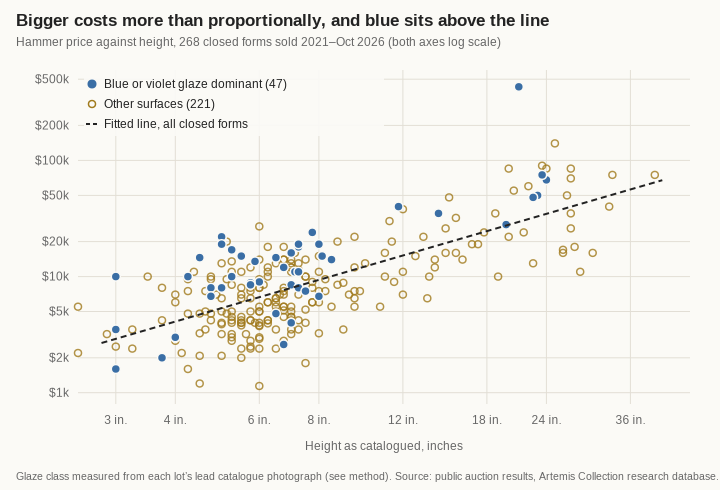
For a Toshiko Takaezu closed form, size sets the level and surface moves the price around it. In public auction results since 2021, doubling a closed form's height went with roughly 2¼ times the hammer price. At a given height, the clearest surface signal we could measure was colour: closed forms whose catalogue photograph is dominated by a saturated blue or violet glaze sold for about 1½ times comparable pieces, and in 18 of 22 same-sale pairs of near-identical size the blue piece made more. Porcelain against stoneware and the presence of a rattle, often assumed to matter, showed no consistent effect once pieces were matched. Even so, two closed forms of the same size, material and sale typically sold 1.6 times apart, so no measurement replaces looking at the surface.
This article goes beyond the height bands in our guide to closed forms: it uses matched pairs from the same sales and a measurement of glaze colour taken from each lot's catalogue photograph (method below). For how closed forms compare with bowls and other open forms, see closed forms versus open vessels.
Size: price rises faster than height
| Height | Lots | Median hammer | Middle half |
|---|---|---|---|
| Under 4 in. | 14 | $3,350 | $2,424–5,175 |
| 4 to under 5 in. | 33 | $6,000 | $3,250–8,000 |
| 5 to under 6 in. | 60 | $5,000 | $3,973–9,003 |
| 6 to under 7 in. | 57 | $6,000 | $4,200–9,000 |
| 7 to under 8 in. | 42 | $8,000 | $4,500–12,000 |
| 8 to under 10 in. | 26 | $8,000 | $6,818–13,500 |
| 10 to under 12 in. | 11 | $10,000 | $6,750–18,000 |
| 12 to under 15 in. | 12 | $14,500 | $10,750–23,000 |
| 15 to under 18 in. | 7 | $19,000 | $17,500–28,000 |
| 18 to under 24 in. | 14 | $49,000 | $25,000–71,250 |
| 24 in. and over | 16 | $45,000 | $17,750–75,000 |
Closed forms sold since 2021 with a published height (292 of 309). Bands above 10 inches are small samples.
Two features of the table matter for an owner. Between 4 and 7 inches, where most closed forms sit, the medians barely move: in that range, height is not what separates a $4,000 result from a $15,000 one. Above about a foot, prices climb steeply, and the largest forms behave as a separate market in which series, exhibition history and the room on the day count for a great deal.
A single sale shows the ladder clearly. At Rago on 11 June 2026, three stoneware closed forms sold in the same session: one 7 inches high for $3,500, one 18¾ inches for $35,000 and a Tall Closed Form of 1988, 40½ inches, for $75,000 (lots 220, 213 and 217).1 Ten times the price for 2.7 times the height, then roughly double again for double the height.
Surface: what we could measure
Auction catalogues rarely describe glaze in words: across 803 Takaezu lot pages, only 6% use any glaze or colour term (see documenting a Takaezu for sale). The photograph does that work. To test whether colour matters, we measured the share of each lead catalogue photograph's central area covered by saturated blue or violet, and flagged pieces where that share reached 10% or more. On inspection, those are pieces where cobalt or violet is the dominant glaze; partly violet pieces mostly fall below the line, so the test is conservative.
After allowing for height, material, rattle, Moon form and sale year:
| Feature | Lots with it | Price relative to comparable pieces | 95% range |
|---|---|---|---|
| Blue or violet glaze dominant | 47 of 268 | ×1.53 | ×1.29–1.82 |
| Porcelain (against stoneware) | 142 of 268 | ×1.16 | ×1.02–1.33 |
| Rattle noted | 184 of 268 | ×1.13 | ×0.97–1.31 |
| Catalogued as a Moon | 16 of 268 | ×2.08 | ×1.44–3.02 |
| Each doubling of height | 268 | ×2.2 | ×2.0–2.4 |
The colour result holds when the threshold changes: at 5%, 15% or 20% of the image, the estimate stays between ×1.4 and ×1.7. It also holds in direct comparisons. We found 68 pairs of closed forms sold in the same sale, of the same material and rattle status, within 10% of each other in height. In the 22 pairs where only one piece was blue-dominant, the blue piece sold for more in 18, with a median ratio of 1.6.
The same measure applied to 153 bowls, tea bowls and plates gave a similar effect (×2.1, though only 16 were blue-dominant), so this is not peculiar to closed forms.
Porcelain and rattles are a different story. The model above gives porcelain a small premium, but matched directly, in the same sale and at similar height, porcelain closed forms sold above their stoneware neighbours in only 40% of 42 comparisons (median ratio 0.95). Rattle against no rattle, matched the same way, came out even: 49% of 57 comparisons, median ratio 1.00. Neither is a reliable price signal on its own. The decade a piece was made, as catalogued, showed no consistent pattern from the 1970s to the 2000s; 1960s closed forms sold somewhat lower, on 12 lots.
Glaze and series names in titles are too rare to measure: Ocean Edge appears in 10 closed-form titles, Makaha Blue in 2. Both tend to sit above the line, but the samples cannot support a figure.
Matched case studies
Each pair below sold in the same sale, so the date, room and bidders were the same. Hammer prices are the published results less the buyer's premium.
| Sale | Higher result | Lower result | What differs |
|---|---|---|---|
| Rago, 10 Oct 2025 | Lot 160: porcelain, rattle, 5 in., c. 1995, deep blue drip glaze: $22,000 | Lot 158: porcelain, rattle, 4⅝ in., c. 1970, pale and earth-toned: $3,500 | Colour and date; same $4,000–6,000 estimate |
| Rago, 2 Oct 2024 | Lot 216: porcelain, rattle, 5¼ in., c. 1980, blue over dark ground: $17,000 | Lot 220: porcelain, rattle, 5¼ in., c. 1995, white with green: $4,000 | Colour; both acquired directly from the artist |
| Rago, 13 Apr 2023 | Lot 100: porcelain, rattle, 7¾ in., c. 1995, violet band over landscape: $24,000 | Lot 153: porcelain, rattle, 8 in., ochre and brown: $6,000 | Colour; both catalogued as from a private collection in Honolulu |
| Rago, 12 Jun 2024 | Lot 159: porcelain, rattle, 5½ in., c. 1990, blue: $15,000 | Lot 154: porcelain, 12 in., c. 1985: $7,000 (estimate $10,000–15,000) | Half the height, twice the price |
| Rago, 13 Apr 2023 | Lot 123: porcelain, rattle, 5½ in., deep red and violet: $11,000 | Lot 156: porcelain, rattle, 5¼ in., white with pink: $11,000 | Different palettes, identical result |
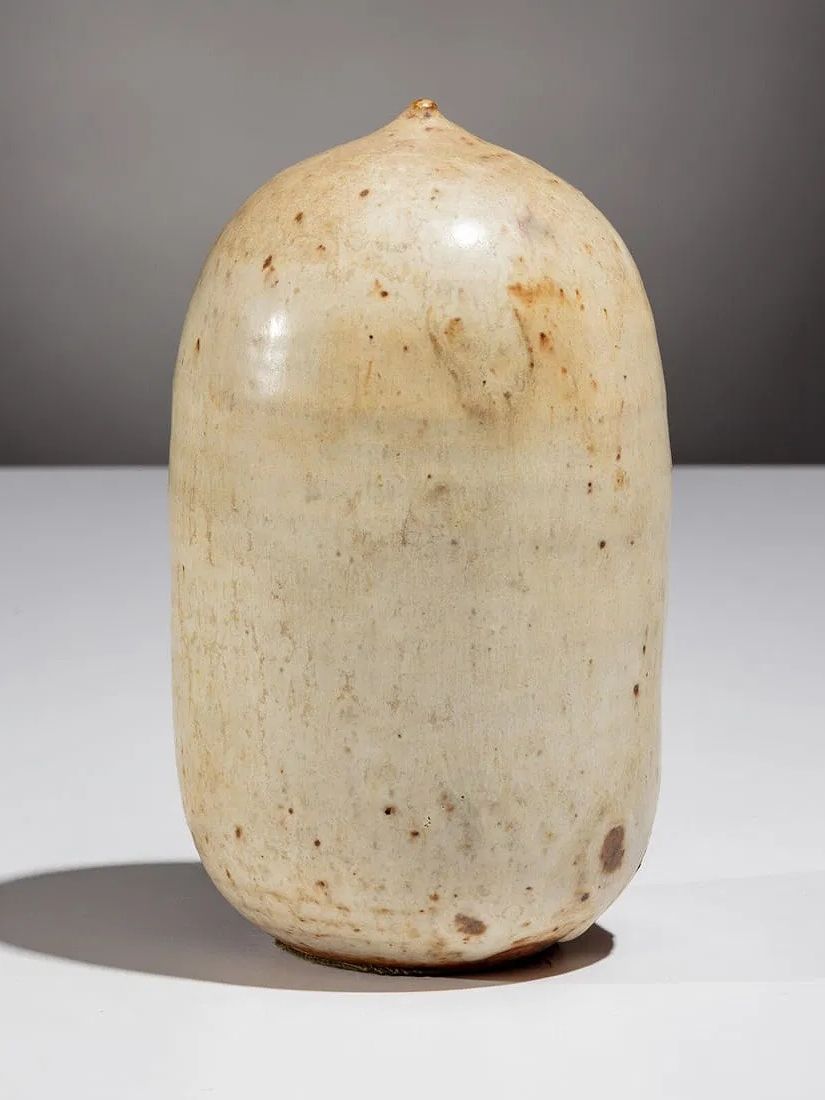
Descriptions of colour are ours, from the catalogue photographs; dimensions, dates and results are from the lot pages.2 The last pair is a reminder that blue is not the only surface buyers pay for: both pieces have strong, resolved glazing, and they made the same price. The house's estimates did not anticipate the colour effect. Blue-dominant closed forms sold at a median 1.7 times their mid-estimate, with 81% above the high estimate, against 1.44 times and 61% for the rest.
What the measurements leave out
Even with height, material, rattle, Moon form, colour and year in the model, about a third of the variation in price is unexplained, and same-sale near-twins of the same colour class still differed by a median of 1.6 times. What fills that gap is what the camera and the catalogue do not capture well: the quality and depth of the glaze, how the drips and pools resolve, the balance of the form, condition, and how many committed bidders are in the room. Rago Wright's own terms warn that images may not show condition clearly and that colours can look different on screen.3
The Takaezu Foundation describes her glazing as applied by dripping, splashing, pouring and brushing, a process open to chance.4 That is why two pieces of identical size and clay can sit far apart, and why a description in words, beside good photographs, helps a buyer see what they are bidding on.
What this means for an owner
- Measure height precisely, in inches and centimetres. Above about 12 inches, each inch matters a great deal.
- Photograph the surface in daylight from four sides and describe the colours in words. Screens differ, and a cataloguer will work from what you send.
- Do not lean on porcelain or a rattle as a reason for a higher price; in matched sales neither made a consistent difference.
- Compare like with like: same form, similar height and a similar surface, ideally from the same few sales. A single result for a different glaze can mislead by a factor of three or more.
- Expect estimates to trail strong surfaces. Houses set estimates mainly by size; striking glazes often finish well above them.
How these figures were calculated
- Source: public auction results for Toshiko Takaezu in the Artemis Collection research database, queried read-only on 2 November 2026, joined to the published lot pages. Duplicate captures were removed. No private sale and no Artemis transaction is included.
- Sample: single closed forms (including Moons and bells, excluding garden seats and a bronze) sold January 2021 to October 2026: 309 lots, 292 with a published height, mostly from Rago, Wright, LAMA and Toomey.
- Prices: hammer price in US dollars, nominal: the published result divided by the house's dated buyer's-premium rate (25–28% for these sales).
- Colour: for each lot, the lead catalogue photograph published by the house (fetched once for measurement; not reproduced here). In the central 60% by 70% of the image, we counted pixels with saturation of at least 0.30 and brightness of at least 0.15 whose hue fell between 190° and 300° (blue to violet). A lot was flagged if that share was 10% or more; 268 of 292 lots had a measurable photograph (for the other 24, mostly Wright lots, no image could be retrieved). Lighting, background and a single viewpoint all affect the measure; we checked a sample of flagged images by eye.
- Model: ordinary least squares on log hammer price with log height, porcelain, rattle, Moon, decade where catalogued, and sale year; robust 95% ranges. R² rose from 0.64 to 0.67 when colour was added.
- Matched pairs: two closed forms in the same sale, same material and rattle status, heights within 10% (or 15% for the porcelain and rattle comparisons, matched on the other attribute).
- Limits: one auction platform supplies most lots; condition is not controlled; catalogue dates are estimates. Past results do not establish the value of another piece.
-
Rago, Post War & Contemporary Ceramics, 11 June 2026, lot 220, lot 213 and lot 217; results including premium $4,480, $44,800 and $96,000. ↩
-
Rago, 10 October 2025, lot 160 and lot 158; 2 October 2024, lot 216 and lot 220; 13 April 2023, lot 100, lot 153, lot 123 and lot 156; 12 June 2024, lot 159 and lot 154. ↩
-
Rago Wright, LLC, Auction Terms of Sale, "Lot Descriptions & Photographs", last updated 2 March 2026, accessed 2 November 2026. ↩
-
Toshiko Takaezu Foundation, "About Toshiko", accessed 2 November 2026. ↩
Sources
- Toshiko Takaezu Foundation, About Toshiko. Glaze applied by dripping, splashing, pouring and brushing; forms in stoneware or porcelain, up to six feet. Accessed 2 November 2026.
- Rago Wright, LLC, Auction Terms of Sale (last updated 2 March 2026). Images may not show condition clearly; colours may look different on screen. Accessed 2 November 2026.
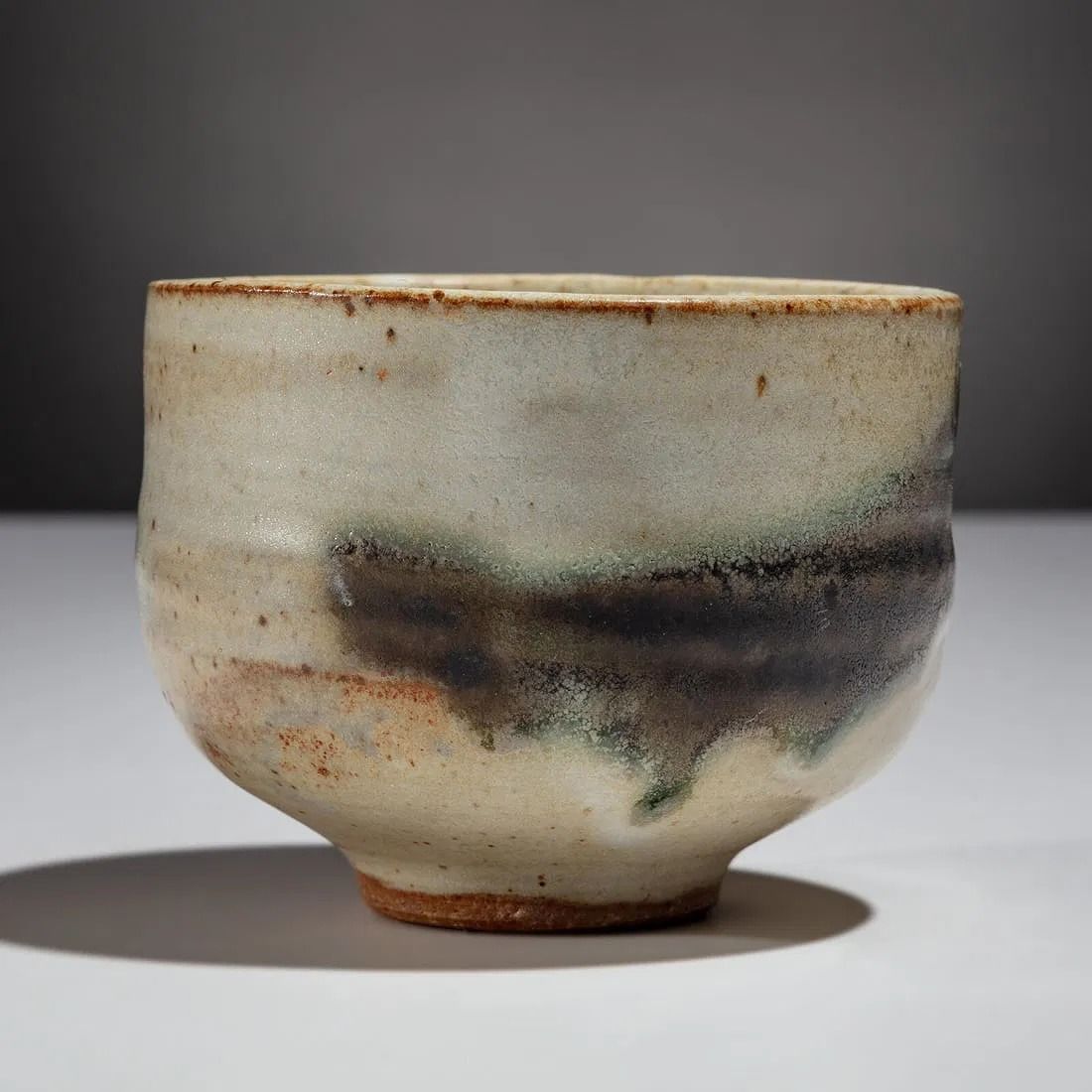
Selling a Toshiko Takaezu closed form, bowl or tea bowl: what drives price in public results, where her work sells, what to document and how to ship it.
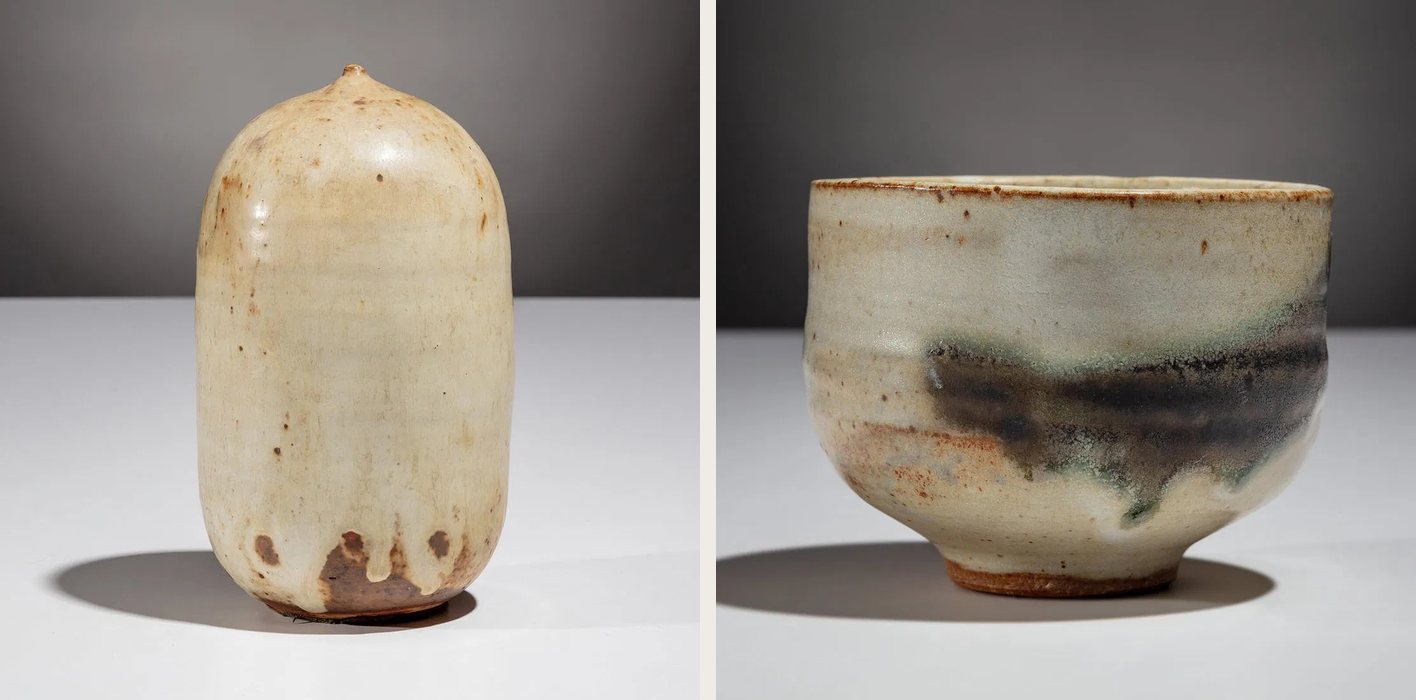
Size-matched and same-sale comparisons of Takaezu closed forms with bowls, tea bowls and bottles: how wide the price gap is, and where it narrows.
What a Toshiko Takaezu closed form is, how the series differ, what documentation and condition mean, and what 821 public auction results show.