

Takaezu Closed Forms Versus Open Vessels: What Auction Prices Reveal
Size-matched and same-sale comparisons of Takaezu closed forms with bowls, tea bowls and bottles: how wide the price gap is, and where it narrows.
Prepared by Artemis Collection. Market figures are drawn from public auction records as described in the methodology note; they are not appraisals.
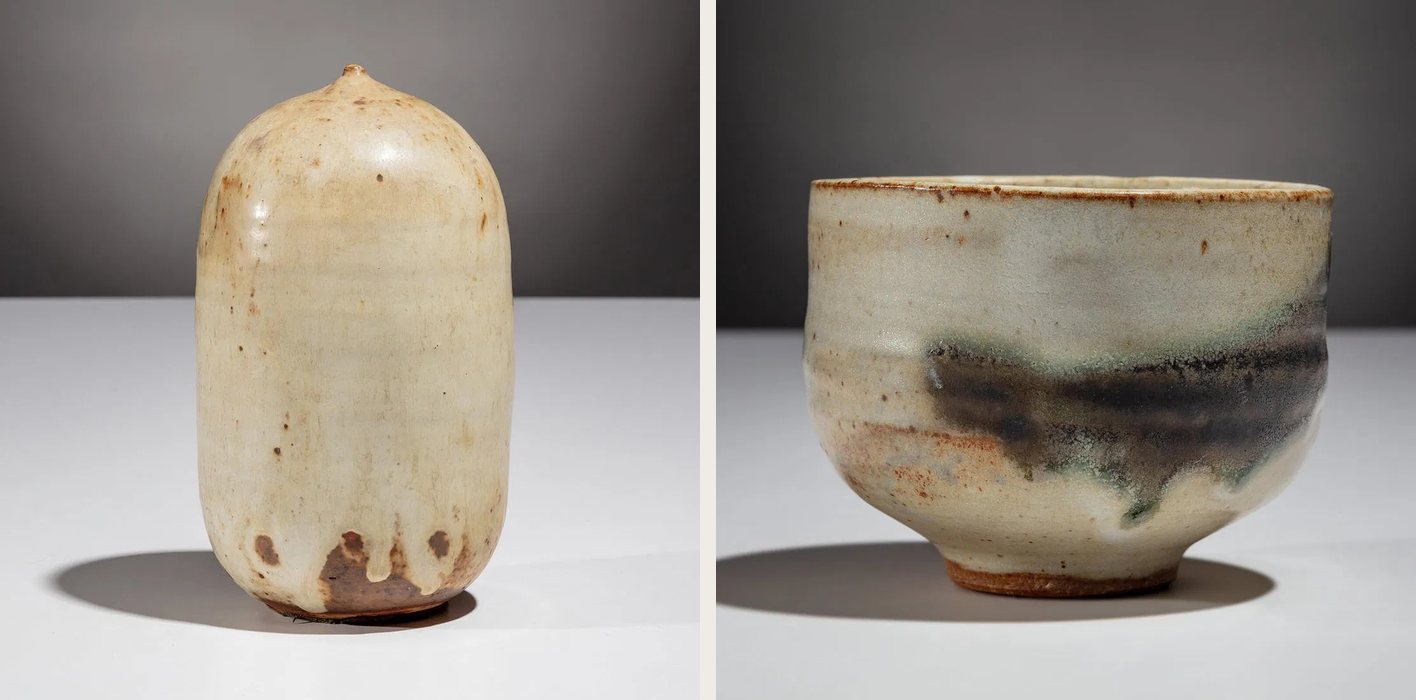
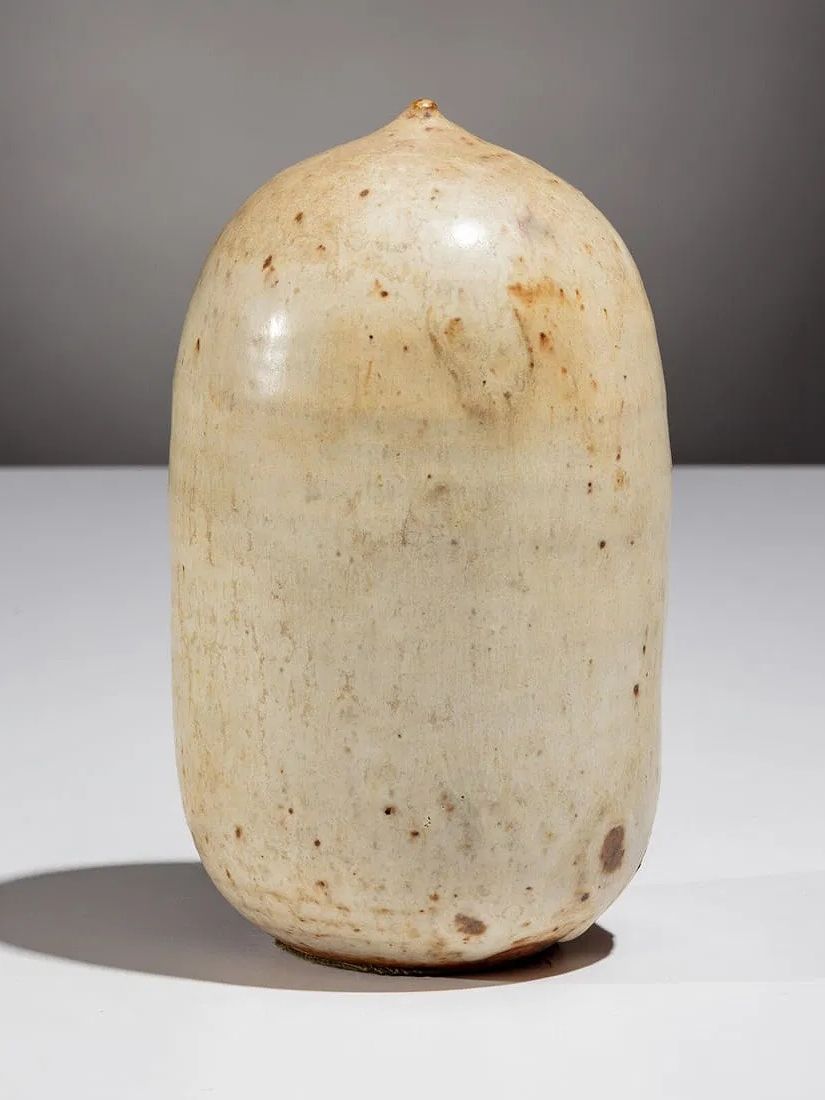
A Toshiko Takaezu closed form sells for many times the price of an open vessel of the same size. In public auction results since 2021, a closed form made about 8.7 times the hammer price of a bowl, tea bowl or plate of the same largest dimension, sold in the same year and in the same material; when the comparison is limited to pieces of matching size offered in the same sale, the closed form made more in all 74 cases we could match, typically about 8 times as much. Vases, bottles and other necked vessels sit in between, at about 3 times the open-vessel level. Open and necked forms come closest when they are early (before 1960) or unusually large; even so, the highest such result since 2021 was $38,000, against closed-form results reaching $430,000.
Our guide to closed forms gives the overall medians by form and height. This article asks a narrower question: is the gap simply a matter of size, and where, if anywhere, does it close?
Two markets, not one
Of the 637 single objects by Takaezu sold at auction since January 2021 in our data, closed forms (including Moons and bells) were 49% of the lots and 73% of the total hammer value. Bowls, tea bowls and plates were 28% of the lots and 4% of the value. Of the 168 lots that hammered at $10,000 or more, 126 were closed forms, 7 were necked vessels and none was a bowl, tea bowl or plate; only one open vessel reached $5,000.
| Form, single objects sold 2021–Oct 2026 | Lots | Median hammer | Middle half | Highest |
|---|---|---|---|---|
| Closed form (excluding Moons and bells) | 290 | $7,500 | $4,200–13,000 | $90,000 |
| Moon | 18 | $39,000 | $14,250–78,750 | $430,000 |
| Bottle | 9 | $7,500 | $5,500–13,000 | $16,000 |
| Teapot | 4 | $3,750 | — | $8,000 |
| Planter | 7 | $2,800 | — | $3,500 |
| Vase | 30 | $2,548 | $1,200–3,950 | $38,000 |
| Bowl | 84 | $1,000 | $721–2,050 | $8,500 |
| Plate | 24 | $1,000 | $688–1,500 | $4,800 |
| Tea bowl | 69 | $750 | $500–1,100 | $3,200 |
Sets of open forms sell for less again. In 63 multi-piece lots of bowls, tea bowls or plates with a stated number of pieces, the median was $400 a piece.
The gap is not just size
Closed forms tend to be taller than bowls are wide, so a crude comparison of medians could simply be measuring size. It is not. Grouping every object by its largest dimension (height, width or diameter) shows the gap at every size:
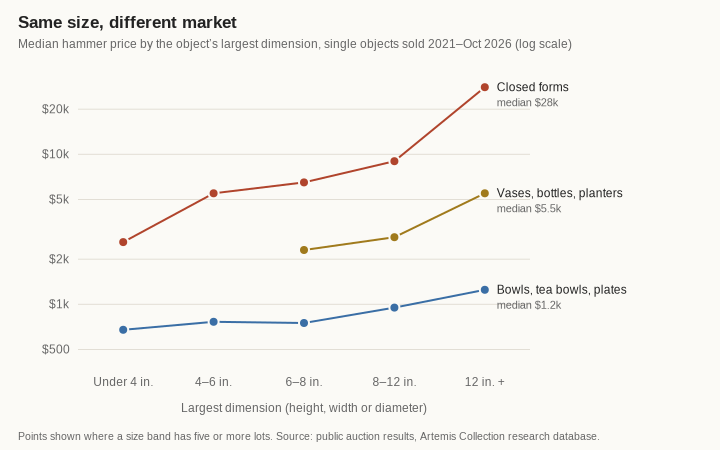
| Largest dimension | Closed forms | Bowls, tea bowls, plates | Vases, bottles, planters |
|---|---|---|---|
| Under 4 in. | $2,600 (11) | $676 (5) | — |
| 4 to under 6 in. | $5,500 (87) | $765 (78) | — (3) |
| 6 to under 8 in. | $6,500 (104) | $750 (21) | $2,300 (16) |
| 8 to under 12 in. | $9,000 (39) | $950 (40) | $2,800 (29) |
| 12 in. and over | $28,000 (53) | $1,250 (34) | $5,500 (6) |
Median hammer, with the number of lots in brackets.
Two things follow. First, at the commonest size, 4 to 6 inches, the median closed form made about seven times the median bowl, tea bowl or plate. Second, size pays more for closed forms: doubling the largest dimension went with about 2½ times the price for a closed form but under twice the price for an open vessel. A 15-inch bowl is still a bowl; a 15-inch closed form is a substantial sculpture.
Statistically, after allowing for largest dimension, porcelain or stoneware and sale year, closed forms sold at about 8.7 times the open-vessel price (95% range 7.7 to 9.8 times) and necked vessels at about 2.8 times (2.1 to 3.6).
Same sale, same size: matched comparisons
A stronger test holds the sale constant, which removes differences in date, house, bidders and season. We matched every bowl, tea bowl or plate with the closed forms of similar largest dimension (within 20%) offered in the same sale. That produced 74 open vessels in 24 sales. In every one of the 74, the matched closed forms made more; the median ratio was 8.0 times (middle half 4.8 to 14 times). For tea bowls alone the median ratio was 8.6 times; for bowls, about 7 times.
Three examples from public results:
| Sale | Closed form | Open vessel | Hammer |
|---|---|---|---|
| Rago, Post War & Contemporary Ceramics, 2 Oct 2024 | Lot 216: porcelain closed form with rattle, 5¼ in. high, c. 1980 | Lot 222: porcelain tea bowl, 5¾ in. wide, c. 1995 | $17,000 against $1,000 |
| Rago, Modern Design, 18 Sep 2025 | Lot 150: stoneware Moon Flask with rattle, 11¾ in. high, 2009 | Lot 153: large stoneware bowl, 12¾ in. diameter, c. 1965 | $40,000 against $950 |
| Rago, Post War & Contemporary Ceramics, 7 Oct 2026 | Lot 210: porcelain closed form, 16 in. high, c. 1987 | Lot 201: large porcelain bowl, 15¾ in. diameter, c. 1987, exhibited in Honolulu in 1987 | $14,000 against $8,500 |
In the first two pairs both pieces were catalogued as acquired directly from the artist, so the difference is not explained by provenance.1 The third pair is the narrowest gap we found: a large, exhibited porcelain bowl at the top of the open-vessel range against a tall closed form near the middle of its size band.
Where open vessels come closest
The open-vessel results that approach closed-form prices share two features.
Early date. Takaezu's chronology dates the idea for her closed forms to 1949, "based on similar bottle forms with barely perceptible neck and openings", records a new double- or multi-spouted bottle in 1954, and places her first truly closed form in 1958.2 At auction, those early necked pieces are a market of their own. An Untitled (Triple Vase), c. 1958, hammered at $38,000 at Rago on 4 October 2023 (lot 147); double-spouted bottles of c. 1955 and c. 1958 made $15,000 and $13,000; and a bottle of c. 1956, illustrated in the Worlds Within exhibition catalogue, made $16,000 at Rago on 13 May 2026 (lot 174).3 After allowing for form, size, material and year, open and necked vessels dated before 1960 sold at about 2½ times the price of later ones (95% range 1.6 to 3.8 times), but this rests on only 18 lots.
Size. The highest bowl result since 2021 was $8,500 for a porcelain bowl 15¾ inches across (the third pair above). Bowls of 12 inches and over had a median of $1,455, against $775 for bowls of 4 to 6 inches.
A practical consequence for owners: a vase, bottle or bowl from the 1950s should be researched and catalogued as an early work, not priced from the general run of functional pots.
Estimates follow the same split
Auction estimates for open vessels are set close to where they sell; closed forms routinely beat theirs. Since 2021:
| Form group | Lots with estimates | Median hammer ÷ mid-estimate | Above high estimate | Below low estimate |
|---|---|---|---|---|
| Closed forms | 310 | 1.5 | 65% | 12% |
| Vases, bottles and similar | 54 | 1.04 | 43% | 31% |
| Bowls, tea bowls, plates | 179 | 1.0 | 40% | 37% |
More than a third of open vessels sold below the low estimate, so a low estimate on a bowl or tea bowl is not a strategy that reliably attracts extra bidding. Discuss the reserve with the house. See how to sell a Takaezu for the selling routes.
What this means for an owner
- Identify the form first. A closed form, a necked bottle and an open bowl are three different markets. A piece with a very small opening at the top is a closed form even if a family has always called it a vase.
- Compare like with like. Use results for the same form and similar largest dimension. A tea bowl result says nothing about a closed form, and the reverse.
- Look for the exceptions. An early (1950s) vessel, an unusually large bowl, or a piece with a documented exhibition history deserves research before it is priced. Our guide to documenting a Takaezu for sale sets out what to gather.
- Within closed forms, size and glaze matter most. See how size, surface and glaze relate to price.
How these figures were calculated
- Source: public auction results for Toshiko Takaezu in the Artemis Collection research database, queried read-only on 4 November 2026, joined to the published lot pages (dimensions, material, date, provenance). Duplicate captures of the same lot were removed. No private sale and no Artemis transaction is included.
- Sample: 637 single objects sold January 2021 to October 2026: Rago 486, Wright 67, LAMA 53, Phillips 16, Toomey 10, others 5. Multi-piece lots are excluded except where noted.
- Form: from the catalogue's form wording, otherwise the lot title, so counts differ slightly from the title-keyword grouping in our guide to selling a Takaezu ceramic. "Closed form" includes Moons and bells; garden seats and unclassified "Untitled" lots are excluded from the comparisons. "Open vessels" are bowls, tea bowls, plates and platters; "necked vessels" are vases, bottles, planters, teapots and similar.
- Size: the largest published dimension (height, width, depth or diameter), measured in inches; 526 of the 543 lots in the three groups had one.
- Prices: hammer price in US dollars, nominal. For Rago-group and other houses the hammer is the published premium-inclusive result divided by that house's dated buyer's-premium rate (25–29% in these records).
- Model: ordinary least squares on log hammer price with form group, log of largest dimension, porcelain, and sale year; 526 lots; robust 95% ranges. The size slope was estimated separately for closed and open groups with an interaction term. The pre-1960 estimate uses 232 open and necked vessels.
- Matched pairs: each open vessel compared with the median of the closed forms in the same sale whose largest dimension was within 20% of its own.
- Limits: one auction platform supplies most lots; condition is not controlled; dates are cataloguers' estimates. Past results do not establish the value of another piece.
-
Rago, Post War & Contemporary Ceramics, 2 October 2024, lot 216 and lot 222; Rago, Modern Design, 18 September 2025, lot 150 and lot 153; Rago, Post War & Contemporary Ceramics, 7 October 2026, lot 210 and lot 201. ↩
-
Toshiko Takaezu Foundation, "Chronology", entries for 1949, 1954, 1958 and 1959, accessed 4 November 2026. ↩
-
Rago, 4 October 2023, lot 147; Rago, 12 June 2024, lot 152; Rago, 22 September 2022, lot 664; Rago, 13 May 2026, lot 174. ↩
Sources
- Toshiko Takaezu Foundation, Chronology. 1949 bottle forms with barely perceptible necks; 1954 double or multi-spouted bottle; 1958 first truly closed form; 1959 Craft Horizons article on bottles, teapots and an early Mask piece. Accessed 4 November 2026.
- Toshiko Takaezu Foundation, About Toshiko. Progression from utilitarian vessels to the closed form; small opening for gases in firing. Accessed 4 November 2026.
- Toshiko Takaezu Foundation, home page (footer statement). The Foundation does not authenticate artwork. Accessed 4 November 2026.
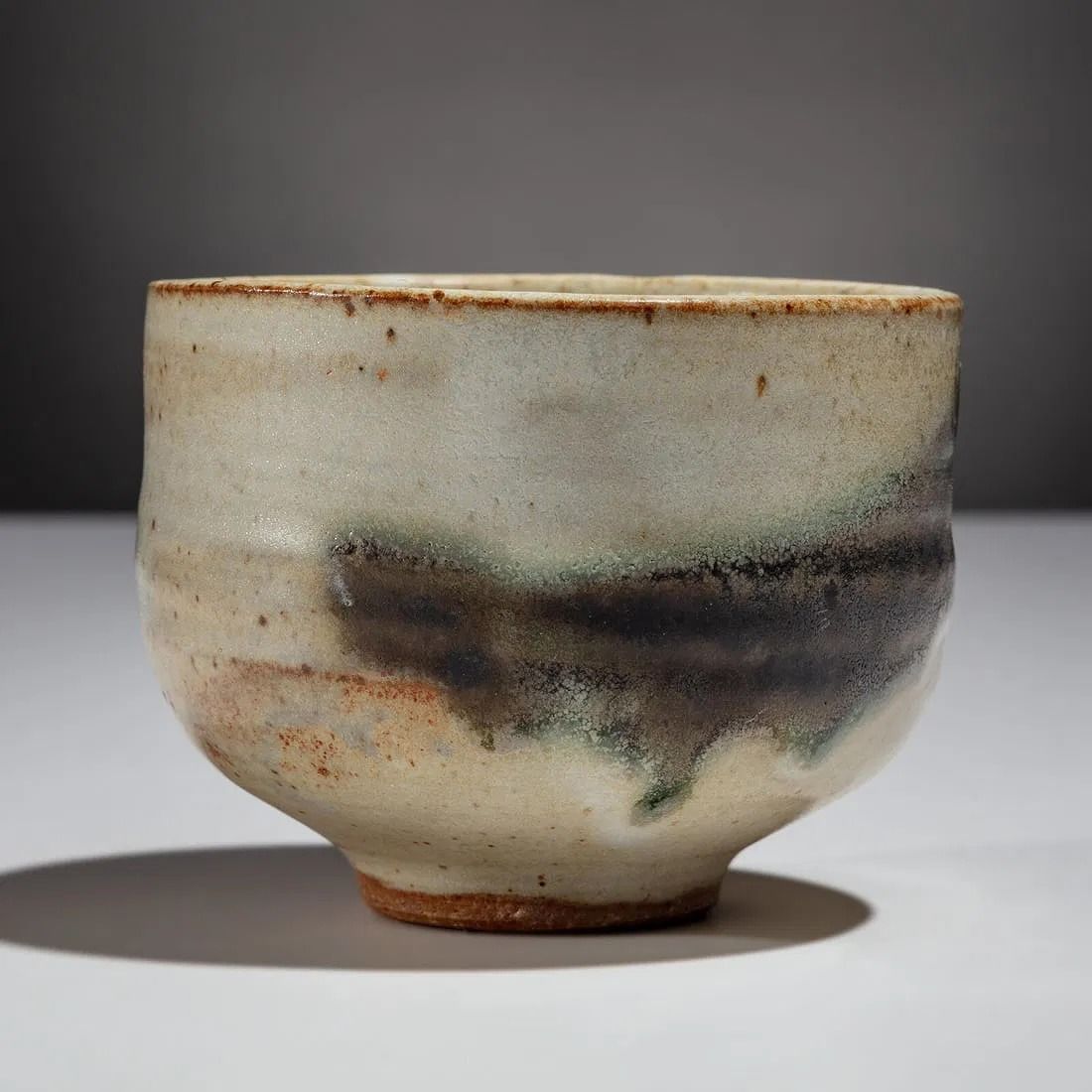
Selling a Toshiko Takaezu closed form, bowl or tea bowl: what drives price in public results, where her work sells, what to document and how to ship it.
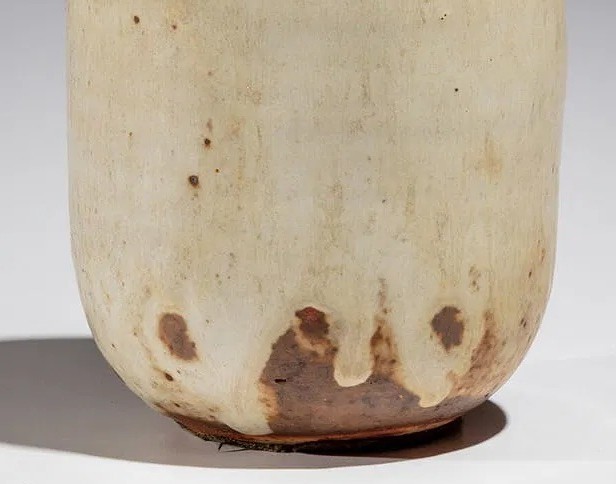
Matched public results for Takaezu closed forms: what height adds, why porcelain and rattles matter less than assumed, and what blue glaze is worth.
What a Toshiko Takaezu closed form is, how the series differ, what documentation and condition mean, and what 821 public auction results show.