

How to Read a Picasso Ceramic Auction Listing
A line-by-line guide to a Picasso Madoura lot: Ramié number, marks, edition, estimate, hammer and buyer's premium, condition report and guarantee.
Prepared by Artemis Collection. Market figures are drawn from public auction records as described in the methodology note; they are not appraisals.
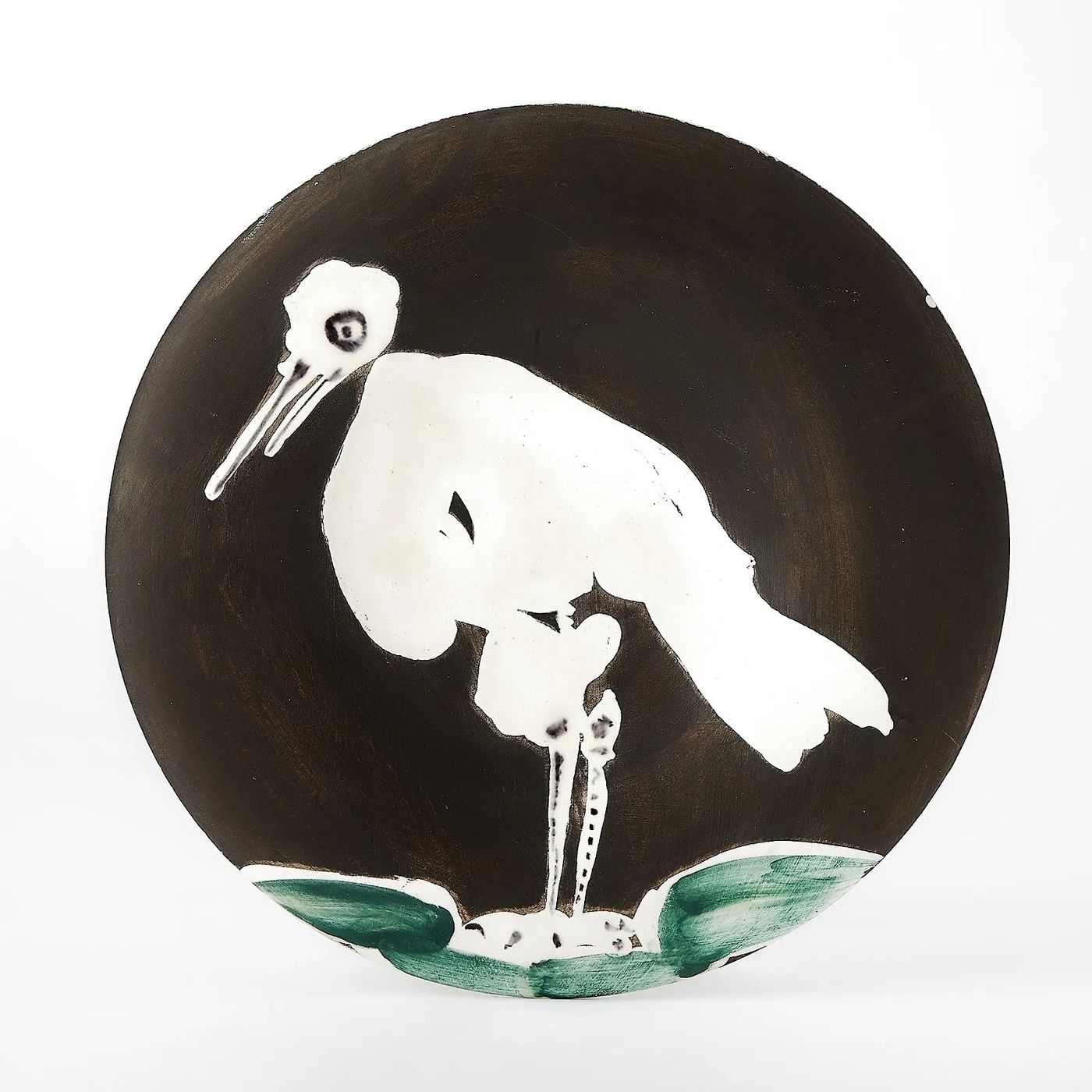
A Picasso ceramic lot listing tells you five things: which design it is (the Ramié or "A.R." number), what is written on the piece (the marks and edition number), what the auction house expects it to sell for (the estimate), what the house says about its condition, and what the house guarantees. Read each separately. The estimate is a pricing tool for the sale, not a valuation; the price you will pay is the hammer price plus a buyer's premium, plus any taxes and charges; and the condition note and the guarantee each cover less than buyers often assume.
A listing, line by line
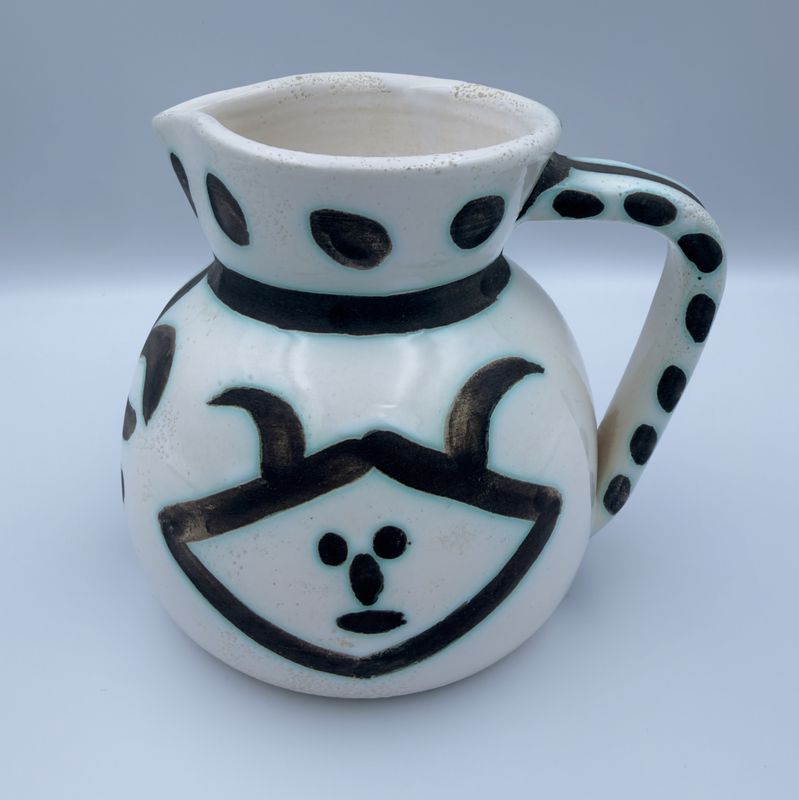
We use a public Christie's lot as the example: Visage de femme (A.R. 192), lot 32 in a Picasso Ceramics Online sale in London, September 2022.1
1. Heading: "PABLO PICASSO (1881-1973)". The artist's name in capitals is the line the house guarantees (see the guarantee section below). Anything qualified, such as "after" or "attributed to" in a heading, means the house is not warranting the attribution.2
2. Title and catalogue number: "Visage de femme (A.R. 192)". The number in brackets is the design's entry in Alain Ramié's 1988 catalogue raisonné of the edition ceramics. It identifies the design, its edition size and the year; it does not prove that this object is one of the edition. Sotheby's writes "A. R." with a space; other houses write "Ramié 192" in the description or the literature line. Many titles are shared by several designs (there are many Visage and Picador designs), so the number matters more than the title. See Alain Ramié catalogue numbers.
3. Marks. The example reads: stamped, marked and numbered "Edition Picasso / Madoura Plein Feu / Edition Picasso / 122/200 / Madoura" (underneath). Houses distinguish stamped (impressed with a die), marked or inscribed (painted or written) and numbered. Sotheby's describes another pitcher as "numbered 82/300 and incised Edition Picasso and Madoura, with the Edition Picasso and Madoura stamps".3 The wording tells you what to look for on the base; it is a transcription, not an authentication. See Madoura stamps and marks.
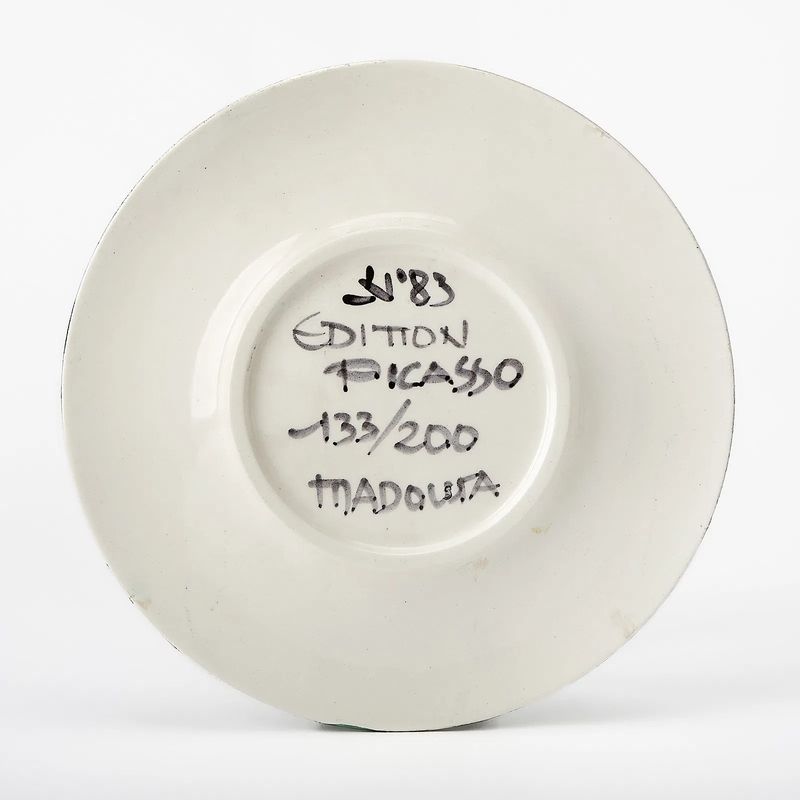
4. Medium, edition and date. "White earthenware ceramic pitcher… Conceived on 7 July 1953 and executed in a numbered edition of 200." "Conceived" dates Picasso's design; the edition was produced over the following years.
5. Dimensions. Compare them with the Ramié entry. A size well away from the catalogue figure is a reason to ask questions.
6. Literature. Older and live-sale listings often cite the catalogue explicitly. A 2016 Sotheby's lot gives "Alain Ramié, Picasso, Catalogue de l'œuvre céramique édité 1947-1971, Madoura, 1988, no. 117, illustration of another example p. 68".4 "Another example" means the book illustrates the design, not this piece. Online-sale pages frequently omit the literature line and rely on the A.R. number in the title.
7. Provenance. A named earlier owner, gallery or sale strengthens a listing; "Private collection" tells you little. See which provenance documents matter.
8. Estimate, then price realised. £5,000–7,000; the published price realised was £8,190.5 The difference between those figures, and what each one includes, is the subject of the next two sections.
Mark wording and edition class
The wording a house transcribes follows the edition class of the design. In 2,771 Christie's and Phillips descriptions of Ramié-catalogued lots (1995–2026), designs that Ramié lists as empreintes originales were described with the words "Empreinte originale de Picasso" 97.5% of the time (n=945); authentic-replica designs were described with "Edition Picasso" 94% of the time (n=1,780). "D'après Picasso" (or "Après Picasso") appears on genuine authorised editions too: in our public records it occurs in Christie's descriptions of 147 sold lots across 54 Ramié designs. If the marks in a listing do not match what the design's class would lead you to expect, ask why.
Estimates: what they are and how houses differ
Christie's conditions of sale say estimates are based on condition, rarity, quality, provenance and recent prices for similar property, and that no one may rely on them as a prediction or guarantee of the selling price or of value. The reserve, the confidential minimum, cannot be above the low estimate (except where a third-party guarantee sets it).2 Sotheby's describes estimates as a guide, notes that lots can sell above or below them, and requires reserves at or below the low estimate.67
How estimates relate to results differs sharply by house. For sold Madoura lots with a published estimate (hammer compared with the same lot's estimate; method below):
| House | Lots | Hammer below low estimate | Within range | Above high estimate | Median hammer ÷ mid-estimate |
|---|---|---|---|---|---|
| Christie's (all rooms, all years) | 4,366 | 4.0% | 30.0% | 65.9% | 1.44 |
| Christie's New York, 2015 onward | 1,284 | 0.9% | 21.0% | 78.1% | 1.62 |
| Christie's London, 2015 onward | 1,624 | 0.7% | 35.1% | 64.2% | 1.40 |
| Sotheby's (2020 onward) | 708 | 5.1% | 35.6% | 59.3% | 1.33 |
| Rago (2018–2026) | 216 | 20.4% | 34.3% | 45.4% | 1.12 |
| Artcurial | 375 | 15.7% | 45.6% | 38.7% | 1.07 |
| Freeman's | 74 | 14.9% | 50.0% | 35.1% | 1.06 |
| Phillips | 284 | 10.6% | 55.3% | 34.2% | 1.04 |
| Doyle | 506 | 18.8% | 49.8% | 31.4% | 1.06 |
| Piasa | 184 | 8.2% | 56.5% | 35.3% | 1.07 |
| Bonhams | 75 | 12.0% | 50.7% | 37.3% | 1.00 |
| LAMA | 78 | 52.6% | 38.5% | 9.0% | 0.80 |
Two readings. First, at Christie's and Sotheby's, Madoura estimates have been set well below where most lots end up; at Phillips, Doyle, Piasa and Freeman's the typical lot hammers near the middle of the estimate. "Estimate times 1.5" is a pattern of particular houses, not a rule. Second, results vary from one sale to the next at the same house: at Rago, the median ratio of hammer to mid-estimate ranged from 0.78 to 1.70 across five sales between June 2024 and April 2026. An estimate is not an appraisal and says little about any one lot.
Hammer price, buyer's premium and the price you pay
- Hammer price: the winning bid when the auctioneer's hammer falls. It does not include the buyer's premium.7
- Buyer's premium: the house's charge to the buyer, a percentage of the hammer. At both Christie's (from 1 September 2026) and Sotheby's the rate is 28% of the hammer up to US$2,000,000 (£1,500,000 in London), with lower rates above that; rates exclude local taxes.89 Other houses' schedules differ; check the sale's own terms.
- Price realised / sold for: the figure published after the sale. Sotheby's states that results customarily include the hammer price plus the buyer's premium (and, where applicable, an overhead premium).7 Treat published results at the major houses as premium-inclusive unless the house says otherwise.
- Taxes and other charges: sales or use tax in the United States depends on the delivery address; in the UK and EU, import VAT and the Artist's Resale Right can apply. The Christie's London lot above carries a resale-right notice and states that import VAT of 5% is payable on the hammer price.1
A worked example at today's rates: a $10,000 hammer at 28% means a $12,800 purchase price before tax and shipping. Read backwards, the £8,190 published for the lot above is consistent with a £6,500 hammer plus a 26% premium. When you compare results across years or houses, convert them to the same basis first; mixing premium-inclusive results with hammer figures overstates or understates by a quarter or more. For the seller's side of the same arithmetic, see the real cost of selling at auction.
Condition reports
Christie's sells lots "as is". Its conditions say that a reference to condition is not a full description, that condition reports are provided free as a convenience and offer the house's opinion, and that they may not mention all faults, restoration or alteration because its staff are not professional restorers or conservators.2 Sotheby's adds that the absence of any reference to condition in a catalogue description does not imply that the lot is in good condition.6
What condition notes look like in practice:
- "Firing crack to the spout" (Christie's, Quatre visages, A.R. 436).11 A crack that occurred in the kiln is different from later damage; the note tells you which.
- "No chips or cracks detected. Evidence of cosmetic retouching to the base" (Christie's, Sujet colombe, A.R. 435, 2019) and "appears to be in generally excellent condition" (the A.R. 192 lot above): each is an opinion formed by the house, not a conservator's examination.10
Always request the full condition report, ask specifically about restoration, and ask for photographs of the base and of anything mentioned. See damage, restoration and value.
What the house guarantees
Christie's authenticity warranty runs for five years from the auction and covers only what is printed in capitals in the first line of the description, the "Heading" (for these lots, the artist's name). It does not cover a qualified heading, nor changes in scholarly opinion after the sale; to claim, you may be asked for the written opinions of two recognised experts and must return the lot; the remedy is a refund of the purchase price and nothing more.2 Sotheby's prints a "Guarantee Line" in bold and its online lots can carry an "Authenticity guaranteed" badge; the scope and term are set in its Conditions of Business for Buyers.73 Read the terms of the specific sale before you bid. Dealers' and online marketplaces' terms vary widely.
Using listings as comparables
- Match the design first. Use results for the same A.R. number. Form alone is a weak guide: among turned pitchers, A.R. 193 has a median hammer of about $33,800 (71 sales) and A.R. 139 about $6,000 (103 sales).
- Put every result on the same basis (hammer or premium-inclusive, same currency).
- Weigh the venue. Comparing designs sold both at Christie's and elsewhere since 2015, the median Christie's hammer was about 1.3 times the hammer of the same design at other houses (306 designs). Against individual houses the ratio ranged from about 1.1 (Sotheby's, about 130 designs) to about 1.6 (Doyle, under 40 designs). A Christie's result is not a forecast for a regional sale, or the reverse. For how far estimates themselves predict the result, see do auction estimates predict prices.
- Look at condition and date. A restored example or a sale from ten years ago is a weaker comparable.
- Remember what is missing. Unsold lots are rarely published, so a list of results shows what sold, not the odds of selling.
No past result sets the value of another piece. For the factors that do drive value, see what is my Picasso ceramic worth; before buying, use our due-diligence checklist.
How these figures were calculated
- Dataset: public auction results for Picasso Madoura ceramics catalogued by Ramié number in the Artemis Collection research database, own sales excluded. After removing cross-source duplicates, non-Madoura and multi-object lots and hammer prices under $300: 9,296 sold lots, 583 designs, May 1986 to October 2026 (queried 3 November 2026). The cleaned pool holds about 9,200–9,900 sold lots, depending on the data snapshot and how strictly multi-object lots are filtered; this article uses the run described here.
- Hammer: most houses publish premium-inclusive prices; hammer is that price divided by one plus a standard buyer's-premium rate for each house (26.5% for Christie's and Sotheby's; actual rates were lower in earlier decades, so older derived hammers are somewhat understated). Rago's lot data carries the hammer itself.
- Estimates: hammer in the sale currency compared with the same lot's published low and high estimate; "within" includes the bounds. Sold lots with recorded estimates only; coverage differs by house (Christie's 1995–2026, Sotheby's from 2020, Rago from 2018; other houses every sold lot with a recorded estimate in our data, through October 2026).
- Mark wording: keyword search of 2,771 Christie's and Phillips lot descriptions joined to our transcription of Ramié's edition class (the set used in our stamps and marks guide).
- Venue ratio: for each design with at least three sales at Christie's and three elsewhere (2015 onward), the ratio of the two median hammers; we report the median ratio across designs. The baseline matters: the figure is about 1.3 against all other houses combined (306 designs, 2015 to October 2026; middle half of designs 1.1–1.6), about 1.1 against Sotheby's alone and about 1.6 against Doyle alone. It is an observation about past results and may change as data are added.
- Worked example: the £8,190 result and £5,000–7,000 estimate are from Christie's public record of the lot; the £6,500 hammer is our inference (£6,500 plus 26% equals £8,190); the house publishes the premium-inclusive figure.
- Limits: results are nominal (not inflation-adjusted); USD conversions use our FX series; unsold lots are largely missing.
-
Christie's, Picasso Ceramics Online, Visage de femme (A.R. 192), lot 32, 20 September 2022; lot page accessed 3 November 2026. ↩↩
-
Christie's, New York Conditions of Sale effective 1 September 2026, sections A3 (condition), A5 (estimates), C2 (reserves), D1 (buyer's premium), E2 (authenticity warranty). ↩↩↩↩
-
Sotheby's, Pichet espagnol (A. R. 244), lot 22, 22 November 2022; page accessed 3 November 2026. ↩↩
-
Sotheby's, Impressionist & Modern Art Day Sale, London, 2016, lot 190, literature line; page accessed 3 November 2026. ↩
-
Estimate and published result from Christie's public record of the lot as held in our database (the lot page loads these figures dynamically). ↩
-
Sotheby's, glossary of auction terms (buy-sell page), accessed 3 November 2026. ↩↩↩↩
-
Christie's, Financial information, buyer's premium effective 1 September 2026, accessed 3 November 2026. ↩
-
Sotheby's, "What is a buyer's premium?", updated 9 September 2026, accessed 3 November 2026. ↩
-
Christie's, Picasso Ceramics Online, Sujet colombe (A.R. 435), lot 11, November 2019; https://onlineonly.christies.com/s/picasso-ceramics-online/pablo-picasso-1881-1973-11/76840, accessed 3 November 2026. ↩
-
Christie's, Picasso Ceramics, Quatre visages (A.R. 436), lot 70, December 2020; condition report on lot page, accessed 3 November 2026. ↩
Sources
- Christie's, New York Conditions of Sale (effective 1 September 2026), PDF. Condition, estimates, reserves, buyer's premium, authenticity warranty (section E2). Accessed 3 November 2026.
- Christie's, Financial information: buyer's premium (effective 1 September 2026). 28% to US$2,000,000 / £1,500,000; 22%; 15%. Accessed 3 November 2026.
- Sotheby's, What is a buyer's premium?. 28% to US$2,000,000 / £1,500,000; 22%; 15%. Page updated 9 September 2026; accessed 3 November 2026.
- Sotheby's, Guide for Buyers. Estimates as a guide; lots sold as is; absence of condition reference. Accessed 3 November 2026.
- Sotheby's, Glossary of auction terms. Hammer price, results, reserve, bought in, Guarantee Line. Accessed 3 November 2026.
- Christie's, Picasso Ceramics Online: Visage de femme (A.R. 192), lot 32. Public lot used as the worked example. Accessed 3 November 2026.
- Christie's, Picasso Ceramics: Quatre visages (A.R. 436), lot 70. Condition report example. Accessed 3 November 2026.
- Sotheby's, Pablo Picasso including Important Ceramics from a Japanese Family Collection: Pichet espagnol (A. R. 244), lot 22. Marks transcription and guarantee badge. Accessed 3 November 2026.
- Sotheby's, Impressionist & Modern Art Day Sale (London, 2016), lot 190. Example of a Ramié literature line citing 'another example'. Accessed 3 November 2026.
- Ramié, Alain. Picasso: Catalogue of the Edited Ceramic Works 1947–1971 (English edition). Vallauris: Galerie Madoura, 1988.. The catalogue raisonné of the edition ceramics; source of A.R. numbers. Auction literature lines often cite the French title, Catalogue de l'œuvre céramique édité.
A buyer's checklist for Picasso Madoura ceramics: Ramié number, marks, edition, condition, provenance, comparable prices, guarantees and shipping.
A practical checklist for photographing and documenting a Picasso Madoura ceramic: the views, marks, measurements, condition and papers a specialist needs.
Which past auction results predict a Madoura ceramic's price best? We tested nine ways of choosing comparables on 5,000+ public sales.