

What Repeat Sales Reveal About Picasso Ceramic Prices Over Time
77 numbered Picasso Madoura ceramics that came back to auction: how we matched them, what prices did after inflation and fees, and why venue mattered.
Prepared by Artemis Collection. Market figures are drawn from public auction records as described in the methodology note; they are not appraisals.
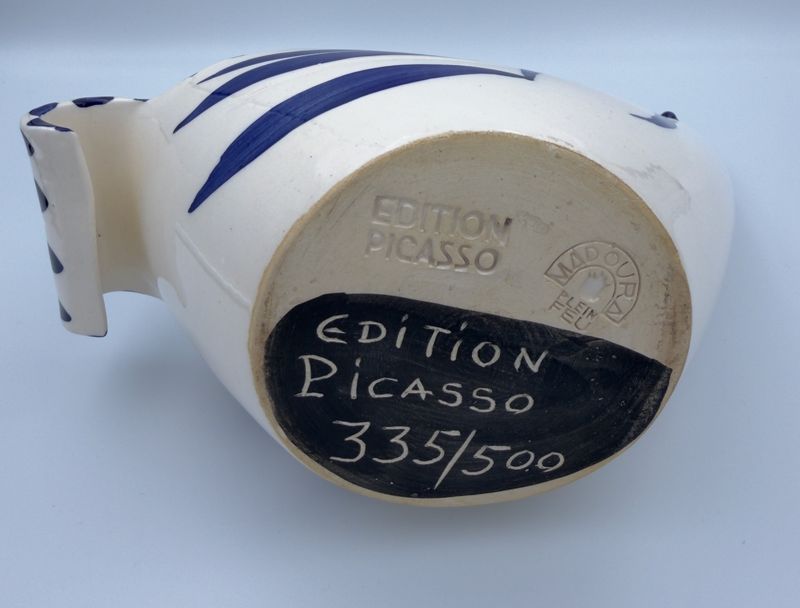
Fewer than you might expect, and mostly about venue rather than time. Most Madoura designs were issued in editions of tens or hundreds of identical-looking copies, so the same physical object can be followed through the auction record only when its edition number or its provenance is published. Across about 9,800 public results we found 77 objects sold twice (80 pairs of sales). Seven of the matches are confirmed by a second, independent piece of evidence; the rest match on design and edition number alone.
What they show:
- Most resales were quick. Half the pairs (41 of 80) were resold within two years.
- Venue explains more than time. Objects that moved from another house to Christie's typically made 1.46 times their earlier hammer, about a year later. Objects resold between other houses typically made a little less than before.
- Inflation matters over long holds. Objects held five years or more were up 20% in money terms at the median, but down 13% after US inflation.
- Costs set a high bar. After allowing for the buyer's premium paid the first time, 59% of objects resold for a hammer above what the earlier buyer had paid. Allowing a 10% seller's commission as well, the share falls to about half.
Why repeat sales are hard to find
A repeat sale compares an object with itself, which removes the biggest problem in any price comparison: differences between examples. But for Picasso ceramics it is unusually difficult to be sure two lots are the same object.
- Many editions are not numbered. In Ramié's catalogue, 387 of the 633 designs are numbered editions. The rest (often editions of 300 or 500) carry no individual number, so one copy cannot be told from another in a listing. See how the editions were produced.
- Many listings omit the number. Of the 9,845 sold lots in our cleaned data, 5,454 are of numbered designs, but only 1,748 listings state a number we could read and check against the edition size.
- Provenance rarely names the earlier sale. We found only 13 lots whose published provenance cites an earlier auction by date and lot number.
- Photographs cannot always settle it. Hand-painted pieces vary enough to compare brushwork, but pressed and unpainted pieces look alike, and some houses do not permit automated access to their images.
So the sample is small, and we graded it.
How the matches were made, and how sure we are
We looked for the same A.R. number with the same edition number (for example 344/500), where the edition size matched Ramié's, in two different sales more than six weeks apart. That found 89 numbered objects offered more than once. We then checked each one.
| Evidence | Pairs with prices on both sides |
|---|---|
| Confirmed: the later catalogue's provenance cites the earlier sale, or photographs show the same object (same frame, same painted detail, same photograph) | 7 |
| Probable: same design and edition number, nothing contradicting | 73 |
| Excluded: the same house re-offered the object within nine months (a possible failed sale or quick re-consignment) | 7 |
A false match turned up while we were screening candidates, and it is instructive. It is not in the counts above, because the second lot is not tagged to Ramié's design in our records. A Christie's London lot of 2018 numbered 14/50 hammered at £50,000; a "porcelain" piece with the same title and number sold at a small regional sale in 2024 for $1,600. Whatever that second piece was, it was not the first. A matching number on a listing is only as reliable as the object it is painted on, which is why our guides to identification and marks start with the object.
How large is the false-match risk? We cannot measure it exactly. Among the 89 candidate objects, none that we could compare by photograph was contradicted, but the case above shows that wrong matches occur. A wrong pair is still a sale of the same design, so the main effect of an error would be to blur the results towards an ordinary same-design comparison. We report the confirmed pairs separately throughout.
Eight further objects were offered, failed to sell and sold later. They are not price pairs, but they show a buy-in is not the end of the road: after an unsold lot in February 2024, the same vase (A.R. 190, 169/200) sold at the same house four months later.
What the prices did
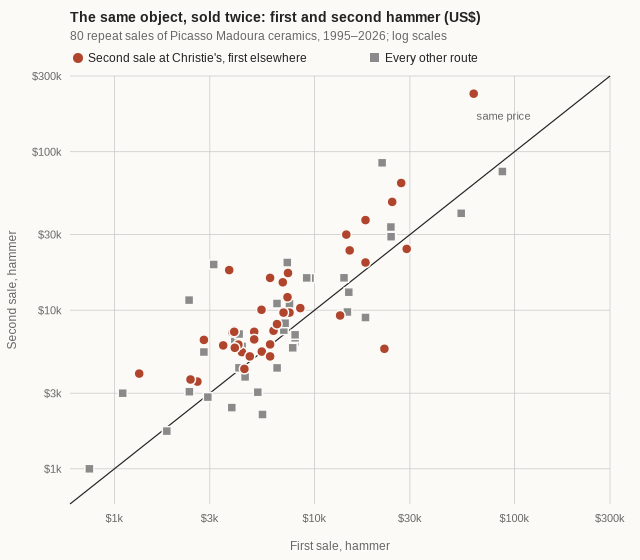
| Group | Pairs | Median years between sales | Median second ÷ first hammer | After US inflation | Share higher (in money terms) |
|---|---|---|---|---|---|
| All matched pairs | 80 | 1.9 | 1.32 | 1.25 | 72% |
| Confirmed only | 7 | 2.4 | 0.88 | 0.85 | 43% |
| Probable only | 73 | 1.8 | 1.36 | 1.27 | 75% |
| Elsewhere, then Christie's | 39 | 1.0 | 1.46 | 1.45 | 87% |
| Christie's, then Christie's | 15 | 2.7 | 1.20 | 1.13 | 67% |
| Christie's, then elsewhere | 10 | 3.7 | 1.30 | 1.12 | 70% |
| Elsewhere, then elsewhere | 16 | 3.7 | 0.92 | 0.87 | 44% |
| Held under 2 years | 41 | 1.0 | 1.36 | 1.33 | 80% |
| Held 2–5 years | 19 | 2.8 | 1.30 | 1.19 | 68% |
| Held 5 years or more | 20 | 10.0 | 1.20 | 0.87 | 60% |
The confirmed pairs point the other way from the probable ones, but they are seven objects, and six of them were sold the second time at houses that, like for like, sell below the market (see which houses get the strongest prices). The routes explain more than the grading: more than half the probable pairs moved to Christie's, and none of the confirmed ones did.
The spread is wide. The second hammer ranged from about a quarter of the first to more than six times it. A single earlier price for your own piece is therefore a weak guide to what it will fetch next, which is the point our guide to what a Picasso ceramic is worth makes about comparables in general.
Three objects, followed
A goat's head dish, three months apart (confirmed). Tête de chèvre de profil (A.R. 146) hammered at US$9,500 (US$11,970 with premium) at Christie's New York on 3 June 2024. Its Phillips London catalogue in September 2024 cites that sale in its provenance, "acquired at the above sale by the present owner", and it sold there for £15,240 with premium (about £12,000 hammer). A quick resale at a higher price, at a house that usually sells below Christie's: individual results can beat the averages.
A face plate, three sales (probable). Visage no. 111 (A.R. 476), numbered 344/500, sold at Doyle in New York in April 2022 for US$5,000 with premium, according to our records of that sale. It hammered at £6,000 at Christie's London in September 2023, and at US$20,000 at Christie's New York in May 2026. Same object, same number on all three catalogues, four years, roughly five times the first hammer.
A large vase, five months apart (probable). Vase aztèque aux quatre visages (A.R. 402), numbered 26/100, hammered at US$62,500 at Doyle in April 2020 according to our records, and at £180,000 (£225,000 with premium) at Christie's London in September 2020.
Not every story ends higher. Femme du barbu (A.R. 193), whose 2024 Phillips London catalogue cites a Phillips New York sale of April 2012 in its provenance, sold for £40,640 with premium in 2024, below the US$68,500 with premium recorded for that 2012 lot in our data, before allowing for twelve years of inflation.
Inflation and costs
Inflation. We restate both prices in US dollars at the exchange rate on each sale date, then adjust for US consumer prices using the Bureau of Labor Statistics CPI-U (annual averages). Over short holds this makes little difference. Over long ones it is decisive: the 20 objects held five years or more were up a median 20% in money terms and down 13% in real terms, and fewer than half gained in real terms. These are a handful of objects, not an index of the market.
Transaction costs. A resale has to recover the costs of the first purchase as well as the second sale. The buyer at the first sale paid the hammer plus a premium (typically 25–28% of the hammer at the houses in these records). The seller at the second sale receives the hammer less commission and other charges, which are negotiable (see the real cost of selling at auction).
| Seller's commission assumed at the second sale | Objects whose net hammer exceeded what the first buyer paid, including premium |
|---|---|
| none | 59% |
| 5% | 54% |
| 10% | 50% |
| 15% | 42% |
These figures leave out shipping, insurance, photography, restoration and the cost of money tied up, so the true round trip is less favourable still.
What this means for an owner
- Your own purchase price is a starting point, not a valuation. The same object has resold for a quarter of its earlier price and for six times it.
- Where it is sold can matter more than when. In this sample, moving an object to the strongest venue changed its price far more than a few years of waiting did.
- Keep the paper trail. The edition number, the receipt and any earlier sale record are what let a buyer, or a researcher, connect your piece to its history. See which provenance documents matter.
- Count costs and inflation before calling a past purchase a gain.
If you own a piece with a recorded sale history, we can look at that history alongside current results for the design.
How these figures were calculated
- Dataset. Public auction results for Picasso Madoura ceramics identified by Ramié A.R. number, sold and unsold, compiled by Artemis Collection from auction houses' own results and from results aggregators; lots identified as sold by Artemis Collection itself excluded. Cleaned sold pool: 9,845 lots (May 1986 – October 2026); elsewhere the cleaned pool is stated as about 9,200–9,900 sold lots, depending on the data snapshot and how strictly multi-object lots are filtered; cleaning rules as in our auction-house comparison. Queried 4 November 2026.
- Edition numbers. Read from the lot title, description and catalogue text ("344/500", "numbered 26/100", "no. 12 of 200" and French and German equivalents), kept only when the edition size matches Ramié's for that design. Copies of one sale on several websites (same design and number within 21 days) were treated as one offering.
- Candidate objects. Same A.R. number and edition number in two offerings more than 45 days apart: 89 objects, 182 offerings.
- Confirmation. (a) Provenance: catalogue text citing an earlier sale by date and lot number, matched to that lot in our records (4 pairs). (b) Photographs: the houses' published main images, compared side by side where the house permits automated access (11 objects viewed; 3 confirmed by painted detail or frame, 4 by an identical photograph of a re-offered lot, 4 inconclusive). Christie's images could not be compared.
- Pairs used. Consecutive sales of the same object, both sold with a price, at least three months apart: 87 pairs, less 7 same-house re-offers within nine months, leaving 80 pairs of 77 objects (November 1995 – October 2026).
- Prices. Hammer prices, derived from published premium-inclusive prices with dated buyer's-premium schedules where available (Rago and LiveAuctioneers report hammer); "with premium" figures are as published. Converted to US dollars at the European Central Bank rate on each sale date.
- Inflation. US CPI-U annual average for each sale year (BLS series via the Federal Reserve Bank of Minneapolis); the 2026 value is the bank's estimate.
- Round trip. Second sale's hammer, less an assumed seller's commission, divided by the first sale's premium-inclusive price.
- Limits. A small sample, not chosen at random: owners resell when they expect to do well, and objects that never came back are invisible. Condition at each sale is not recorded. Probable matches may include a few errors. These results describe the objects in the sample, not the market as a whole, and do not set the value of any other piece.
Sources
- Ramié, Alain. Picasso: Catalogue of the Edited Ceramic Works, 1947–1971. Vallauris: Galerie Madoura, 1988. Whether each design was issued as a numbered edition, and its edition size.
- Public auction results for Picasso Madoura ceramics, 1995–October 2026, as published by the auction houses named in the article and by results aggregators. Compiled and cleaned by Artemis Collection; see 'How these figures were calculated'.
- Federal Reserve Bank of Minneapolis: Consumer Price Index, 1913–. Annual averages of the US Bureau of Labor Statistics CPI-U (1982–84 = 100); 2026 is the bank's estimate. Accessed 4 November 2026.
- European Central Bank euro foreign exchange reference rates, via the Frankfurter API. Sale-date conversion of sterling, euro and Swiss franc results. Accessed 4 November 2026.
- Christie's, Picasso Ceramics, New York, 3 June 2024, lot 51: Tête de chèvre de profil (A.R. 146). Hammer US$9,500; price realised US$11,970. Accessed 4 November 2026.
- Phillips, London, September 2024, lot 127: Tête de chèvre de profil (A.R. 146). Sold for £15,240; provenance cites the Christie's sale above. Accessed 4 November 2026.
- Christie's, Picasso Ceramics Online, London, September 2023, lot 101: Visage no. 111 (A.R. 476), numbered 344/500. Hammer £6,000; price realised £7,560. Accessed 4 November 2026.
- Christie's, Picasso Ceramics, New York, May 2026, lot 30: Visage no. 111 (A.R. 476), numbered 344/500. Hammer US$20,000; price realised US$25,400. Accessed 4 November 2026.
- Christie's, Picasso Ceramics, London, 17 September 2020, lot 49: Vase aztèque aux quatre visages (A.R. 402), numbered 26/100. Hammer £180,000; price realised £225,000. Accessed 4 November 2026.
- Phillips, Pablo Picasso: Paper and Clay, London, 6 June 2024, lot 16: Femme du barbu (A.R. 193). Sold for £40,640; provenance cites Phillips, New York, 25 April 2012, lot 6. Accessed 4 November 2026.
A practical checklist for photographing and documenting a Picasso Madoura ceramic: the views, marks, measurements, condition and papers a specialist needs.
Which past auction results predict a Madoura ceramic's price best? We tested nine ways of choosing comparables on 5,000+ public sales.

Size is the strongest catalogue predictor of Madoura prices: what extra centimetres add within each form, and where size stops adding value.