

Picasso Lithographs, Etchings and Linocuts: How Do Their Markets Compare?
Auction prices for 2,182 original Picasso prints by technique, before and after allowing for period, edition, signature, size and colour.
Prepared by Artemis Collection. Market figures are drawn from public auction records as described in the methodology note; they are not appraisals.
At auction, Picasso's linocuts sell for the most, his lithographs next and his etchings and other intaglio prints for the least: median hammer prices since 2018 were about $21,300, $13,300 and $6,200. Most of that ranking is not about technique. Linocuts are almost all large, colourful, pencil-signed sheets from a few years around 1960; many intaglio prints are small plates from big series. Comparing like with like (same period, edition size, signature, image size and colour), lithographs and intaglio prints sell at about the same price, and linocuts keep a smaller but clear premium of roughly 1.8 times. Technique tells you what kind of object you have; it does not by itself tell you what it is worth.
Three techniques, three different bodies of work
| Family | How the image is made | Picasso's main campaigns |
|---|---|---|
| Intaglio: etching, drypoint, aquatint, engraving | lines or tones are bitten by acid or cut into a metal plate, which holds the ink below its surface1234 | the Saltimbanques (1904–1905, published 1913); the Vollard Suite (1930–1936, published 1939); the 347 Series (1968), printed by Aldo and Piero Crommelynck, and the 156 Series (1970–1972)78 |
| Lithography | drawn on stone, zinc or transfer paper with a greasy medium; the print relies on grease and water repelling each other5 | a few earlier lithographs, then, from 1945, hundreds printed at Fernand Mourlot's Paris workshop, catalogued in Mourlot's Picasso lithographe9 |
| Linocut | a relief print cut in linoleum; the raised surface is inked6 | posters for Vallauris exhibitions and bullfights from 1951, then large colour linocuts from 1958 to about 1963, printed by Hidalgo Arnéra1011 |
The linocuts include a technical innovation that matters to collectors. In 1958 Picasso cut a separate block for each colour of Portrait of a Lady, after Cranach the Younger; from 1959 he and Arnéra worked largely with a single block, printing the whole edition in one colour, cutting the block away, and printing the next colour over it.1011 Because the block was cut away as the printing went on, each colour had to be printed across the whole edition before the next cut, and, as the Cleveland Museum of Art notes, a single mistake could ruin the edition.
Each technique has its usual catalogue: Geiser and Baer for the intaglio prints (museums and auction houses also cite the linocuts by Baer number), Mourlot for the lithographs, and Bloch across all of them.12 The same catalogue number does not mean the same object; check states and papers as well.
Prices by technique, before any adjustment
We read 2,182 sold, single-sheet original Picasso prints with a known technique and catalogue number, sold at thirteen auction houses between 1993 and October 2026 (method below).
| Technique | Lots | Works | Median hammer, all years | Middle half | Median since 2018 |
|---|---|---|---|---|---|
| Intaglio (etching, drypoint, aquatint, engraving) | 1,166 | 619 | $5,700 | $3,600–9,200 | $6,200 (615 lots) |
| Lithograph | 732 | 258 | $11,000 | $5,200–25,100 | $13,300 (299 lots) |
| Linocut | 284 | 112 | $20,100 | $11,900–41,400 | $21,300 (203 lots) |
On these numbers a linocut is worth more than three times an etching. That conclusion does not survive a closer look at what is being compared.
What each group actually contains
| Intaglio | Lithograph | Linocut | |
|---|---|---|---|
| Made 1958–1965 | 9% | 16% | 91% |
| Made 1966–1973 | 47% | 4% | 8% |
| Made 1930–1944 | 27% | under 1% | none |
| Printed in colour (as catalogued) | 2% | 15% | 85% |
| Median image area | 766 cm² | 2,994 cm² | 3,379 cm² |
| Pencil-signed | 72% | 82% | 96% |
| Edition of 31–60 | 54% | 67% | 54% |
Intaglio lots include hundreds of small plates from the 347 Series and the 156 Series (median since 2015 about $5,000 and $2,800) alongside the Vollard Suite (about $9,500). Linocuts are nearly all large colour sheets from five years, pencil-signed by the artist. A linocut and an etching that come up at auction are rarely comparable objects.
Holding other things equal
We then compared techniques while holding constant, step by step, the factors that differ between them.
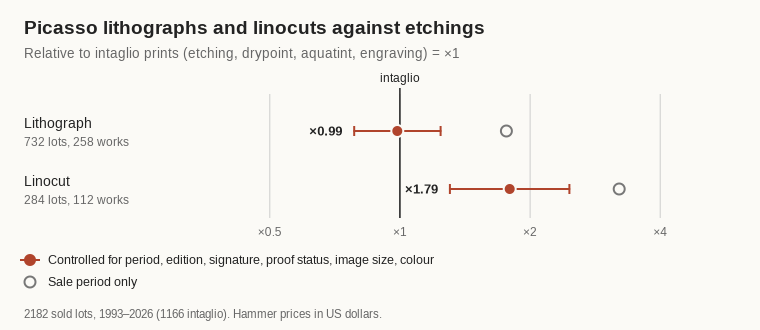
| Comparison with intaglio prints | Lithograph | Linocut |
|---|---|---|
| Sale period only | 1.76 | 3.22 |
| + period of creation | 1.20 | 3.10 |
| + edition size, signature, proof status | 1.29 | 2.72 |
| + image size and colour | 0.99 (0.78–1.24) | 1.79 (1.31–2.47) |
The lithograph "premium" disappears once image size and colour are taken into account: like for like, a Picasso lithograph and a Picasso etching of the same scale and period sold at about the same price. The linocut premium shrinks by about half but remains. Part of what remains may be the images themselves (the linocuts include some of Picasso's best-known prints, such as the portraits of Jacqueline and Buste de femme d'après Cranach le Jeune), and part may be the scarcity created by the reduction method. Our data cannot separate the two.
Among linocuts alone, colour matters: since 2015 colour linocuts sold for a median of about $25,000 (202 lots) and black-and-white or single-colour linocuts for about $9,000 (35 lots).
Originals, reproductions and "after Picasso"
The comparisons above use original prints only. Excluded, because they are a different market:
- Reproductions: offset and collotype prints, photogravures and facsimiles of Picasso's paintings and drawings, including many posters.
- "After Picasso": prints made by other printmakers interpreting his work, sometimes catalogued as "lithograph" or "aquatint". A catalogue entry that begins "After Pablo Picasso" describes such a print, however fine.
- Posters: exhibition posters, even those printed from Picasso's own linocuts or lithographs, which are catalogued separately (Czwiklitzer) and sell differently.13
The word "after" needs care in one respect: Picasso's own variations on old masters carry titles such as "d'après Cranach" or "d'après Manet", and these are original prints by Picasso. They include some of his most valuable linocuts. In preparing these figures we found such prints mislabelled as reproductions in our own database and corrected the labels.
For the general distinctions between originals, reproductions and posthumous impressions, see our guide to selling prints and limited-edition multiples.
What this means for an owner
- Identify the technique correctly, then set it aside. It determines which catalogue to use and which sales are comparable. It is not a price tier.
- Compare within the same body of work. A plate from the 156 Series should be compared with other 156 Series plates, a colour linocut with colour linocuts of the same years.
- Size and colour matter more than the process name. Two prints in the same technique can be an order of magnitude apart in price.
- Check the signature and the edition before relying on any comparable; both carry large effects of their own (see signatures and edition size).
How these figures were calculated
- Source: public auction records for Pablo Picasso prints in the Artemis Collection research database, queried read-only on 4 November 2026: catalogue descriptions from thirteen auction houses, led by Galerie Kornfeld, Christie's, Phillips, Ketterer Kunst, Grisebach and Sotheby's. Sold lots from November 1993 to October 2026. Lots identified as sold by Artemis Collection itself, and duplicate records of the same lot, are excluded.
- Which lots: single-sheet original prints whose description cites a Bloch, Geiser/Baer or Mourlot number and names the technique; reproductions, posters, "after Picasso", books, portfolios and multi-sheet lots excluded. Mixed-technique lots (for example lithograph with linocut) and the handful of woodcuts and mezzotints were left out of the technique comparison.
- Technique, colour, size, period: read from the house's wording (English, French, German, Italian). "Intaglio" groups etching, drypoint, aquatint (including sugar-lift) and engraving. Image area is the first dimension given, which houses use for the image or plate. Period of creation is the date given in the description, taken as the median for each work. Colour depends on the catalogue saying so and is probably under-recorded for lithographs.
- Model: regression of log hammer price on technique and the controls named in each row, with intervals clustered by work (2,182 lots, 983 works). It explains 43% of the variation in price at the final step.
- Prices: hammer price in US dollars, derived from the published premium-inclusive price using the buyer's premium schedule in force at each house on the sale date, at the sale-date exchange rate; not adjusted for inflation.
- Limits: sold lots only; condition, paper, impression quality and subject not controlled; the linocut group covers about 110 works. Past results do not establish the value of any other print.
-
Tate, Art Terms, "Etching", accessed 4 November 2026. ↩
-
Tate, Art Terms, "Drypoint", accessed 4 November 2026. ↩
-
Tate, Art Terms, "Aquatint", accessed 4 November 2026. ↩
-
Tate, Art Terms, "Engraving", accessed 4 November 2026. ↩
-
Tate, Art Terms, "Lithography", accessed 4 November 2026. ↩
-
Tate, Art Terms, "Linocut", accessed 4 November 2026. ↩
-
Cleveland Museum of Art, "Vollard Suite: Minotaur Caressing a Sleeping Woman" (2000.20); The Metropolitan Museum of Art, "The Frugal Repast" (1904, printed 1913). Accessed 4 November 2026. ↩
-
The Metropolitan Museum of Art, "Conversation, 347 Suite" (1968), printers Aldo and Piero Crommelynck, publisher Galerie Louise Leiris (Met Open Access API, 4 November 2026). ↩
-
Fernand Mourlot, Picasso lithographe, 4 vols (Monte Carlo: André Sauret, 1949–1964), covering 1919–1963; Bibliothèque nationale de France catalogue record, 4 November 2026. ↩
-
Cleveland Museum of Art, "Luncheon on the Grass" (1996.318) and "Still Life Under a Lamp" (1984.61), collection records, accessed 4 November 2026. ↩↩
-
Minneapolis Institute of Art, "Le Banderillero" (2018.36.1–5), collection record, accessed 4 November 2026. ↩↩
-
Georges Bloch, Pablo Picasso: catalogue de l'œuvre gravé et lithographié, 4 vols (Bern: Kornfeld et Klipstein, 1968–1979); Bernhard Geiser and Brigitte Baer, Picasso peintre-graveur (Bern, 1933–1996). Library of Congress and BnF catalogue records, 4 November 2026. ↩
-
Christophe Czwiklitzer, Picasso's Posters (New York: Random House, 1971), a translation of Les affiches de Pablo Picasso; Library of Congress catalogue record, 4 November 2026. ↩
Sources
- Tate, Art Terms: Etching; Drypoint; Aquatint; Engraving; Lithography; Linocut. Definitions of the techniques. Accessed 4 November 2026.
- The Metropolitan Museum of Art, The Frugal Repast (1904, printed 1913). Printer Louis Fort, publisher Ambroise Vollard; read via the Met Open Access API, 4 November 2026.
- The Metropolitan Museum of Art, Conversation, 347 Suite (1968). Printers Aldo and Piero Crommelynck, publisher Galerie Louise Leiris; read via the Met Open Access API, 4 November 2026.
- Cleveland Museum of Art, Vollard Suite: Minotaur Caressing a Sleeping Woman (2000.20). 100 prints of 1930–36 published by Vollard in 1939; edition 50 on large paper, 260 on small. Accessed 4 November 2026.
- Cleveland Museum of Art, Luncheon on the Grass (1996.318). Linocut posters from 1951; six-block colour linocut of 1958; single-block method. Accessed 4 November 2026.
- Cleveland Museum of Art, Still Life Under a Lamp (1984.61). Single-block linocut method: a single mistake could ruin the edition. Accessed 4 November 2026.
- Minneapolis Institute of Art, Le Banderillero, proofs (2018.36.1–5). Reduction linocut with Hidalgo Arnéra from summer 1959. Accessed 4 November 2026.
- Bibliothèque nationale de France catalogue: Fernand Mourlot, Picasso lithographe (André Sauret, 1949–1964). Four volumes covering 1919–1963. Record read 4 November 2026.
- Library of Congress catalogue: Georges Bloch, Pablo Picasso, catalogue de l'œuvre gravé et lithographié (Kornfeld et Klipstein, 1968–1979). Four volumes; volume III the ceramics, volume IV 1970–1972. Record read 4 November 2026.
- Library of Congress catalogue: Geiser and Baer, Picasso peintre-graveur (Bern, 1933–1996). Vols 1–2 by Bernhard Geiser, vols 3–7 and addendum by Brigitte Baer. Record read 4 November 2026.
- Library of Congress catalogue: Christophe Czwiklitzer, Picasso's Posters (Random House, 1971). Translation of Les affiches de Pablo Picasso. Record read 4 November 2026.
Selling a print or multiple: original or reproduction, what signatures, numbers and proof marks mean, catalogue references, condition and where to sell.
Edition size and price across 1,886 Picasso print sales: small editions, proofs and low numbers compared like for like, with images issued twice.
Same-work comparisons of 2,293 Picasso print sales: how pencil-signed, unsigned, stamp-signed and plate-signed impressions compare at auction.