

Which Picasso Ceramic Subjects Attract the Strongest Auction Prices?
Faces, owls, bulls or fauns? Madoura designs coded by subject show owls lead only because they are vases, and faces edge birds and myth like for like.
Prepared by Artemis Collection. Market figures are drawn from public auction records as described in the methodology note; they are not appraisals.
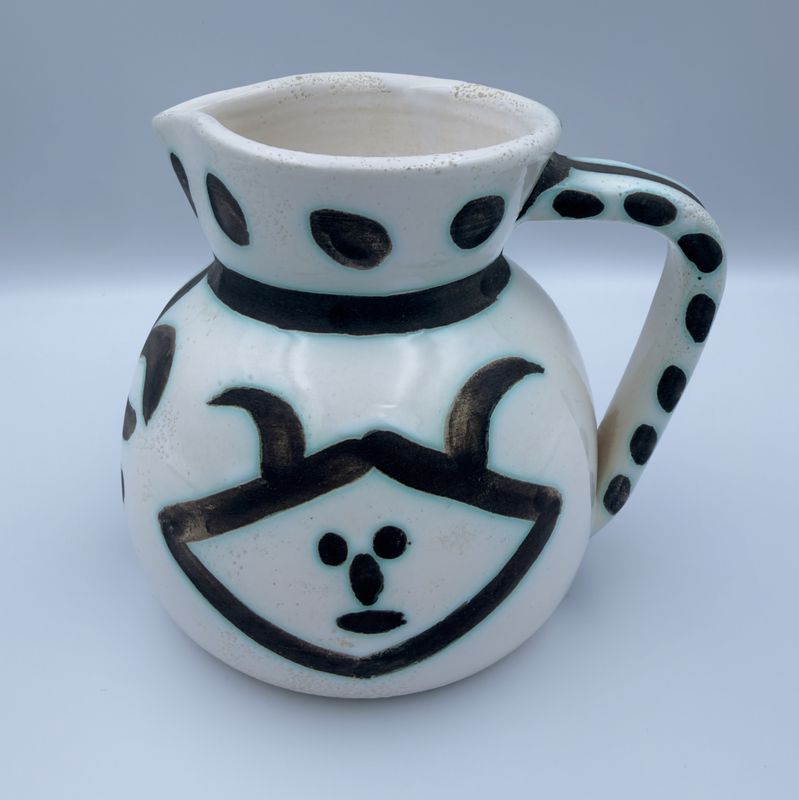
Subject matters less than form, size or edition. Owls have the highest prices of any subject, but that is because most owl designs are vases and pitchers: compared with face designs of the same form, size and edition, owls are not clearly dearer. Like for like, faces and heads are at or near the top. Birds, fauns and other mythological figures, and abstract motifs sell about 18–25% below comparable faces. Bullfight scenes sit about 10% below, a gap too small to be certain of across all forms. The clearest evidence comes from series in which Madoura issued different subjects on identical objects: among the numbered 25 cm plates of 1963, the bird plates sell about 40% below the face plates.
The analysis covers 9,231 public auction results for 583 designs sold between May 2000 and October 2026. It describes the public record and is not a valuation of any piece.
How we grouped the subjects
Ramié's catalogue gives each design a title, such as Face no. 197, Wood-owl, Picador, Centaur or Still life with spoon. We assigned every one of the 633 designs to one of ten subject groups using fixed keyword rules on those titles, applied in a set order: owls before other birds, bullfighting before animals, myth before faces, faces before figures. Fourteen titles that no rule could place, such as Ice-pitcher, Spanish pitcher or Vallauris, were assigned by looking at the catalogue illustration, and two rule results were overridden the same way.
We then checked the rules against the catalogue images. In a random sample of 60 designs, the rule-based subject matched the image in 57. After correcting the rules, a second, fresh sample of 40 matched in 35 of the 37 designs the rules could place, and the two remaining disagreements were fixed by tightening the rules. Most designs fall clearly into one group, but some combine subjects (a face with an owl, a centaur with a face), and those take the first matching group. The coding and the audit are kept with our working files.
| Subject group | Designs in catalogue | Examples |
|---|---|---|
| Faces and heads | 248 | Face no. 197 (A.R. 494), Bearded man's wife (A.R. 193) |
| Bulls and bullfighting | 75 | Picador (A.R. 160), the bullfight dishes Paseo to Arrastro (A.R. 416–431) |
| Figures and scenes | 65 | Woman pitchers (A.R. 296–297, 300–301), Divers (A.R. 376–378) |
| Fish and sea creatures | 53 | the "Fish" service (A.R. 3–28) |
| Still life, plants and landscape | 44 | "Fruits from Provence" service, Landscape dishes |
| Owls | 37 | Wood-owl vases (A.R. 602–607) |
| Fauns, centaurs and myth | 36 | Centaur (A.R. 338–339), Flute player and goat (A.R. 381–382) |
| Birds | 34 | Bird no. 76 (A.R. 481), Dove subject (A.R. 435) |
| Other animals | 28 | Goat's head in profile (A.R. 105–155) |
| Signs, motifs and decoration | 13 | Motifs no. 45 (A.R. 465) |
The raw ranking, and why it misleads
| Subject | Designs | Sales | Median design, hammer since 2015 | Vases and pitchers among the designs |
|---|---|---|---|---|
| Owls | 33 | 938 | $14,300 | 73% |
| Fish and sea creatures | 26 | 439 | $9,600 | 12% |
| Fauns, centaurs and myth | 32 | 464 | $7,500 | 6% |
| Faces and heads | 203 | 3,411 | $7,400 | 18% |
| Figures and scenes | 51 | 851 | $7,300 | 39% |
| Still life, plants and landscape | 19 | 404 | $7,000 | 16% |
| Other animals | 24 | 366 | $6,900 | 4% |
| Birds | 32 | 834 | $6,900 | 41% |
| Bulls and bullfighting | 59 | 1,189 | $6,300 | 8% |
| Signs, motifs and decoration | 10 | 162 | $5,900 | 30% |
Designs with at least three sales since 2000. "Vases and pitchers" includes other turned pieces.
On these raw numbers, owls lead by a wide margin. But 73% of owl designs are vessels, against 18% of face designs, and vessels sell at a premium whatever their subject (see which forms command higher prices). Bullfight designs, near the bottom of the raw table, are almost all flat pieces (only 8% are vessels), and 14 of the 59 were made in 500 copies.
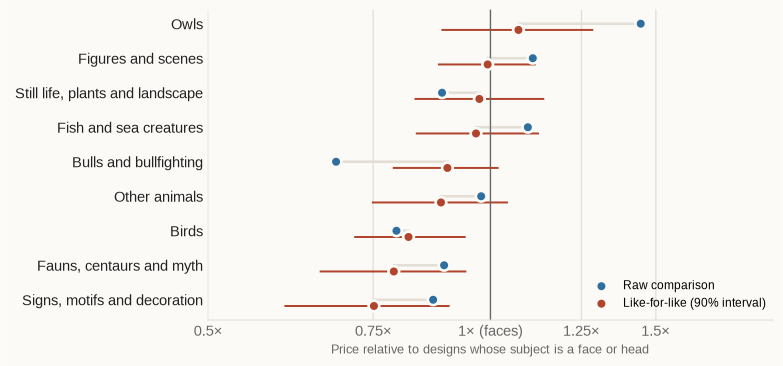
| Subject, compared with faces and heads | Sale year and house only | Like for like | 90% interval |
|---|---|---|---|
| Owls | +45% | +7% | −11% to +28% |
| Figures and scenes | +11% | −1% | −12% to +11% |
| Still life, plants and landscape | −11% | −3% | −17% to +14% |
| Fish and sea creatures | +10% | −3% | −17% to +12% |
| Bulls and bullfighting | −32% | −10% | −21% to +2% |
| Other animals | −2% | −11% | −25% to +4% |
| Birds | −21% | −18% | −28% to −6% |
| Fauns, centaurs and myth | −11% | −21% | −34% to −6% |
| Signs, motifs and decoration | −13% | −25% | −40% to −10% |
Once form, size and edition are equal, most subjects sit within about 11% of faces, and the owl premium shrinks from 45% to a statistically uncertain 7%. Three groups sell clearly below faces: birds, fauns and myth, and abstract motifs. Taken together the subject groups are a real but small factor. On their own they account for about 6% of the price differences between designs, and they add about one percentage point once form, size and edition are known. These estimates hold when the analysis is re-run on sales since 2015, on Christie's only, on every other house, and without the dinner services.
Same object, different subject
The like-for-like model compares across the whole catalogue. Two Madoura series allow a more direct test, because the pottery issued many subjects on an identical object.
The numbered 25 cm plates of 1963 (A.R. 458–496). These round plates share a size and a year, and most were made in 150 copies, a few in 100, 200 or 500. Thirty-nine of them have at least three public sales: 25 faces, 8 birds, 4 motif plates and two others. The median face plate has an index of 1.06, the median bird plate 0.66. Allowing for edition size, the bird plates sell about 39% below the face plates (90% interval 27% to 49% below) and the motif plates about 26% below.
| Plate (all 25 cm, 1963) | Edition | Sales since 2015 | Median hammer since 2015 |
|---|---|---|---|
| A.R. 494 Face no. 197 | 500 | 39 | $8,900 |
| A.R. 458 Face no. 0 | 500 | 39 | $9,500 |
| A.R. 481 Bird no. 76 | 200 | 20 | $4,000 |
| A.R. 483 Bird no. 83 | 200 | 8 | $4,000 |
| A.R. 484 Bird no. 86 | 150 | 8 | $5,300 |
The face plates in 500 copies sell for more than twice the bird plates in 200, another reminder that subject can outweigh edition size.
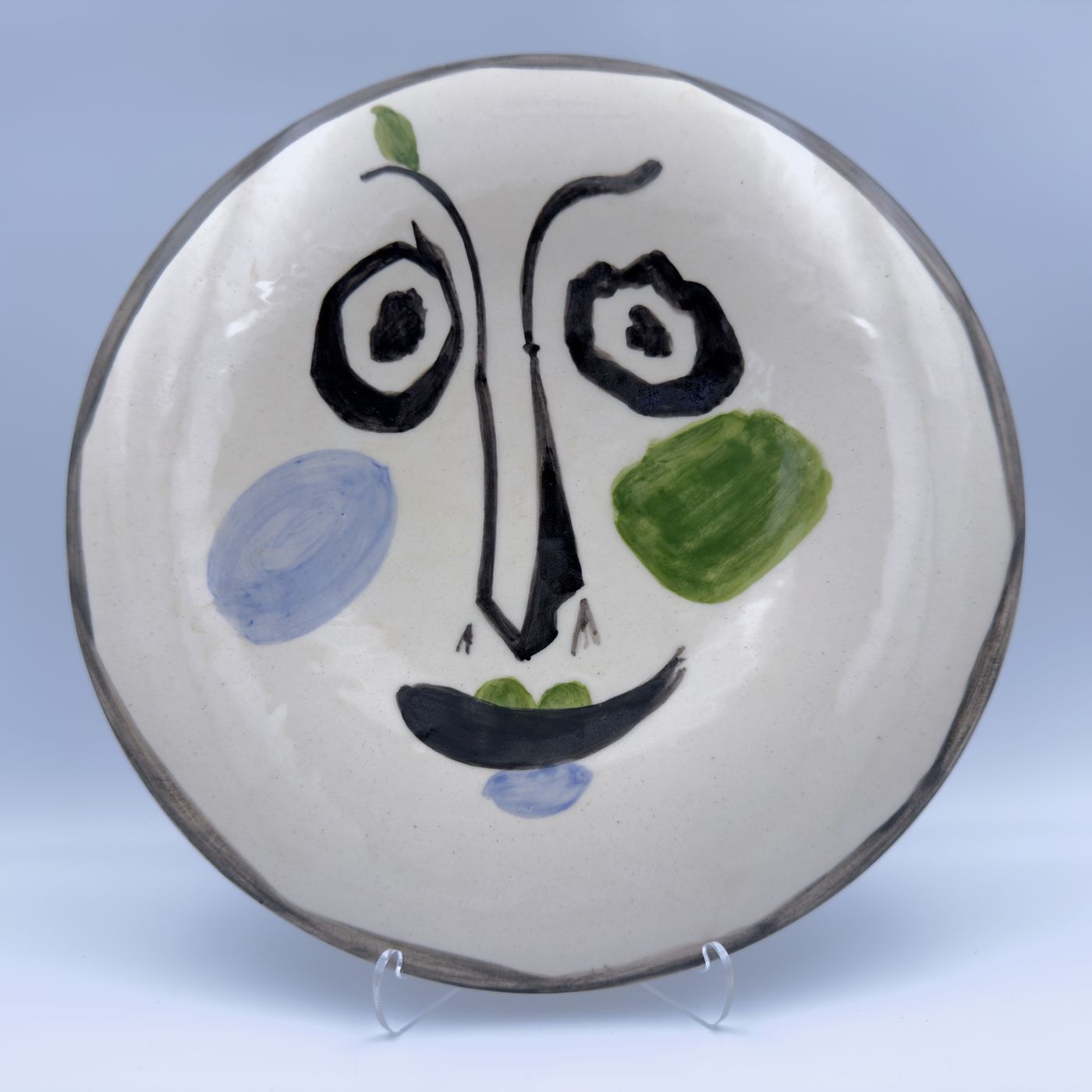
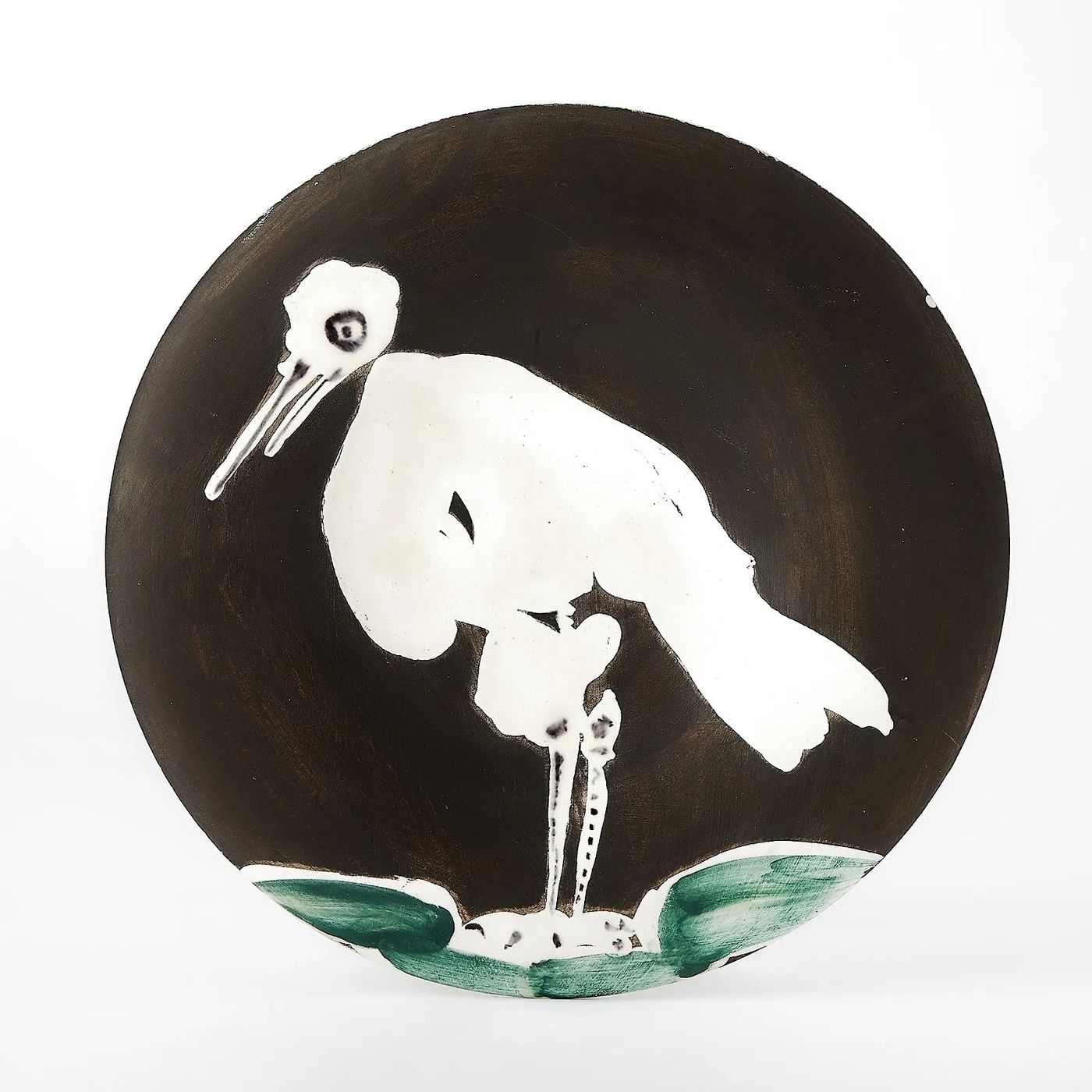
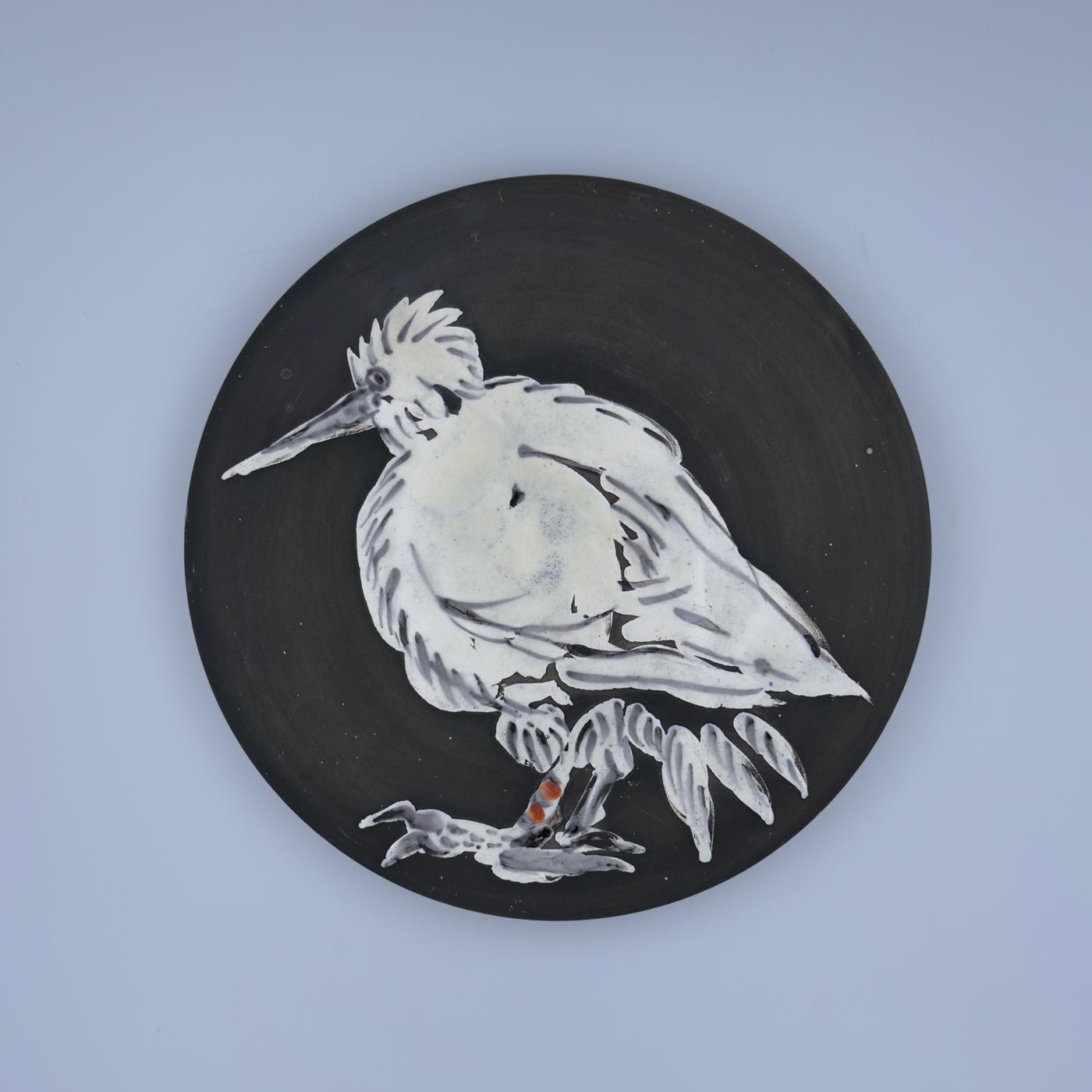
The 42 cm round dishes. Sixty-four designs catalogued at 42 cm diameter, almost all round dishes, have at least three sales, most of them in editions of 100: 30 faces, 18 bullfight scenes, 9 fauns and mythological scenes, and a few others. Allowing for edition size, the bullfight dishes sell about 24% below the face dishes (90% interval 0% to 42% below) and the myth dishes about 31% below (15% to 45% below). The ranges are wide: the dearest bullfight dish in this group sells above most of the face dishes.
Owls: a subject that travels with its form
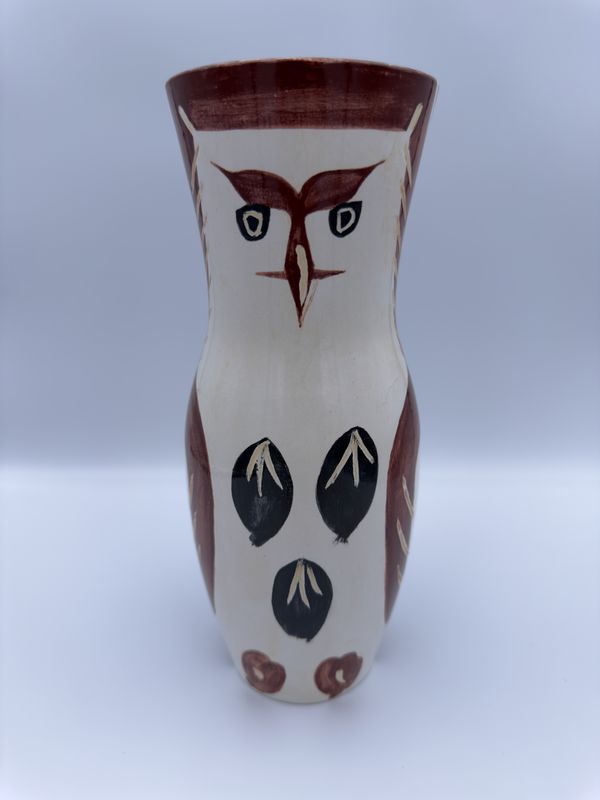
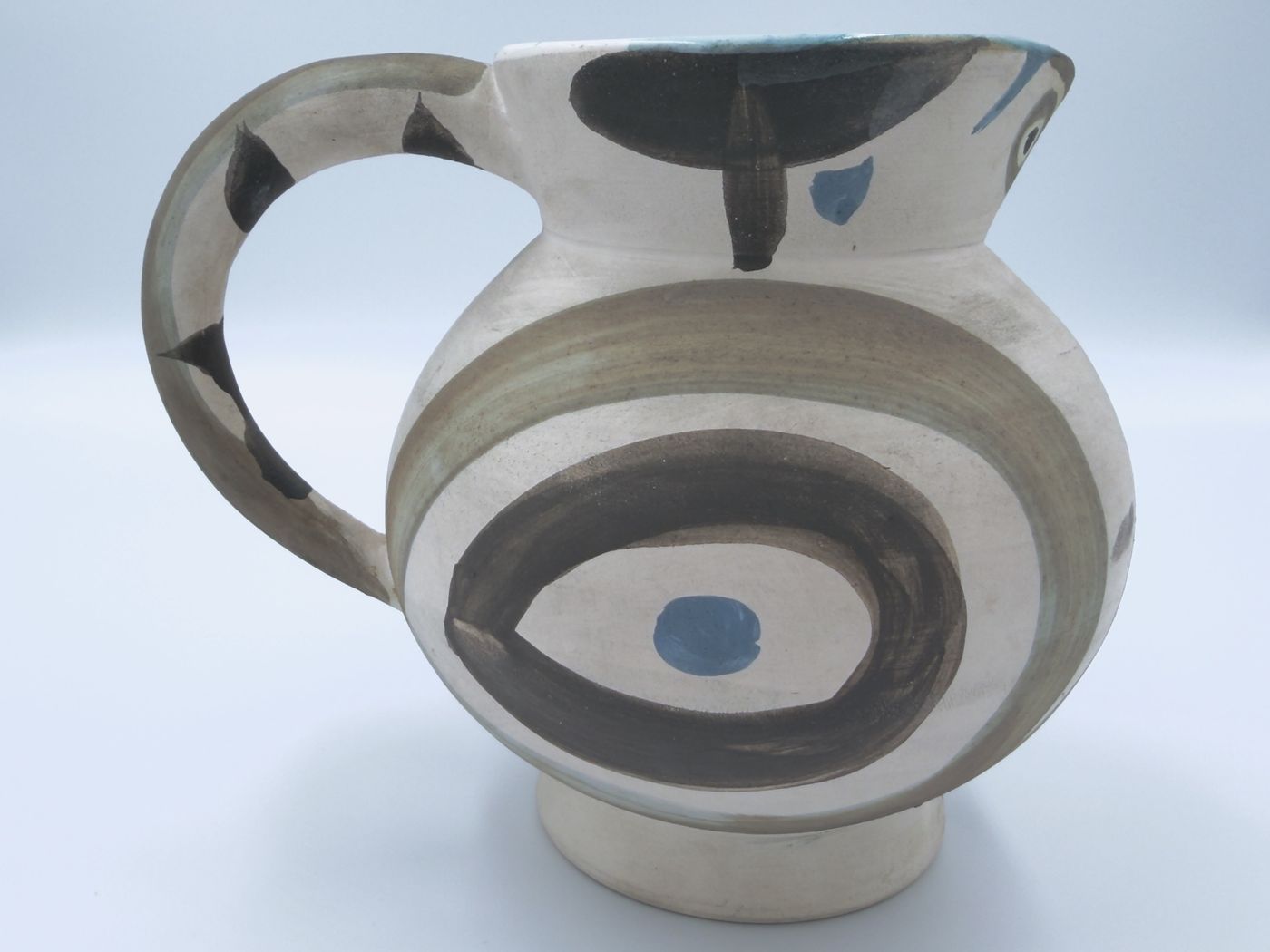
Owls are Picasso's best-known ceramic motif, and the raw numbers make them look like the strongest subject. The like-for-like comparison and the figures above suggest a different reading. Owls are expensive mainly because so many of them are turned vases and pitchers, the forms that carry their own premium. Where owls appear on flat or square pieces, as on the Wood-owl's head plaques (A.R. 581–583), they have not sold above comparable faces in public results; there are too few sales to say more.
What this means for an owner
- Subject is a modest factor. Within the same form, size and edition, most subjects sit within about 10% of each other. The design, its condition and the sale matter more.
- Faces hold up well like for like. Where the same object carries different subjects, face designs have usually sold above birds, bullfights and mythological scenes.
- Do not read "owl" as a premium in itself. An owl vase sells as a vase.
- Compare like with like. A comparable sale of a different subject on a different form tells you little; start from your own A.R. number (see what is my Picasso ceramic worth and how to identify your Madoura ceramic).
How these figures were calculated
Dataset. Sold lots of Picasso Madoura ceramics with an A.R. number in the Artemis Collection research database, excluding lots identified as sold by Artemis Collection and records superseded by a better copy of the same sale. We removed aggregator copies of house results, "style of", "after", replica and Italian titles, lots under $300 hammer, multi-object lots and exact duplicates. The cleaned pool holds about 9,200–9,900 sold lots, depending on the data snapshot and how strictly multi-object lots are filtered; 9,231 lots of 583 designs, sold from 9 May 2000 to 29 October 2026, are analysed here.
Hammer prices. Converted from premium-inclusive results with each house's dated buyer's-premium schedule; Rago and LiveAuctioneers report hammer directly. Nominal US dollars.
Subject coding. Ten groups assigned by ordered keyword rules on the English catalogue titles of our transcription of Ramié, plus 16 assignments made from the catalogue illustration (14 titles no rule could place, 2 rule results overridden). Audit: 60 randomly drawn designs compared with their catalogue images (57 agreed); after rule corrections, a fresh random draw of 40 (35 of the 37 rule-coded designs agreed). Disagreements were corrected.
Design index and like-for-like comparisons. A regression of log hammer on design, sale year and auction house gives each design an index free of venue and timing. For the 489 designs with at least three sales, we regressed the index on subject group, form family, log catalogue dimension, log edition size, Ramié production class and design period, weighting designs by sales (capped at 25). Intervals are 90% bootstrap intervals over designs. A joint test of the subject groups gives p = 0.02 (F = 2.21). Production class (Ramié's A.R. and O.P. groupings) is a control here, not a finding of this article: in the full model O.P. designs sell about 18% below comparable A.R. designs (90% interval about −28% to −8%), a gap that depends on which other factors are held equal. Series comparisons (1963 plates, 42 cm dishes) regress the index on subject and log edition size within the series, with robust standard errors.
Limits. Subject groups are broad, and some designs combine subjects. Unsold lots are largely absent from public records. The comparisons describe associations in past sales, not causes.
Sources
- Ramié, Alain. Picasso: Catalogue of the Edited Ceramic Works 1947–1971. Vallauris: Galerie Madoura, 1988 (English edition). Catalogue titles (the basis of the subject coding), form, dimensions and edition size for each A.R. number. Cited by catalogue number; not reproduced.
- Public auction records of Picasso Madoura ceramics, May 2000 – October 2026, compiled by Artemis Collection. Results published by the auction houses; see 'How these figures were calculated'.
A practical checklist for photographing and documenting a Picasso Madoura ceramic: the views, marks, measurements, condition and papers a specialist needs.
Which past auction results predict a Madoura ceramic's price best? We tested nine ways of choosing comparables on 5,000+ public sales.

Size is the strongest catalogue predictor of Madoura prices: what extra centimetres add within each form, and where size stops adding value.