

Selling Picasso Ceramics in New York, London or Paris: Does Location Matter?
Same designs, converted at the sale-date exchange rate: how New York, London, Paris and German sales compare, and the costs that change with the saleroom.
Prepared by Artemis Collection. Market figures are drawn from public auction records as described in the methodology note; they are not appraisals. Nothing here is tax or legal advice.
Less than most people expect, once the house is held constant. The same Picasso Madoura design has sold for about the same in Christie's London and Christie's New York over the last decade as a whole. What differs between cities is mostly which houses sell there: London and New York host the dedicated sales of the two leading houses, while Paris and the German cities sell Madoura mainly through houses that achieve less for the same design. Since 2023, though, Christie's New York sales have mostly run ahead of its London sales.
The location also changes what a sale costs and when the money arrives: the currency you are paid in, import VAT if the piece crosses a border, and, in the UK and EU, the artist's resale right.
This article compares cities on like-for-like prices converted at the exchange rate on the sale date, then sets out those practical differences with official sources. It builds on our comparison of auction houses, which explains the method in more detail.
City by city, like for like
Each lot is compared with the same Ramié design (same A.R. number) sold in other cities within two years either side. A city scores 1.00 when its lots sell at the price the same design was making elsewhere.
| Where the lot was sold | Lots compared | Designs | Like-for-like (median) | Main houses in our records |
|---|---|---|---|---|
| London | 1,552 | 271 | 1.17 | Christie's, Sotheby's, Phillips |
| New York | 1,687 | 272 | 1.10 | Christie's, Sotheby's, Doyle, Phillips |
| Paris | 391 | 178 | 0.88 | Piasa, Artcurial, Christie's, Millon, Bonhams |
| Germany | 237 | 129 | 0.88 | Lempertz, Grisebach, Ketterer, Van Ham |
| Elsewhere in the US | 584 | 190 | 0.83 | Rago, Heritage, Palm Beach Modern, Freeman's | Hindman, LAMA |
| All other places | 562 | 192 | 0.70 | many smaller houses |
On its own this table says London and New York are the strongest cities. But it mixes the city with the house. London's figure is mainly Christie's and Sotheby's; New York's includes Doyle, which sells well below the market for the same designs. Looked at saleroom by saleroom, the picture is closer:
| Saleroom | Lots | Like-for-like |
|---|---|---|
| Christie's New York (including online) | 1,204 | 1.29 |
| Christie's London (including online) | 1,146 | 1.22 |
| Sotheby's London | 391 | 1.06 |
| Christie's Paris | 71 | 1.01 |
| Piasa, Paris | 129 | 0.98 |
| Lempertz, Cologne | 93 | 0.94 |
| Sotheby's New York | 316 | 0.93 |
| Grisebach, Berlin | 87 | 0.93 |
| Ketterer, Munich | 39 | 0.91 |
| Phillips New York | 82 | 0.84 |
| Phillips London | 158 | 0.84 |
| Artcurial, Paris | 148 | 0.79 |
| Doyle, New York | 283 | 0.73 |
The same house tends to perform at much the same level wherever it sells. Phillips scores 0.84 in both London and New York. Christie's Paris is well below Christie's London or New York, but Madoura appears there mostly as a few lots in general modern-art sales rather than in dedicated ceramics sales.
London against New York at the same house
Christie's is the cleanest test, because it sells Madoura in both cities in the same kind of dedicated sale. For each London lot we took the same design sold at Christie's New York within twelve months, and the reverse.
- 2015 to October 2026 as a whole: no meaningful difference. London lots sold at about 0.97 times New York for the same design (999 London lots and 1,036 New York lots, 290 designs).
- 2015–2019: London slightly ahead (about 1.03).
- 2020–2022: level (about 1.00).
- 2023 to October 2026: London about 20% behind New York (0.80; 225 London lots, 247 New York lots).
The sale-by-sale record shows the recent gap clearly.
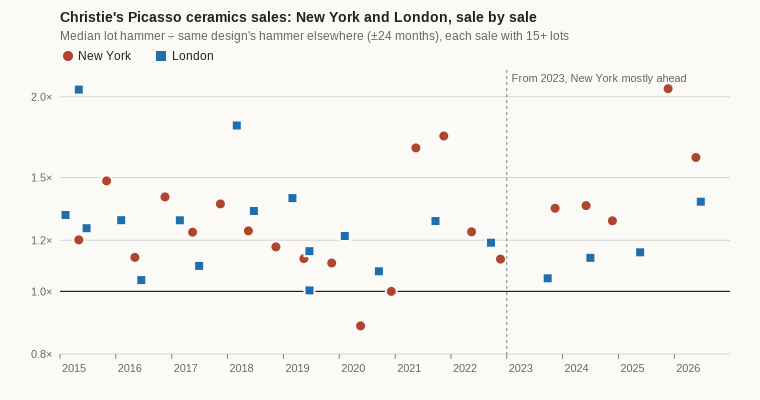
Since 2023 the five New York sales scored between 1.29 and 2.06 and the four London sales between 1.05 and 1.38. Four of the five New York sales sit above every London sale, but the ranges overlap (New York's November 2024 sale, at 1.29, was below London's June 2026 sale, at 1.38), and four or five sales a side is a short record, and it does not say why. The sales are held in different seasons, and the consignments differ. Before 2023 the two cities alternated for years with no lasting gap. We would treat the recent difference as a current pattern rather than a rule.
At Sotheby's, which also sells in both cities, the matched sample is too small for a reliable figure. Across all its lots since 2015, its London sales scored 1.06 against 0.93 for New York.
Does the exchange rate drive the difference?
All prices here are converted to US dollars at the European Central Bank reference rate for the sale date. Over the period the pound moved between about $1.06 and $1.59. If London buyers bid in pounds without regard to the dollar, London prices in dollars would fall when sterling weakened.
We found no reliable sign of that. Year by year, the London-to-New York ratio at Christie's moved by more than the exchange rate did, and in no consistent direction relative to it (a correlation of about −0.1 over the nine years with enough matched sales, which is no relationship worth reading into). One possible reason is that these sales draw bidders from many countries, but the records cannot show that.
Currency still matters to a seller in another way: between the sale and the payment. Proceeds are normally settled in the currency of the sale some weeks later (see how long it takes to sell). Over 35 days between 2015 and October 2026, the pound moved against the dollar by a median of 1.6%, by 3.9% or more one time in ten, and by as much as 11.4%. The euro moved by a median of 1.4%, by 3.6% or more one time in ten, and by up to 7.9%. A seller whose costs are in dollars carries that risk on a London or Paris sale unless it is hedged.
Costs that change with the saleroom
These are general points about how the rules work. Whether and how they apply to a particular piece depends on where it is, who owns it and the terms of the sale. Ask the auction house and a qualified adviser before you decide.
Artist's resale right (droit de suite)
The UK and EU countries give artists and their heirs a royalty on qualifying resales of original works. Picasso died in 1973, and the right lasts for the artist's life plus 70 years, so it applies to his works in the UK until the end of 2043.
- UK: the right applies to sales through art-market professionals at or above £1,000, at 4% of the price up to £50,000 and lower rates above that, capped at £12,500 per sale. The UK guidance names ceramics among the works covered.
- Who pays varies by country and by the terms of sale. Christie's marks affected lots with the symbol λ and states that the person responsible for paying the royalty varies from country to country. Read the conditions of sale for the saleroom you are considering.
- United States: there is no resale royalty in US federal law.
For a buyer, a resale royalty adds to the cost of a lot; for a seller, it may be deducted from proceeds where local rules or the agreement put it on the seller. Either way it can make the same hammer worth less to a seller in London or Paris than in New York.
Import VAT and duty
Sending a piece to a sale in another country can mean import taxes on arrival, at sale or both.
- UK: HMRC applies a reduced valuation that gives an effective 5% import VAT to qualifying works of art. Its guidance defines qualifying ceramics as individual pieces created entirely by, and signed by, the artist. Madoura editions were made by the pottery's craftsmen from Picasso's originals (see how the editions were produced), so whether they qualify is a question for the auction house and a customs adviser, not one to assume.
- Temporary admission (UK): goods imported for auction can enter under temporary admission, which suspends duty and VAT. If the piece is sold and released into free circulation in the UK, VAT is accounted for at that point.
- United States: the tariff heading for original sculpture and statuary is duty-free. Classification of a particular edition, and any other charges in force when it is shipped, are matters for a customs broker.
Shipping, insurance and timing
Shipping a ceramic abroad for sale needs professional packing, insurance in transit and export and import paperwork, and an unsold piece may have to come back. These costs fall on the seller and are the same whatever the result, so they weigh most heavily on modest pieces. A dedicated sale abroad also has its own calendar and consignment deadline (see the best time to sell).
What this means for a seller
- Choose the house and the sale first; the city follows. The difference between houses is much larger than the difference between London and New York at the same house.
- Do not assume Paris is the natural market because the pottery was French. In our records the same designs have sold for less in Paris and in Germany than at the leading houses in London and New York.
- Count the cross-border costs before the premium. Shipping, possible import VAT, the resale right and currency risk can outweigh a modest price advantage, especially below a few thousand dollars.
- Compare net proceeds in your own currency, after fees and conversion (see the real cost of selling at auction).
If you are deciding where to offer a piece, we can look at whether it is better sold at home or abroad.
How these figures were calculated
- Dataset. Sold public auction results for Picasso Madoura ceramics identified by Ramié A.R. number, January 2015 – October 2026: 7,394 lots of 578 designs after cleaning (pool and cleaning rules as in our auction-house comparison). Lots identified as sold by Artemis Collection itself are excluded. Queried 11 November 2026.
- Place of sale. Taken from the saleroom code or location the house publishes. Christie's and Sotheby's online sales are assigned to the saleroom that ran them (New York for US-dollar sales, London for sterling sales). Houses with one saleroom are assigned to its city.
- Currency. Every sterling, euro and Swiss franc result was converted to US dollars at the European Central Bank reference rate for the sale date (the last rate before it at weekends). The stored dollar figures for Christie's London sales of 2023–2024 were found to agree with this rate; a few hundred earlier London online-sale results (March 2019 and September 2020) differed by 2–3% from it and were replaced. Prices are hammer prices derived as in our auction-house comparison, and are nominal.
- City and saleroom index. For each lot, the median hammer of the same design sold in other cities (or at other salerooms) within 24 months, with at least three such sales; the figure reported is the median across lots.
- Christie's London against New York. For each lot in one city, the median hammer of the same design at Christie's in the other city within 12 months (at least one sale; at least two gives 0.99 overall and the same 0.80 since 2023). The two directions are combined as the square root of their ratio, so neither city is treated as the baseline.
- Sale-by-sale chart. Christie's dedicated Picasso ceramics sales with at least 15 matched lots, 2015 – October 2026; baseline as in the saleroom index.
- Exchange-rate movements. Change in the ECB rate over 35 calendar days, every day from January 2015 to October 2026.
- Practical rules. Taken from the official pages listed in the sources, read on 11 November 2026. Rules change; check the current version and the house's own terms.
- Limits. City and house cannot be fully separated. Matched samples for Sotheby's, Phillips and Christie's Paris are small. The analysis does not control for condition or quality within a design, and it describes past results only.
Sources
- Public auction results for Picasso Madoura ceramics, 2015–October 2026, as published by the auction houses named in the article and by results aggregators. Compiled and cleaned by Artemis Collection; see 'How these figures were calculated'.
- European Central Bank euro foreign exchange reference rates, via the Frankfurter API. Daily rates, January 1999 – November 2026, used to convert each result at its sale date. Accessed 11 November 2026.
- GOV.UK (Intellectual Property Office): Artist's Resale Right. Threshold £1,000, rates 4% to 0.25%, cap £12,500, life plus 70 years; ceramics included. Last updated 2 December 2024; accessed 11 November 2026.
- GOV.UK (HMRC): How to value goods for import VAT. Reduced valuation giving an effective 5% import VAT for qualifying works of art; definition of qualifying ceramics. Last updated 2 November 2026; accessed 11 November 2026.
- GOV.UK (HMRC): Import works of art, antiques and collectors' items using the VAT margin or global accounting scheme. Temporary admission for goods imported for sale; VAT accounted for on release into free circulation. Accessed 11 November 2026.
- Christie's: How to buy at Christie's – Financial information. Artist's Resale Right lot symbol; who pays the royalty varies by country. Accessed 11 November 2026.
- U.S. Copyright Office: Resale Royalty Right. A resale royalty is not part of current U.S. copyright law (report of 13 December 2013). Accessed 11 November 2026.
- U.S. International Trade Commission: Harmonized Tariff Schedule, heading 9703. Original sculptures and statuary: general duty free. Accessed 11 November 2026.

Is there a best month to sell a Picasso ceramic? We tested 6,100 public auction results. No seasonal pattern held up; which sale you join matters more.

From consignment to payment: how long selling a Picasso ceramic at auction takes, what the houses publish about settlement, and what causes delay.
What 461 public Madoura results that hammered below the low estimate have in common, and what the records can and cannot explain.