

Why Do Some Picasso Ceramics Sell Below Their Auction Estimates?
What 461 public Madoura results that hammered below the low estimate have in common, and what the records can and cannot explain.
Prepared by Artemis Collection. Market figures are drawn from public auction records as described in the methodology note; they are not appraisals.
When a Picasso Madoura ceramic sells below its low estimate, the public records show one of two patterns: the estimate was set high relative to recent sales of the same design, or the price itself was weak compared with that design's market at the time. In the records we analysed, the second is far more common. The records usually cannot say why a price was weak: condition, colour, the particular sale and the bidders in the room are rarely written down, so this article describes patterns and does not assign causes.
Selling below the low estimate is the exception, not the rule. Of 6,858 sold lots with a published estimate in the auction houses' own records (1994–2026), 461 (6.7%) hammered below the low estimate, and the rate differs widely by house. Our separate article on whether auction estimates predict selling prices covers the overall pattern. This article looks only at the misses.
How far below, and why a lot can sell there at all
A lot can only sell below its low estimate if the seller's reserve allows it. Christie's describes the reserve as the confidential minimum agreed with the seller, set at or below the published low estimate; if bidding does not reach it, the lot is "bought in" and no sale takes place.1 Where a house follows that convention, every result in this article is one where the seller had agreed, in advance, to accept less than the low estimate.
The misses are usually modest. Among the 461 below-low results, the median hammer was 0.86 of the low estimate (middle half 0.80–0.92). A plate estimated at $5,000–7,000 that hammers at $4,300 is the typical case; a collapse to half the low estimate is rare.
What the published results leave out matters as much: a lot that failed to reach a reserve set at the low estimate does not appear here at all, because it did not sell. Our article on what happens when a Picasso ceramic goes unsold looks at those lots.
The estimate: how high was it set?
For each sold lot we compared the low estimate with the median hammer price of the same design (same Ramié number) at other sales in the previous three years, the information a cataloguer would have had. Most estimates sit well below that figure: the median low estimate was 0.65 of the design's recent median. The higher the estimate was pitched against that benchmark, the more often the lot sold below it.
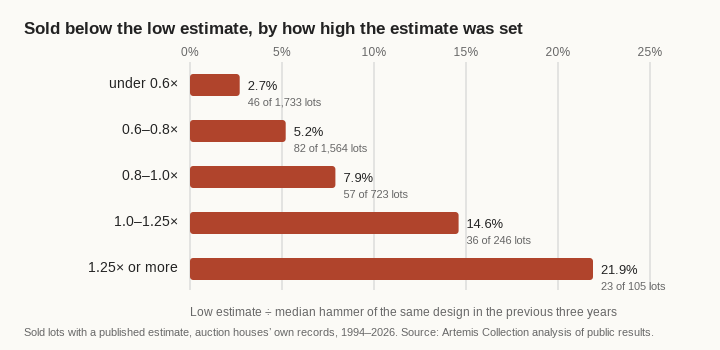
| Low estimate ÷ design's recent median | All houses | Christie's | Other houses |
|---|---|---|---|
| Under 0.6 | 2.7% (46 of 1,733) | 0.6% (6 of 944) | 5.1% (40 of 789) |
| 0.6–0.8 | 5.2% (82 of 1,564) | 1.6% (15 of 928) | 10.5% (67 of 636) |
| 0.8–1.0 | 7.9% (57 of 723) | 2.2% (9 of 413) | 15.5% (48 of 310) |
| 1.0–1.25 | 14.6% (36 of 246) | 4.9% (6 of 122) | 24.2% (30 of 124) |
| 1.25 or more | 21.9% (23 of 105) | 4.3% (2 of 47) | 36.2% (21 of 58) |
The pattern holds at Christie's and elsewhere, though from very different starting points. At Christie's, where estimates are typically set well below where lots end up, a below-low result is rare at any estimate level; at other houses an estimate at or above the design's recent median was followed by a below-low result in 24% to 36% of lots.
An example of an estimate-driven miss: at Piasa in Paris in September 2021, a Centaure (A.R. 102) was estimated at €10,000–15,000. The design's median hammer over the previous three years was about $5,700 (10 sales), so the low estimate stood at roughly twice the recent median. The lot sold for €12,350 including buyer's fees, below the low estimate at hammer, yet still about 1.9 times the design's median of the surrounding two years.2 Measured against the estimate it was a disappointment; measured against the market it was a strong price.
The result: was it weak against the market?
An optimistic estimate accounts for only a minority of the misses. We could compare 235 of the 461 below-low lots both with the design's earlier sales (for the estimate) and with its sales in the two years either side (for the result, at least three of each):
| Below-low lots (n = 235) | Result more than 20% under the design's market | Result within 20% of it, or above |
|---|---|---|
| Low estimate at or under the design's recent median | 150 | 31 |
| Low estimate above the design's recent median | 14 | 40 |
In about two cases out of three (150 of 235), the estimate was ordinary and the price itself was low: the hammer fell more than 20% below the median of other sales of the same design around the same time. Only 40 lots (17%) look like a high estimate meeting a normal market. Only 26 of the 235 (11.1%) hammered at or above the design's median of the previous three years.
So a below-low result usually signals a weak price, not just an optimistic estimate. What the records rarely say is why.
What the records can document
The kind of sale. At Christie's the gap between its dedicated Picasso ceramics sales and its general sales is large and persists over time: from 2014 to 2019, 0.7% of sold Madoura lots in dedicated sales hammered below the low estimate (10 of 1,410) against 5.7% in other sales (12 of 212); from 2020 to October 2026, 0.5% (9 of 1,735) against 3.2% (3 of 94). At Sotheby's the direction is reversed (7.8% in dedicated sales, 53 of 679; 1.4% elsewhere, 2 of 140), with the misses concentrated in two years: 18 of 164 lots in its dedicated sales of 2023 and 14 of 74 in 2025. "Dedicated sale" is not a guarantee in itself, and the two kinds of sale also differ in the lots and estimates offered, so the gap is an association.
A mixed-sale example: at a Christie's Interiors sale in New York in December 2017, a Sauterelle sur une branche (A.R. 258) estimated at $3,000–5,000 realised $2,250 including premium, a hammer of about $1,800, against a median of about $5,500 for the design's other sales in the surrounding two years (only five sales, so a thin benchmark).3 The listing gives the marks, the date and the edition of 100, and nothing that would explain the price.
The year. Below-low results cluster in particular years. In 2008, 27 of 51 sold lots with estimates (53%) hammered below the low estimate, and 28 of 79 (35%) in 2009; between 2014 and 2022 the yearly rate ran between 1% and 5%; in 2023–2025 it rose to 7.3–9.4%, and in 2026 to October it was 2.4% (10 of 409). We report this as a pattern in the records; the data do not show what caused any of these swings, and it is not a forecast.
Condition, where it is written. Only 37 of 3,296 searchable lot descriptions carried a condition remark (chip, crack, restoration and similar); 10 of them (27%) sold below the low estimate, against 4.5% of descriptions without one. The sample is too small to measure an effect, and most of those descriptions predate 2013. Our article on damage, restoration and value covers what condition notes can and cannot show.
A case where condition, provenance and estimate are all on the page and the outcome is still hard to read: at Lempertz in Cologne in May 2025, a Femme du barbu (Ramié 193) with a named German collection as provenance, described as having "two insignificant small chips on the base, otherwise in perfect condition", was estimated at €25,000–30,000 and sold for €23,940 including premium (a hammer of about €19,000).4 The low estimate was about 0.7 of the design's median of the previous three years, an ordinary level, and the hammer was about 0.58 of the design's median around that time. The chips may have weighed on bidders, or the sale may simply have drawn fewer of them than a dedicated Picasso sale would; the record does not tell us which.
What the records usually cannot say
- Whether the piece was the variant the comparables were. Some apparent misses in our data are identification problems: a lot catalogued under one number but priced like another design. Comparing with the wrong design makes a normal price look like a failure, or the reverse.
- How it looked. Colour, glaze and the quality of a particular firing differ between examples of the same design; descriptions rarely record it. Our five sales with unexpected results include cases where we could not explain the outcome.
- Who was bidding. Two determined bidders make a result; their absence unmakes one. No public record captures it.
- What the reserve was. Reserves are confidential, so we cannot tell whether a seller chose a low reserve deliberately.
What sellers can take from this
- Ask how the estimate compares with recent sales of the same design, by Ramié number, and at which houses those sales took place. An estimate pitched at or above the recent median raises the odds of a below-low result, or of no sale.
- Decide on the reserve with the estimate in mind. A reserve below the low estimate is what makes a below-low sale possible; that can be the right choice, but make it knowingly.
- Look at the sale as well as the house. At Christie's, dedicated sales showed far fewer below-low results than general sales over the same years; the records do not show why.
- Disclose condition and identify the design precisely, so that bidders and the house price the piece you actually have. Our guide to what drives a Picasso ceramic's value sets out the other factors.
How these figures were calculated
- Dataset: public auction results for Picasso Madoura ceramics identified by Ramié (A.R.) number in the Artemis Collection research database, queried on 8 November 2026. Only records taken from the auction houses' own published results were used for this article (aggregator copies excluded); superseded duplicates, multi-object lots, lots described as "style of" or similar, and lots under $300 hammer were removed, as were lots consigned or sold by Artemis Collection itself. Result: 6,858 sold lots with a published low and high estimate, 575 designs, November 1994 to October 2026.
- Below the low estimate: hammer below 99.5% of the low estimate, both in the sale currency. "Within" includes the bounds.
- Hammer: most houses publish a price including the buyer's premium; hammer is that price divided by one plus the house's premium rate in force at the sale (dated schedules for Christie's, Sotheby's, Phillips, Rago and others; a standard rate where no schedule is held). Sotheby's online results carry the hammer itself.
- Design benchmarks: "recent median" is the median hammer, in US dollars, of the same A.R. number at other sales in the three years before the sale (at least three sales); "the design's market" is the median of other sales in the two years either side (at least three). The comparison pool is our full cleaned set of sold lots (9,804 lots, 584 designs, 1986–2026), with aggregator copies of house records removed.
- Dedicated sales: sale titles naming Picasso ceramics (for example "Picasso Ceramics", "Important Picasso Ceramics", "Curated: Picasso").
- Condition remarks: keyword search of lot descriptions for chip, crack, hairline, restoration, repair, losses and similar, excluding firing flaws noted as "in the making"; descriptions exist mainly for Christie's and Phillips.
- Limits: sold lots only; reserves are not public; results are nominal; currency conversions use our FX series; houses' premium rates before the dated schedules are approximations. Associations are not causes.
-
Christie's, Auction help library, "What is a reserve?", accessed 8 November 2026. ↩
-
Piasa, Paris, 30 September 2021, lot 18, Centaure (A.R. 102); estimate €10,000–15,000; result €12,350 including buyer's fees (hammer about €9,500 at the house's premium rate). Lot page accessed 8 November 2026. ↩
-
Christie's, New York, Interiors, 13 December 2017, lot 73, Sauterelle sur une branche (A.R. 258); estimate $3,000–5,000; price realised $2,250. Lot page accessed 8 November 2026. ↩
-
Lempertz, Cologne, Auction 1269 (Modern Art, Day Sale), 31 May 2025, lot 283, Femme du barbu (Ramié 193); estimate €25,000–30,000; result €23,940 including premium. Lot page accessed 8 November 2026. ↩
Sources
- Christie's, Auction help library: What is a reserve?. Reserve at or below the low estimate; 'reserve not met' lots are bought in. Accessed 8 November 2026.
- Piasa, Paris, 30 September 2021, lot 18: Pablo Picasso, Centaure (A.R. 102). Estimate €10,000–15,000; result €12,350 including buyer's fees. Accessed 8 November 2026.
- Christie's, New York, Interiors, 13 December 2017, lot 73: Sauterelle sur une branche (A.R. 258). Estimate $3,000–5,000; price realised $2,250. Accessed 8 November 2026.
- Lempertz, Cologne, Auction 1269 (Modern Art), 31 May 2025, lot 283: Femme du barbu (Ramié 193). Estimate €25,000–30,000; result €23,940 including premium; condition and provenance lines. Accessed 8 November 2026.
- Public auction records of Picasso Madoura ceramics, 1994–2026, compiled by Artemis Collection. See 'How these figures were calculated'.
Is there a best month to sell a Picasso ceramic? We tested 6,100 public auction results. No seasonal pattern held up; which sale you join matters more.
From consignment to payment: how long selling a Picasso ceramic at auction takes, what the houses publish about settlement, and what causes delay.
The routes for selling a Picasso Madoura ceramic, where the public market trades, what to prepare, and how prices are arrived at under each route.